Outdoor cats face unique spring hazards including parasites, grass seeds, and debris matting. This guide covers a complete post-outing grooming routine to keep your cat healthy all season.
Key Takeaways
- Outdoor cats need a structured grooming check after every outing during spring, covering coat, paws, ears, and skin.
- Parasite checks should happen within 15 minutes of returning indoors, before ticks have time to attach firmly.
- Grass seeds (grass awns) are a serious seasonal hazard that can migrate into ear canals, paw pads, and skin folds.
- Matting worsens rapidly in spring as the undercoat loosens; daily brushing prevents painful tangles.
- Any sign of embedded foreign bodies, inflamed skin, or behavioural changes warrants a veterinary visit rather than home intervention.
Why Spring Grooming Matters for Outdoor Cats
Spring brings a convergence of grooming challenges for cats that spend time outside. Rising temperatures trigger a heavy moult as cats shed their winter undercoat. At the same time, parasite activity increases sharply: fleas, ticks, and mites become more prevalent as ambient temperatures climb above roughly 7 to 10 degrees Celsius. Grass awns (commonly called grass seeds) begin to ripen and detach, creating barbed projectiles that can lodge in ears, eyes, between toes, and even penetrate skin.
Professional grooming bodies, including the International Professional Groomers (IPG) and the National Dog Groomers Association of America (NDGAA), which also publishes feline grooming guidance, emphasise that seasonal grooming is not cosmetic: it is a health screening process. A structured post-outing routine catches parasites before they transmit disease, identifies foreign bodies before they migrate deeper, and prevents the matting cycle that can lead to skin irritation, bacterial infection, and concealed wounds.
For owners who also manage parasite prevention across species, the principles here complement flea and tick prevention strategies used for dogs.
Tools and Products You Will Need
Before establishing a grooming schedule, gather the right equipment. Using incorrect tools can damage a cat's coat or skin.
Essential Grooming Kit
- Fine-toothed flea comb: 12 to 14 teeth per centimetre. Used for parasite detection and removing small debris.
- Slicker brush: Choose a flexible-pad version with fine, angled pins for medium to long coats.
- Undercoat rake or carding tool: Necessary for double-coated breeds (British Shorthair, Maine Coon, Norwegian Forest Cat) to remove loose undercoat without cutting guard hairs.
- Stainless steel greyhound comb: Half fine, half coarse teeth. Ideal for final checks and for single-coated breeds.
- Blunt-tipped grooming scissors or mat splitter: For carefully addressing small mats. Never use pointed scissors near skin.
- Ear cleaning solution: A veterinary-approved ear cleaner formulated for cats. Avoid solutions containing alcohol or hydrogen peroxide.
- Cotton pads or gauze squares: For ear cleaning and wiping paws.
- Tick removal tool: A hook-style tick remover is safer than tweezers, reducing the risk of leaving mouthparts behind.
- Paw balm (optional): A pet-safe, fragrance-free balm for dry or cracked paw pads.
- Grooming wipes: Unscented, hypoallergenic wipes for quick coat surface cleaning.
Those interested in environmentally conscious product choices can explore options in our guide to sustainable pet grooming products for summer.
The Post-Outing Grooming Routine: Step by Step
This routine is designed to be completed in roughly 10 to 15 minutes. Consistency matters more than perfection: a brief, calm check after each outing is more effective than an occasional deep session.
Step 1: Quick Visual Scan (1 Minute)
Before handling the cat, observe posture and movement. Note any limping, head shaking, excessive scratching, or reluctance to be touched in a specific area. These behavioural cues direct attention to problem areas during the hands-on check.
Step 2: Parasite Check (3 to 4 Minutes)
Ticks can begin transmitting pathogens within 24 to 48 hours of attachment, so early detection is critical. Run both hands over the entire body, pressing gently enough to feel any small bumps. Pay particular attention to these high-risk areas:
- Around the ears and behind the ear flaps
- Under the chin and along the jawline
- The armpits (axillae)
- The groin area
- Between the toes
- Along the tail base
Follow the hand check with a flea comb pass. Comb through the fur over a white paper towel or cloth. Flea dirt (flea faeces) appears as tiny dark specks that turn reddish brown when dampened, confirming flea activity.
If a tick is found: Use a hook-style tick remover. Slide the hook under the tick's body, close to the skin, and twist gently to release. Do not squeeze the tick's body. Clean the bite site with a mild antiseptic. Monitor the area for several days for redness or swelling. If signs of infection or illness develop, consult a veterinarian.
Step 3: Ear Inspection for Grass Seeds (2 to 3 Minutes)
Grass awns are one of the most underestimated spring hazards. Their barbed structure means they travel forward only, potentially migrating into the ear canal, causing pain, infection, and in severe cases, eardrum perforation.
Gently fold back each ear flap and inspect the visible portion of the ear canal. Look for:
- Visible seeds or plant debris sitting in the ear opening
- Redness, swelling, or discharge
- A sudden onset of head shaking or ear scratching (often unilateral, meaning one side only)
Surface debris removal: If a grass seed is visible and sitting loosely at the ear opening, it may be gently removed with blunt-tipped tweezers. Apply a small amount of veterinary ear cleaner to a cotton pad and wipe the inner ear flap.
Important: Never insert cotton buds, swabs, or any tool into the ear canal itself. If a seed appears to be lodged below the visible opening, or if the cat shows pain, this requires veterinary removal under sedation or otoscopic guidance. Attempting home extraction of a deep grass awn risks pushing it further in.
Routine ear cleaning (once weekly, or after outings in long grass) involves applying a few drops of approved ear cleaner into the ear canal, gently massaging the base of the ear for 15 to 20 seconds, and allowing the cat to shake. Then wipe away loosened debris with a cotton pad.
Step 4: Paw Pad Inspection (2 to 3 Minutes)
Outdoor cats walk on variable terrain including tarmac, gravel, garden mulch, and rough ground. Spring also brings thorns, broken glass, and chemical lawn treatments.
Hold each paw gently and inspect:
- Between the toes: Check for grass seeds, small stones, thorns, or matted fur. Long-haired breeds commonly develop fur mats between the toe pads that trap debris and moisture, creating a breeding ground for bacteria.
- Pad surface: Look for cuts, cracks, peeling, or burns. In early spring, ground temperatures can be deceptively hot on dark surfaces.
- Nail length: Outdoor cats typically wear down their claws naturally, but check for overgrown, split, or torn nails. Dewclaws (the inner "thumb" claw) do not contact the ground and are prone to overgrowth.
Trim any matted fur between the toes using blunt-tipped scissors, cutting parallel to the pad surface. Apply pet-safe paw balm if pads appear dry or cracked.
Step 5: Coat Care, Debris Removal, and Mat Management (4 to 5 Minutes)
Spring coat care serves two purposes: removing environmental debris and managing the seasonal moult to prevent matting.
For short, single-coated breeds (Siamese, Burmese, Bengal): A once-over with a fine flea comb followed by a rubber grooming mitt or soft bristle brush is usually sufficient. These coats rarely mat but still collect pollen, dust, and small debris.
For double-coated breeds (Maine Coon, Siberian, Ragdoll, British Shorthair, Norwegian Forest Cat): Begin with an undercoat rake or carding tool, working in the direction of hair growth. This removes loose undercoat without cutting through the topcoat. Follow with a slicker brush to address the outer coat, and finish with a greyhound comb to detect any remaining tangles.
Common matting zones on long-haired outdoor cats include:
- Behind the ears
- Under the armpits
- Along the belly and between the hind legs
- Around the collar area (if a collar is worn)
- At the base of the tail and the "trousers" (rear leg feathering)
Addressing mats safely: Small mats (under 2 cm) can often be teased apart with fingers, then worked through with a comb. For tighter mats, use a mat splitter or seam ripper-style tool, always cutting away from the skin. Hold the base of the mat firmly against the skin to create a buffer, preventing the blade from reaching skin.
When to stop: If a mat is large, close to the skin, or if the cat shows pain or distress, do not continue. Large or pelted mats (where matting forms a continuous sheet against the skin) require professional removal, often with electric clippers under controlled conditions. Attempting to cut these at home carries a high risk of skin lacerations, as matted fur pulls skin taut and makes it nearly impossible to see where fur ends and skin begins.
Frequency Guide by Coat Type
The following schedule assumes the cat goes outdoors at least once daily during spring.
Short, Single-Coated Cats
- Post-outing parasite check: After every outing
- Paw and ear inspection: After every outing
- Full brushing: Two to three times per week
- Ear cleaning: Once weekly, or after exposure to long grass
Medium-Coated Cats
- Post-outing parasite check: After every outing
- Paw and ear inspection: After every outing
- Full brushing: Daily during peak moult (typically four to six weeks in mid-spring)
- Ear cleaning: Once weekly
Long-Haired and Double-Coated Cats
- Post-outing parasite check: After every outing
- Paw and ear inspection: After every outing, including toe fur check
- Full brushing with undercoat tool: Daily
- Mat check of high-risk zones: Daily
- Ear cleaning: Twice weekly during grass seed season
- Toe fur trim: Every two to three weeks
Warning Signs to Watch for During Grooming
Spring grooming doubles as a health screening opportunity. The following signs should prompt veterinary consultation rather than continued home management:
- Embedded ticks that break during removal: Retained mouthparts can cause localised infection or granuloma formation.
- Skin lesions under mats: When mats are removed, the skin beneath may reveal hot spots, fungal patches, or parasitic dermatitis. These require veterinary diagnosis.
- Ear discharge (yellow, brown, or bloody): May indicate infection, ear mites, or a lodged foreign body deeper than can be seen.
- Limping or paw licking that persists after inspection: Could signal a deep-seated grass awn, fracture, or abscess.
- Bald patches, scabbing, or crusty skin: Potential indicators of ringworm, feline miliary dermatitis, or allergic reactions, all of which need professional assessment.
- Behavioural changes: Sudden aggression during grooming in a previously tolerant cat may indicate hidden pain.
For owners concerned about the cost of veterinary visits for grooming-related issues, our article on budget-friendly vet visit alternatives offers practical guidance. Additionally, understanding pet insurance waiting periods can help owners plan ahead for spring health needs.
Professional Groomer vs Home Grooming: A Decision Guide
Not every grooming task belongs at home. The following framework helps owners decide when professional intervention is warranted.
Safe for Home Grooming
- Routine brushing and combing
- Surface debris removal
- Outer ear flap cleaning
- Small mat removal (if the cat is cooperative and the mat is away from skin)
- Paw pad inspection and superficial cleaning
- Flea combing and topical parasite prevention application
- Nail trimming (with proper technique and cat-safe clippers)
Seek a Professional Groomer (IPG or NDGAA Certified)
- Pelted or extensive matting requiring clipper work
- Full sanitary trims on long-haired breeds
- Cats that become severely stressed or aggressive during home grooming
- Lion cuts or seasonal clip-downs for heavily coated breeds
- Bathing (most cats rarely need baths, but when required, professional handling reduces stress and injury risk)
Seek a Veterinarian
- Suspected embedded grass awns (especially in ears or between toes)
- Skin conditions discovered under mats: hot spots, fungal lesions, parasitic infections
- Tick-borne illness symptoms: lethargy, fever, joint swelling, or appetite loss following a tick bite
- Ear infections or deep ear canal debris
- Any wound, abscess, or lump found during grooming
Cats that go outdoors in spring also face other seasonal risks. Owners should be aware of lily poisoning risks, which peak during the same season, and those planning travel should consult our guide on preparing pets for late spring holiday travel.
Creating a Calm Grooming Environment
Cats, particularly those accustomed to outdoor independence, may resist structured grooming. The following techniques improve cooperation:
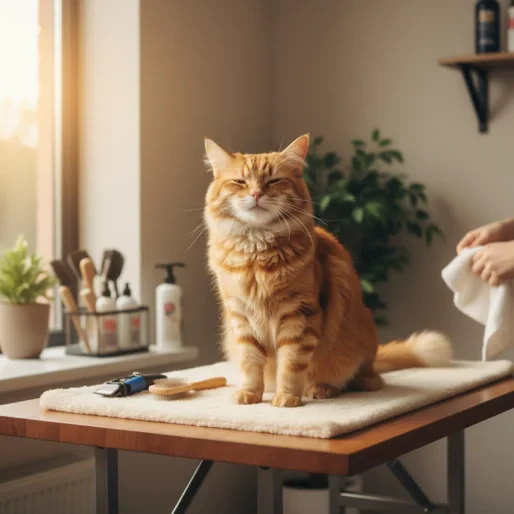
- Consistent location: Use the same quiet area each time, such as a table covered with a non-slip mat or a familiar blanket on a lap.
- Short sessions: Keep initial sessions under five minutes, gradually building duration as the cat becomes accustomed to the routine.
- Positive association: Offer a small, high-value treat immediately after grooming. Over time, cats often begin to associate the grooming space with a reward.
- Read body language: Flattened ears, tail lashing, dilated pupils, and skin rippling along the back are signs of escalating stress. Pause or end the session before the cat reaches a threshold of aggression or panic.
- Never restrain forcefully: Scruffing an adult cat for grooming is discouraged by veterinary behavioural guidelines, as it increases fear and can damage trust.
Seasonal Transition: From Spring Into Summer
As spring progresses into summer, the grooming focus shifts. The heavy moult subsides, but parasite pressure intensifies, particularly for fleas. Outdoor cats may also encounter more hazards such as grass seed heads at their driest and most barbed, sunburn risk on pale-skinned ears and noses, and increased territorial encounters leading to bite wounds and abscesses.
Maintaining the post-outing check habit established in spring creates a year-round health monitoring system that catches problems early, reduces veterinary emergencies, and keeps the bond between owner and cat strong through gentle, routine handling.
Frequently Asked Questions
How soon after my cat comes indoors should I check for ticks? ↓
Can I remove a grass seed from my cat's ear at home? ↓
How often should I brush my outdoor cat in spring? ↓
What should I do if I find matted fur on my outdoor cat? ↓
Is it safe to clean my cat's ears at home? ↓

Sophie Bianchi
Certified Master Pet Groomer
Certified master pet groomer — breed-standard techniques, skin health awareness, and at-home grooming guidance.
Content Disclosure
This article was created using state-of-the-art AI models with human editorial oversight. It is intended for informational and entertainment purposes only and does not constitute veterinary medical advice. Always consult a licensed veterinarian for your pet's specific health needs. Learn more about our process.