
In this article
Key Takeaways
- Most cages sold as "budgie cages" are far too small for healthy, active birds.
- A seed-only diet can lead to serious nutritional deficiencies, especially a lack of vitamin A.
- Mirrors may cause behavioral problems in solo budgies, including obsessive bonding and regurgitation.
- Budgies are flock animals. A single bird kept alone needs several hours of daily social interaction at a minimum.
- Many common budgie health issues are preventable with the right setup from day one.
Frequently Asked Questions From First-Time Budgie Owners
1. What size cage does a budgie actually need?
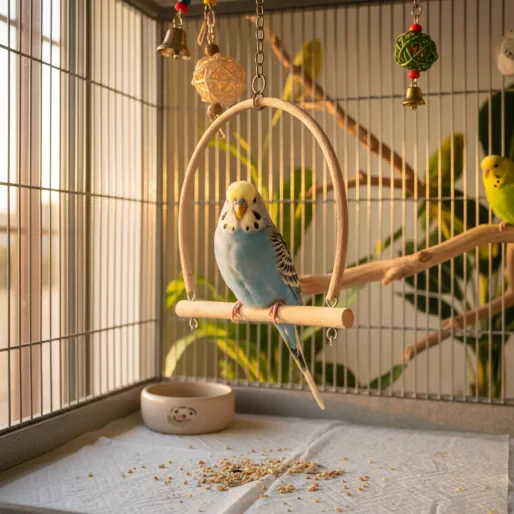
This is one of the most common questions on pet helplines, and for good reason. Many cages marketed specifically for budgies are barely large enough for the bird to stretch its wings. Avian veterinary guidelines generally recommend a minimum cage size of around 76 cm long by 46 cm wide by 46 cm tall (roughly 30 x 18 x 18 inches) for a single budgie. Longer is better than taller, because budgies fly horizontally rather than vertically.
A good rule: the bird should be able to make at least two or three full wingbeats between perches without hitting the bars. If the cage feels roomy to you, it is probably closer to adequate. If it looks "just right," it is almost certainly too small.
2. Can budgies live on seeds alone?
No. This is perhaps the single most damaging myth in budgie care. Seeds are high in fat and low in many essential nutrients. A seed-only diet is strongly associated with vitamin A deficiency, obesity, and fatty liver disease in budgerigars. The Association of Avian Veterinarians (AAV) and many avian nutrition specialists recommend a base diet of high-quality formulated pellets (typically making up around 50 to 70 percent of daily intake), supplemented with fresh vegetables, leafy greens, and a small amount of seed as a treat.
Good everyday vegetables include broccoli, carrot tops, spinach (in moderation), and dark leafy greens like kale. Fruit can be offered sparingly due to sugar content. Avocado, chocolate, onion, garlic, and caffeine are toxic to birds and must be avoided entirely.
3. Are mirrors safe for budgies?
Mirrors are one of the most commonly purchased budgie accessories, but avian behavior specialists increasingly advise caution. A budgie cannot recognize its own reflection and may interpret the "bird in the mirror" as a companion. In a solo bird, this can lead to obsessive behavior: repeated regurgitation onto the mirror, territorial aggression, frustration, and reduced interest in interacting with human family members.
If a budgie already has a real avian companion and shows no fixation, a mirror is less likely to cause problems. However, for a single budgie, the mirror can become a source of chronic stress rather than enrichment. Removing the mirror and replacing it with foraging toys or shreddable materials is generally a better approach.
4. Do budgies need a companion?
Budgerigars are highly social flock birds in the wild, typically living in groups of dozens to thousands. Keeping a single budgie is possible, but it comes with a significant responsibility. A lone budgie requires several hours of direct, engaged social interaction each day. This means talking, gentle handling, training sessions, and being in the same room during active hours.
Owners who work long hours away from home are strongly encouraged to consider keeping at least two budgies. A pair of budgies will preen each other, vocalize together, and generally show fewer signs of stress and boredom. The idea that a paired budgie will not bond with its owner is largely a myth; many owners report that budgies kept in pairs are actually more confident and interactive with people, not less. For more on how bonded pairs benefit animals, see our guide on why adopting a bonded pair is easier.
5. How can you tell if a budgie is sick?
This is the question that comes through helplines at 2 AM more than any other. Budgies are prey animals and instinctively hide signs of illness until they are quite unwell. Warning signs include:
- Fluffed-up feathers for extended periods (not just during sleep)
- Sitting at the bottom of the cage
- Changes in droppings: color, consistency, or volume
- Discharge from the nostrils or eyes
- Tail bobbing while breathing (a sign of respiratory distress)
- Loss of appetite or refusal to eat
- Lethargy, sleeping during normally active hours
When to call the vet immediately: tail bobbing, open-mouth breathing, bleeding, a visible injury, or sudden inability to perch. These are emergencies. Do not wait and see. For budgies, "wait and see" is only appropriate for minor behavioral changes observed over a day or two, never for visible physical symptoms.
6. Is a round cage acceptable for a budgie?
Round cages are not recommended by avian welfare organizations. The curved bars make it difficult for budgies to climb comfortably, and the lack of corners can contribute to feelings of insecurity (birds often retreat to a corner to feel safe). Additionally, round cages tend to be quite small. A rectangular cage with horizontal bar spacing of no more than about 1.2 cm (roughly half an inch) is the standard recommendation.
7. What kind of perches should a budgie have?
The smooth, uniform dowel perches that come with most cages are actually poor for foot health. Using the same diameter perch throughout the cage can contribute to pressure sores and bumblefoot. A healthy setup includes a variety of perch types and diameters: natural wood branches (untreated, bird-safe species like eucalyptus, apple, or willow), rope perches, and perhaps a flat platform perch for resting. Sandpaper perch covers should be avoided, as they can abrade the feet.
8. How much sleep does a budgie need?
Budgies need approximately 10 to 12 hours of quiet, uninterrupted darkness each night. Sleep deprivation is a commonly overlooked stressor. If the cage is in a room where lights, television, or conversation continue late into the evening, the bird is not getting adequate rest. Common solutions include covering the cage with a breathable cloth at a consistent time each night or, ideally, placing the cage in a quiet room with a predictable light cycle.
9. Do budgies need baths?
Yes, most budgies enjoy and benefit from regular bathing opportunities. A shallow dish of lukewarm water, a gentle misting with a spray bottle, or even a wet bunch of leafy greens placed in the cage can encourage bathing. Bathing helps maintain feather condition and is a natural behavior. Some budgies prefer misting while others prefer to wade in; offering options and watching what the bird gravitates toward is the best approach. Never force a budgie into water.
10. Why is my budgie biting?
Biting in budgies usually signals fear, not aggression. Common causes include:
- Being grabbed or restrained (budgies should be trained to step up onto a finger, not grabbed from above)
- Insufficient socialization during the early weeks in the home
- Hormonal changes, especially in spring
- Territorial behavior around the cage (many budgies are calmer when interacting outside the cage)
Punishment, such as flicking the beak or yelling, is counterproductive and damages trust. Positive reinforcement, patience, and short daily training sessions using millet spray as a reward are the professional consensus approach.
11. Is it safe to let a budgie fly around the room?
Out-of-cage time is extremely beneficial for physical and mental health, but the room must be made safe first. Ceiling fans must be off, windows and mirrors should be covered or marked so the bird does not fly into them, open water (toilets, pots of water) must be inaccessible, and other pets should be secured in a separate space. For guidance on managing multi-pet households safely, see our article on how to introduce a new dog to your cats safely, which covers useful principles for supervised coexistence.
12. Should I clip my budgie's wings?
This is a topic with strong opinions on both sides. Wing clipping reduces the risk of escape and collision injuries, but it also limits exercise, can contribute to obesity, and may affect a budgie's confidence and psychological wellbeing. Many avian veterinarians now lean toward keeping birds flighted and instead making the environment safe, though individual circumstances vary. If wing clipping is chosen, it should always be performed by an experienced avian veterinarian, never attempted at home by an untrained owner.
13. How do I transition my budgie from seeds to pellets?
Dietary transitions should be done gradually, typically over two to four weeks, because some budgies do not recognize pellets as food initially. Common approaches include mixing pellets into the seed gradually (increasing the ratio over time), offering pellets in a separate dish alongside the familiar seeds, or slightly moistening pellets to change the texture. Monitoring the bird's weight during the transition is important; if the budgie is losing weight rapidly, the transition should be slowed and a vet consulted.
Myth vs. Reality
| Myth | Reality |
| A small cage is fine if you let the budgie out daily. | The cage is where the bird spends most of its life. It must be spacious enough for exercise even when you cannot supervise free flight. |
| Seeds are a budgie's natural diet. | Wild budgies eat a wide variety of grasses, shoots, and vegetation. A captive seed mix is nutritionally incomplete and too high in fat. |
| A mirror keeps a lonely budgie happy. | A mirror often triggers obsessive behavior and does not meet a budgie's need for genuine social interaction. |
| Two budgies will ignore the owner. | Paired budgies are often more confident and willing to engage with people than stressed, isolated single birds. |
| Budgies are low-maintenance starter pets. | Budgies need daily social time, a proper diet, regular vet checkups with an avian specialist, and a carefully managed environment. They can live 8 to 15 years with good care. |
Quick Reference Fact Box
- Scientific name: Melopsittacus undulatus
- Average lifespan: 8 to 15 years (with proper care)
- Minimum cage size (one bird): approximately 76 x 46 x 46 cm (30 x 18 x 18 in), longer is better
- Ideal diet ratio: roughly 50 to 70% pellets, 20 to 30% fresh vegetables, 10 to 15% seeds and treats
- Sleep requirement: 10 to 12 hours of darkness nightly
- Social needs: flock species; a solo bird needs multiple hours of daily interaction or a companion bird
- Vet type: avian veterinarian (not all general practice vets are experienced with birds)
- Toxic foods: avocado, chocolate, onion, garlic, caffeine, alcohol, fruit pits and seeds (apple seeds, cherry pits)
When to Contact an Avian Veterinarian
Finding an avian vet before you need one is essential. General practice veterinarians may have limited bird experience. Look for vets who are members of the Association of Avian Veterinarians (AAV) or who hold specific avian credentials. Schedule a wellness check within the first week or two of bringing a budgie home, even if the bird appears healthy. Early veterinary relationships make emergencies less stressful for both the bird and the owner.
If you are planning to travel with or without your budgie, it is also worth understanding airline and boarding restrictions for pets. Our guides on summer airline pet cargo embargoes and choosing a certified professional pet sitter cover practical planning steps that apply across species.
Frequently Asked Questions
Content Disclosure
This article was created using state-of-the-art AI models with human editorial oversight. It is intended for informational and entertainment purposes only and does not constitute veterinary medical advice. Always consult a licensed veterinarian for your pet's specific health needs. Learn more about our process.