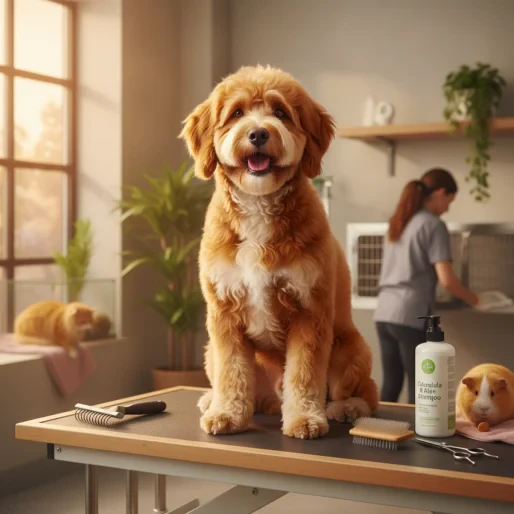

In this article
- Key Takeaways
- Why Post-Rainy-Season Coat Care Matters for Health
- Why Damp Months Leave Coats Dull
- Tools and Products Needed
- Step-by-Step Grooming Routine
- Spotting Ringworm and Hot Spots Early
- Full Groom or Deshed Before the September Holidays?
- Frequency Guide by Coat Type
- A Weekly Grooming Plan for Apartment Living
- Warning Signs to Watch For During Grooming
- Professional Groomer or Home Grooming?
- The Bottom Line
Key Takeaways
- Humidity is the real problem, not rain itself. Coats that never fully dry between walks trap moisture at skin level, which softens the outer skin layer and creates conditions where yeast, bacteria and dermatophytes (ringworm fungi) can establish.
- Autumn coat blow and monsoon damage overlap. Double-coated dogs and many cats shed heavily as daylight shortens, and damp undercoat that is not removed becomes a felted, breathable-proof layer against the skin.
- Drying is a grooming step, not an afterthought. Towel plus forced air or fan drying to the skin, not just the surface, is the single most protective habit during and after the rainy season.
- A deshed treatment and a full groom solve different problems. Deshedding removes bulk undercoat and improves airflow; a full groom includes a haircut and is usually only needed for continuously growing or heavily matted coats.
- Circular, expanding hair loss with scaling suggests ringworm and needs a vet, not a groomer. Ringworm is zoonotic and contagious to other pets and people in the household.
- Hot spots (acute moist dermatitis) escalate within hours. Any warm, wet, rapidly spreading raw patch is a veterinary matter, not a bathing matter.
- Apartment grooming is entirely workable with a bathroom or balcony station, a slicker brush, an undercoat rake, a high-velocity or stand dryer, and a consistent short daily session rather than one long weekly battle.
Why Post-Rainy-Season Coat Care Matters for Health
Mexico's rainy season typically runs from roughly May or June through September or October, with regional variation, and September is often among the wettest months across much of the country. For pet owners, that means several consecutive months in which coats are repeatedly wet, ambient humidity stays high, and indoor drying is slow. In coastal and low-lying areas, humidity can remain elevated even on days without rain; in higher-altitude cities the rain tends to arrive in intense afternoon storms that soak a dog on an otherwise ordinary evening walk.
The skin is a barrier organ. Its outer layer, the stratum corneum, works best when it is relatively dry and intact. Repeated wetting causes maceration, a softening and swelling of that outer layer, which reduces its mechanical strength. At the same time, the microclimate under a dense, damp undercoat is warm, still and moist. That is a hospitable environment for the commensal organisms that already live on healthy skin, particularly Malassezia yeast and Staphylococcus bacteria, to overgrow into a genuine dermatitis. Veterinary dermatology references consistently describe humidity and moisture retention as predisposing factors for both surface pyoderma and yeast overgrowth.
Layered on top of this is the seasonal shed. Coat cycling in dogs and cats is driven substantially by photoperiod, the changing hours of daylight, rather than temperature. As days shorten after the equinox, many double-coated animals release large volumes of undercoat. If that shed undercoat is not brushed out, it does not simply fall away in an apartment. It stays trapped in the guard coat, absorbs moisture, and forms a mat or a dense felted sheet that prevents air from reaching the skin. Professional grooming bodies including the International Professional Groomers (IPG) and the National Dog Groomers Association of America (NDGAA) treat coat and skin condition assessment as a foundational competency precisely because the coat's physical state governs skin health.
The practical consequence is that the weeks after the rains end are the highest-risk window of the year for dull, brittle coat, fungal patches, and moisture-driven dermatitis. They are also, conveniently, the weeks in which many households want their pets looking presentable for September holidays and family gatherings.
Why Damp Months Leave Coats Dull
Mechanical and cuticular damage
Each hair shaft has an outer cuticle of overlapping scales. When those scales lie flat, light reflects evenly and the coat looks glossy. Repeated wetting and incomplete drying, combined with brushing a damp coat too aggressively, lifts and chips those scales. The result is diffuse light scatter, which the eye reads as dull. Rainwater, road runoff and urban dust deposited on a wet coat add a fine mineral and particulate film that compounds the effect.
Sebum disruption
Sebum is the natural oil that coats the hair and contributes to water resistance and shine. Frequent bathing during a wet season, especially with harsh or human shampoos, strips sebum faster than it is replaced. Under-bathing in humid conditions has the opposite problem: sebum oxidises, combines with debris, and becomes a sticky substrate for yeast. Both extremes produce a dull, slightly greasy or slightly straw-like coat.
Trapped dead undercoat
Dead undercoat is by definition no longer receiving nutrients and has no living cuticle maintenance. It is matte, brittle and pale. When a substantial volume of it sits within the coat, it visually mutes the entire animal even if the guard hairs are in reasonable shape. This is why a competent deshed treatment frequently produces a dramatic apparent improvement in shine with no product involved at all.
Underlying skin inflammation
Chronic low-grade dermatitis alters the follicle environment and can produce hairs that grow in thinner and duller. If a coat remains dull after thorough deshedding, correct bathing and complete drying, the cause is more likely to be in the skin than on the hair, and a veterinary dermatology assessment is warranted.
Tools and Products Needed
Apartment grooming does not require a salon's worth of equipment, but tool choice matters more in humid conditions because the margin for error is smaller.
- Slicker brush: fine angled pins on a flexible pad. Used for lifting loose coat, breaking up small tangles and finishing. Choose a soft or medium-flex pad for thin-skinned or short-coated animals to avoid brush burn.
- Undercoat rake: the primary tool for double coats during a shed. Rounded tips, spaced teeth, worked with the lay of the coat. Far safer than a blade-style stripping tool in inexperienced hands.
- Wide-tooth comb and a greyhound-style metal comb: the comb is the honest tool. If a comb passes cleanly from skin to tip everywhere, the coat is genuinely mat-free. A brush alone can glide over a mat and hide it.
- Pin brush: for long single coats and for cats with fine, non-dense hair where a slicker may be too harsh.
- Rubber curry or grooming mitt: for smooth-coated dogs and short-haired cats. Also excellent for distributing sebum and for pre-loosening coat before a bath.
- Dematting or mat-splitting tool: use sparingly and only on small, discrete mats that are not adhered to skin. Blades near skin carry real laceration risk.
- High-velocity dryer or stand dryer: the single highest-value purchase for a rainy-season household. A high-velocity dryer blows water out of the coat mechanically rather than evaporating it with heat, so it dries to skin level far faster. Use on a low or no-heat setting.
- Absorbent microfibre or chamois towels: considerably more efficient than cotton bath towels.
- Gentle pet shampoo appropriate to the coat and skin: a basic mild cleansing shampoo for routine use, or a veterinary-recommended medicated formulation if a specific condition has been diagnosed. Do not self-prescribe medicated antifungal or antibacterial shampoos for an undiagnosed skin problem.
- Non-slip mat for the bathtub or shower base, and a handheld shower attachment.
- Grooming loop or a helper for safety, plus nail clippers or a grinder and ear-cleaning solution recommended by your veterinarian.
Deliberately not on this list: human shampoo (wrong pH for canine and feline skin), household disinfectants applied to skin, and any topical antifungal not prescribed for that animal.
Step-by-Step Grooming Routine
Step 1: Assess before you touch a tool
Run your hands over the whole animal in good light. You are looking for heat, damp patches, lumps, scabs, flaking, odour, and the characteristic firm resistance of a mat. Pay particular attention to the classic moisture traps: behind and under the ears, the throat and ruff, the armpits and groin, the britches and tail base, between the toes and pads, and along the belly line where the coat contacts wet ground. In cats, check the base of the tail, the lower back, and the ruff, all areas that older or overweight cats cannot groom effectively.
Step 2: Dry brush and deshed before any water
This order is non-negotiable. Water tightens mats. Working through loose coat and tangles while dry is faster, less painful and less damaging. Work in sections, brushing in the direction of coat growth with the rake, then finishing each section with the slicker, then verifying with the comb before moving on. For a heavy autumn shed, expect this to be the longest phase.
Step 3: Address mats honestly
Small, loose mats can often be teased apart with fingers and a comb, working from the outer edge inward, never yanking from the base. Large, dense, or skin-adhered mats, and any pelted area where the coat has felted into a continuous sheet, should be clipped out by a professional. Attempting to cut a tight mat with scissors is one of the most common causes of accidental skin lacerations in home grooming, because tented skin lifts into the mat and is indistinguishable from hair by feel.
Step 4: Bathe with intent
Wet thoroughly to the skin, which takes longer than most owners expect on a dense double coat. Dilute shampoo in water before applying to improve distribution. Work it in with fingertips or a rubber curry rather than scrubbing in circles, which tangles. Leave a mild shampoo in contact for a minute or two; medicated products prescribed by a vet often require a longer specified contact time, so follow the label. Rinse until the water runs completely clear, then rinse again. Residue is a major and under-recognised cause of post-bath itching and dullness.
Step 5: Dry to the skin, not to the surface
Towel first, pressing and squeezing rather than rubbing. Then use forced air, working in sections, lifting the coat with a brush or your free hand so the airflow reaches skin level. Keep the nozzle moving, keep heat low, and never direct high-velocity air into ears, eyes or the face; use a lower setting or a towel for the head. Check the standard damp traps by feel at the end. A coat that feels dry on top but cool and slightly heavy underneath is not dry.
For animals who cannot tolerate a dryer, and for many cats, use towels plus a fan in a warm room, keep them contained and supervised until dry, and consider scheduling baths for the driest part of the day. Never crate a wet animal and walk away for hours; that is functionally an incubator.
Step 6: Between-walk drying protocol
During and just after the rainy season, treat every wet return as a mini grooming event. Towel the feet, legs, belly and ruff at the door. Check between the toes and dry the interdigital spaces, a frequent site of moisture-driven dermatitis. Give the coat a quick rake or curry to break up the flattened, wet-plastered layer so air can circulate. Two minutes at the door prevents a great deal of trouble.
Step 7: Ears, nails and finishing
Humid conditions and wet ears predispose to otitis externa. Dry visible outer ear folds with a soft towel after wet exposure. Clean only with a product your veterinarian recommends, and never insert cotton buds into the canal. Nails often grow longer during rainy months because walks are shorter and surfaces softer; trim or grind conservatively. Finish with a comb-through so you know the coat is genuinely clear.
Spotting Ringworm and Hot Spots Early
Ringworm (dermatophytosis)
Ringworm is a fungal infection, not a worm. It is more common in humid environments, in young animals, in multi-pet households, and in cats, where it can be carried with minimal visible signs. Grooming is often the moment it is first noticed, because you are parting the coat and looking at skin.
Typical features include roughly circular areas of hair loss that expand outward, greyish scaling or crusting, broken stubbly hairs at the margin, and lesions commonly appearing on the face, ear margins, forelimbs and paws. Itching is variable and may be mild or absent, which is why it is sometimes missed. Not every circular bald patch is ringworm, and not every ringworm lesion is circular.
Ringworm is zoonotic. It transmits to humans and between household pets, and spores persist in the environment on bedding, brushes and furnishings. If you suspect it, stop grooming that animal with shared tools, isolate where practical, wash your hands, and contact your veterinarian. Diagnosis requires veterinary testing such as fungal culture, PCR or trichogram; a Wood's lamp examination alone is not definitive because only some dermatophyte species fluoresce. Treatment usually combines systemic medication, topical therapy and rigorous environmental decontamination, all of which need veterinary direction. Reputable groomers will decline to work on an animal with suspected ringworm until it has been cleared, and this is a professional standard, not an inconvenience.
Hot spots (acute moist dermatitis)
Hot spots are rapidly developing areas of surface skin infection, classically triggered by moisture trapped against skin plus self-trauma from licking, chewing or scratching. They are strongly associated with thick-coated dogs, with humid weather, and with recent swimming or rain exposure. Onset can be alarmingly fast, sometimes appearing within a day.
Look for a well-demarcated patch that is red, moist or weeping, warm to the touch, painful, often malodorous, with matted or missing hair over and around it. Common sites are the cheek and neck below the ear, the flank, and the rump near the tail base. The animal will typically be fixated on the area.
A hot spot is a veterinary matter. Management generally involves clipping the hair around the lesion to expose it to air, gentle cleaning, appropriate topical or systemic treatment, pain and itch control, and preventing further self-trauma. Crucially, it also involves identifying the underlying trigger, which is frequently flea allergy dermatitis, atopy, food allergy, an ear infection or trapped moisture. Repeated hot spots in the same location almost always signal an unaddressed underlying cause. Do not apply home remedies, do not cover the area, and do not bathe the whole dog in the hope it resolves. Our guide to summer coat care, swims and hot spots covers moisture-related dermatitis in more detail.
Yeast overgrowth
A distinct but related humid-season problem. Signs include a greasy or waxy feel, a characteristic musty odour, redness in skin folds, armpits, groin and between toes, brown discolouration of the fur where the animal has been licking, and persistent itch. It requires veterinary diagnosis and typically responds to prescribed antifungal shampoos or systemic therapy, plus management of the underlying allergy in many cases.
Full Groom or Deshed Before the September Holidays?
These two services address different problems and are frequently confused when booking.
Choose a deshedding treatment when
- The animal has a double coat that sheds seasonally: Husky, Malamute, German Shepherd, Golden Retriever, Labrador, Pomeranian, Australian Shepherd, Corgi, and many mixed breeds, plus long-haired cats.
- The coat is structurally fine but dense, dull and shedding heavily.
- The main complaint is hair volume in the home and poor airflow to the skin.
- You want improved appearance and comfort without changing coat length.
A professional deshed usually combines a thorough dry brush-out, a bath with a shed-release or conditioning product, a high-velocity blowout that mechanically ejects loose undercoat, and a final rake and comb. The visual result is a cleaner outline, restored shine and dramatically reduced shedding for several weeks.
Choose a full groom when
- The coat grows continuously and requires cutting: Poodle, Bichon, Shih Tzu, Maltese, Cocker Spaniel, many Doodle crosses, and similar.
- There is significant matting that cannot be safely resolved by brushing.
- Length management is needed for hygiene areas, feet, face or sanitary trim.
- A breed-standard or pet trim finish is wanted for photographs and gatherings.
Do not shave a double coat as a humidity fix
This is a persistent and damaging misconception. The double coat provides insulation against heat as well as cold and protects skin from solar radiation and moisture contact. Clipping it can result in uneven regrowth, texture change, and in some individuals post-clipping alopecia where the coat regrows poorly or patchily. The correct intervention for a hot, humid climate is to remove dead undercoat so air can circulate, not to remove the protective structure. Exceptions exist, such as severe irreversible pelting or a veterinary requirement, and those decisions belong with a professional groomer and your vet together.
Booking timing
Groomers in Mexico typically see demand spike ahead of the September holiday period. Book two to three weeks in advance, and schedule the appointment three to five days before the event rather than the day before, so any minor irritation settles and the coat relaxes into its finished shape. Arrive with the coat as dry and brushed as you can manage; a soaking, matted arrival limits what can safely be done.
Frequency Guide by Coat Type
Double-coated dogs (Husky, German Shepherd, Golden Retriever, Corgi, Pomeranian)
Brushing: daily to every other day during autumn coat blow, dropping to two or three times weekly otherwise. Undercoat rake at least twice weekly during the shed. Bathing: roughly every four to eight weeks, more often only if soiled, and always with complete drying. Professional deshed: at the start and end of the shedding period, so twice yearly at minimum, with an additional session after a particularly wet season being reasonable.
Long single-coated dogs (Shih Tzu, Maltese, Poodle, Doodle crosses)
Brushing and combing: daily, without exception, in humid conditions. These coats mat rather than shed. Bathing: every three to four weeks. Professional groom: every four to eight weeks depending on length carried. A shorter clip through the rainy season is a legitimate and kind choice for these coats.
Short and smooth-coated dogs (Beagle, Boxer, Pug, Chihuahua, Staffordshire types)
Rubber curry or mitt twice weekly. Bathing: every six to twelve weeks. Priority is skin fold hygiene in brachycephalic and wrinkled breeds, keeping folds clean and dry, and drying thoroughly after rain. Short coats are not low-risk in humidity; they simply show problems sooner.
Wire-coated dogs (Terriers, Schnauzers)
Weekly brushing plus hand-stripping or carding on a professional schedule of roughly every six to twelve weeks to maintain harsh texture. Clipping a wire coat softens it over time and reduces its natural weather resistance, which matters in a wet climate.
Cats
Long-haired cats need combing every day or two, with particular attention to the ruff, armpits, britches and tail base. Short-haired cats benefit from a weekly rubber brush during the autumn shed to reduce hairball load. Most cats do not need routine bathing. A cat who suddenly stops grooming, or develops a greasy, clumped coat, may be in pain, arthritic, obese or unwell, and that is a veterinary consultation. Never use a high-velocity dryer on an unaccustomed cat. Our guide to coat recovery for long-haired pets covers the recovery process for heavily shed coats.
Small mammals
Rabbits and guinea pigs shed seasonally too and are particularly vulnerable to humidity-related skin and coat problems. See our guide to rabbit and guinea pig grooming for species-specific technique.
A Weekly Grooming Plan for Apartment Living
The plan below assumes a medium double-coated dog in coat blow, in an apartment, in a humid post-rainy-season month. Adjust the intensity to your animal's coat type.
- Daily (2 to 5 minutes): door-side towel and dry-off after any wet walk, focusing on feet, belly, ruff and between the toes. Quick hand check for heat, damp or new lumps.
- Monday (10 minutes): full slicker pass over the body, then comb-check the ears, ruff and armpits. Collect hair onto a sheet or towel for easy disposal.
- Tuesday (5 minutes): ear folds, face and paw check. Wipe outer ear folds dry. Inspect pads and interdigital spaces for redness or debris.
- Wednesday (15 minutes): undercoat rake session on the heaviest shedding zones, typically the neck, shoulders, hindquarters and tail base. Follow with slicker and comb.
- Thursday (5 minutes): nails and a light body brush. Handle paws routinely so trims are uneventful.
- Friday (10 minutes): skin survey in strong light. Part the coat systematically along the spine, flanks and belly. Photograph anything new so you can judge whether it is changing.
- Saturday (30 to 45 minutes): bath day if scheduled, with the full dry-brush, bathe, blow-dry, comb sequence. On non-bath weeks, use this slot for a longer rake and a second undercoat blowout.
- Sunday: rest, plus a light curry or mitt session that doubles as a bonding and body-check routine.
Apartment-specific tips: groom on a balcony or in a bathroom with the door shut to contain hair; lay an old sheet under the animal and shake it out over a bin bag; run a HEPA air purifier during and after sessions to manage airborne dander; and clean brushes after every use, since a damp hair-clogged slicker is itself a reservoir for yeast and fungal spores. Wash bedding weekly in the hottest wash the fabric allows during high-humidity months.
Warning Signs to Watch For During Grooming
Stop and contact your veterinarian if you find any of the following:
- Circular or irregular expanding hair loss with scaling or crusting, especially on face, ears or paws.
- Any warm, moist, rapidly spreading raw patch, with or without odour.
- Yellow crusts, pustules, or an epidermal collarette (a circular ring of scaling with a peeling edge).
- Persistent musty or sweet odour, or greasy skin that does not resolve after bathing.
- Head shaking, ear odour, discharge, or pain when the ear base is touched.
- Skin that feels thickened, leathery or darkly pigmented, suggesting chronic inflammation.
- Flea dirt (dark specks that turn rust-red on a damp tissue) or visible parasites.
- Sudden intolerance of being brushed in an animal who previously accepted it, which frequently indicates pain.
- Broken skin under a mat, or any laceration sustained during grooming.
- Lumps, swellings or asymmetry noticed during the body check.
Professional Groomer or Home Grooming?
Safe to manage at home
- Routine brushing, combing and undercoat raking on a cooperative animal.
- Bathing with a mild or veterinarian-prescribed shampoo, with proper drying.
- Small, loose tangles teased out with fingers and comb.
- Nail trims, if you are confident about the quick and the animal is settled.
- Daily post-walk drying and skin checks.
Refer to a professional groomer
- Extensive matting, felting or pelting anywhere on the body.
- Any coat requiring scissoring, clipping or breed-pattern work.
- Hand-stripping or carding of wire coats.
- Heavy coat blow in a large double-coated dog, where a high-velocity blowout does in one session what weeks of home brushing struggles to achieve.
- Animals who resist handling, where a trained groomer with proper restraint and safety equipment reduces injury risk to both parties.
Refer to a veterinarian first
- Any suspected ringworm, hot spot, ear infection, yeast overgrowth or pyoderma.
- Open wounds, bleeding, or skin that is painful to touch.
- Coat changes accompanied by lethargy, weight change, increased thirst or behaviour change, which can indicate endocrine disease.
- Recurrent skin problems in the same site, which point to an underlying allergic or parasitic cause.
- Geriatric or medically fragile animals before any sedation-free full groom.
Professional groomers are trained to recognise skin abnormalities and to refer, and organisations such as the IPG, the NDGAA and the British Dog Groomers Association include skin and coat assessment in their certification frameworks. A groomer who tells you an area needs a vet before they can proceed is applying that standard correctly.
The Bottom Line
The weeks after Mexico's rainy season are a recovery period for coat and skin, not just a cosmetic catch-up. The three habits that matter most are drying to the skin every time an animal gets wet, removing dead undercoat systematically so air can reach the skin, and parting the coat weekly in good light to look at the skin itself. Book a deshed rather than a shave-down for double coats, book a full groom for coats that grow, and treat any expanding circular lesion or hot, weeping patch as a veterinary appointment rather than a grooming problem. Consistency in small daily sessions will outperform an occasional marathon every time, and it turns grooming into a health surveillance routine rather than a chore.
This article is for general educational purposes and does not replace individual advice from a licensed veterinarian, veterinary dermatologist or certified professional groomer. Always seek professional assessment for any skin condition.
Frequently Asked Questions
Content Disclosure
This article was created using state-of-the-art AI models with human editorial oversight. It is intended for informational and entertainment purposes only and does not constitute veterinary medical advice. Always consult a licensed veterinarian for your pet's specific health needs. Learn more about our process.