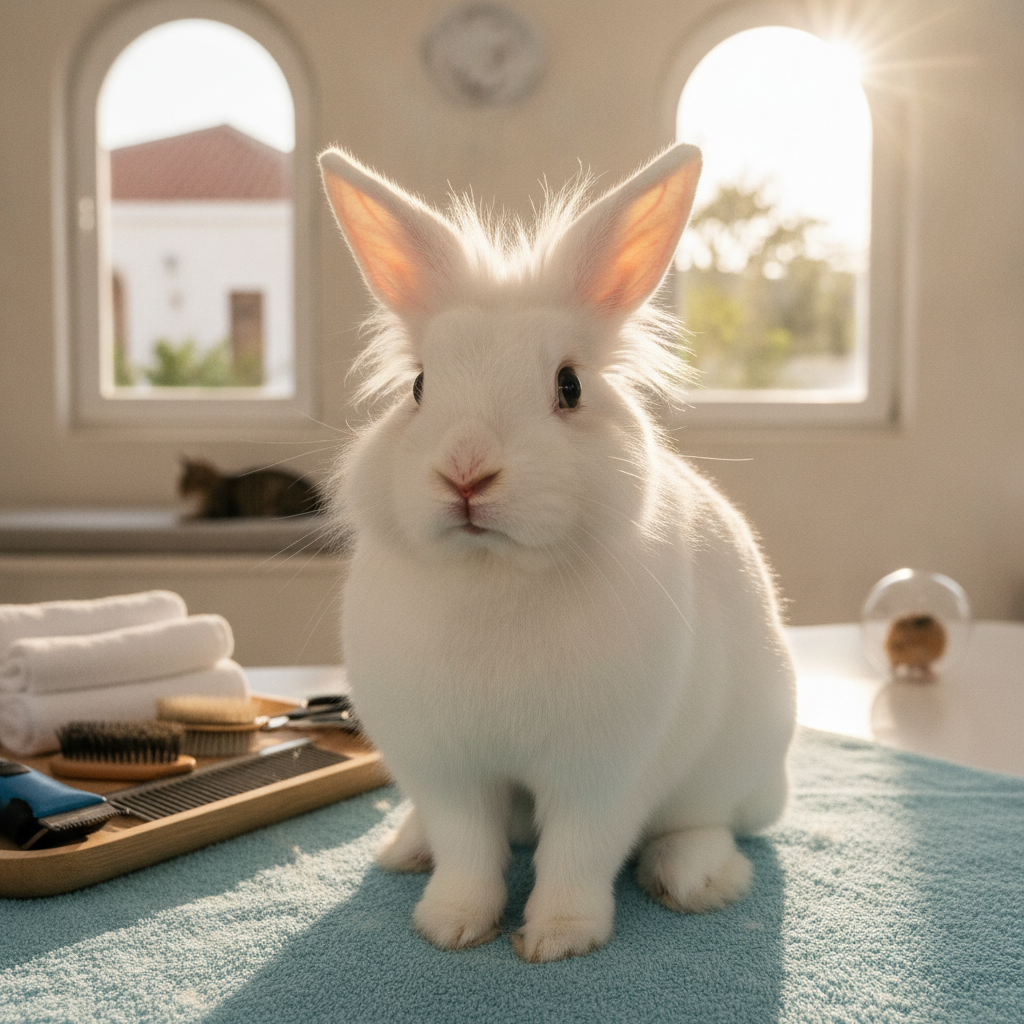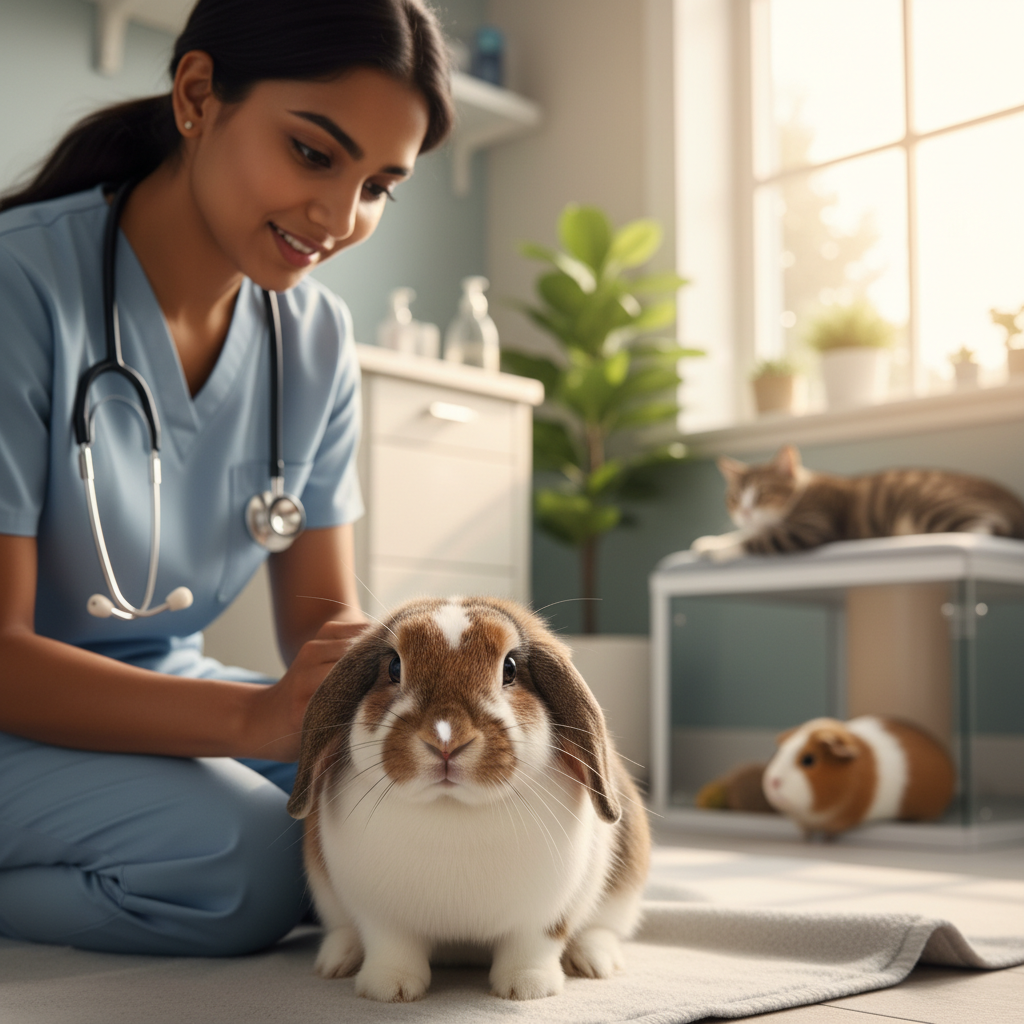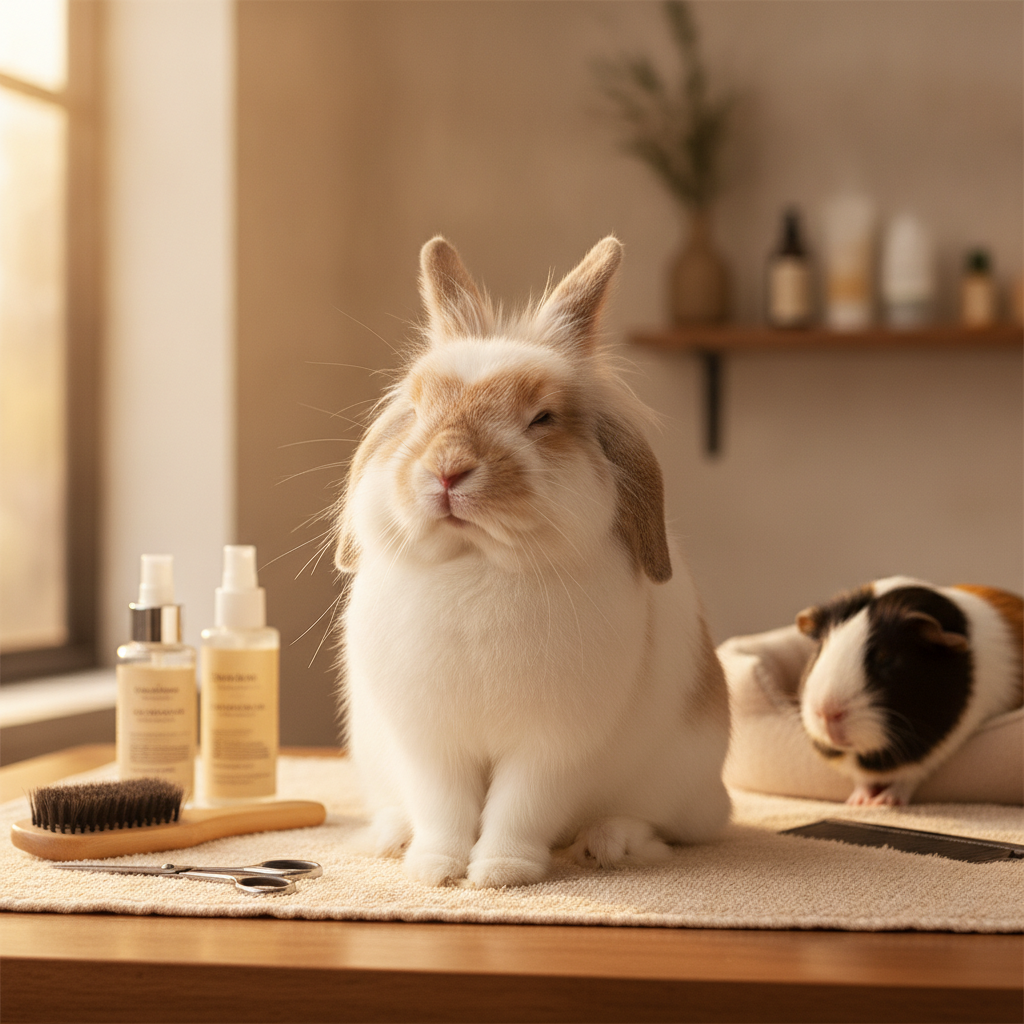
Heated Australian homes in July and August strip moisture from rabbit and guinea pig coats, causing static, flaking, and hidden matting. This grooming guide covers safe brushing, nail and sanitary trims, mite and fungal detection, and a practical weekly routine.
Key Takeaways
- Indoor heating is the main winter coat problem in Australia, not the cold. Reverse-cycle air conditioning and ducted heating drop indoor humidity sharply, leaving small pet coats static, brittle, and prone to flaking.
- Never bathe a rabbit routinely. Full-body water baths cause dangerous stress and hypothermia in rabbits. Guinea pigs tolerate occasional bathing but should be bathed sparingly in winter.
- Angora and long-haired types need daily attention in July and August. Mats form fastest behind the ears, in the armpits, along the flanks, and around the hindquarters.
- Mats must be cut out with blunt-nosed scissors or clipped, never pulled. Rabbit and guinea pig skin is roughly as thin as tissue paper and tears with alarming ease.
- Flaky skin plus hair loss is a veterinary matter, not a grooming matter. Cheyletiella mites and ringworm both present as scale and are easily mistaken for dry winter skin.
- Nails grow year-round. Winter housing on soft bedding means less natural wear, so trim every three to six weeks.
Why Winter Grooming Matters for Small Pet Health
Australian winters do not threaten rabbits and guinea pigs with cold in the way northern hemisphere climates do. The genuine risk sits indoors. From late June through August, households across Melbourne, Canberra, Hobart, Adelaide, and the Southern Highlands run ducted gas heating or reverse-cycle systems for hours each day. These systems pull indoor relative humidity down substantially, and a hutch or pen positioned within a few metres of a vent sits in an unusually dry microclimate for weeks on end.
Coat and skin respond predictably. The stratum corneum loses moisture, dander production increases, guard hairs lose flexibility, and static charge builds in the coat. Static-charged fibres cling to one another, which is the beginning of matting. In long-haired Angora rabbits and Peruvian, Silkie, and Texel guinea pigs, this happens quietly under the outer coat where owners cannot see it.
The health consequences are not cosmetic. A mat sitting against rabbit skin traps moisture and urine near the perineum, creating ideal conditions for urine scald and, in warmer parts of the house, flystrike. Rabbits are also obligate groomers who cannot vomit. A coat shedding heavily into a dry, static-heavy environment means more ingested fibre, and gastrointestinal stasis remains one of the most common emergency presentations in pet rabbits. Regular brushing is not vanity. It is preventive medicine.
Guinea pigs face a different but parallel problem. Their skin is prone to scaling and their long-haired varieties drag coat across bedding constantly, picking up hay, faecal pellets, and moisture. Winter bedding is typically deeper and changed slightly less often in cold weather, which compounds the issue.
Tools and Products You Actually Need
Professional grooming bodies including the International Professional Groomers (IPG) and the National Dog Groomers Association of America (NDGAA) publish coat-handling standards developed primarily for dogs and cats, but the underlying principles of line brushing, dematting, and tool selection transfer directly to small mammals with one critical adjustment: every tool must be gentler, because the skin is dramatically thinner.
Brushing and Combing Tools
- Fine-toothed metal comb (often sold as a flea comb or cat face comb). This is the single most useful tool for both species. It detects mats, lifts scale, and reveals mite debris.
- Soft bristle brush or a small boar-bristle brush for distributing natural skin oils along the coat shaft and reducing static in short-haired rabbits and Abyssinian or American guinea pigs.
- Wide-toothed comb for the first pass through Angora, Peruvian, Silkie, or Texel coats before any fine comb is used.
- Rubber grooming mitt or small rubber curry for short-coated rabbits during moult. It lifts loose undercoat without dragging on skin.
- Slicker brush, used with real caution. Many professionals avoid slickers on rabbits entirely because the wire pins abrade thin skin. If used at all, choose a flexible-pad slicker, hold it at a shallow angle, and never apply pressure.
Trimming and Dematting Tools
- Blunt-nosed (ball-tipped) safety scissors for sanitary trims and for cutting mats free.
- A small cordless clipper with a #10 blade if you are comfortable with clippers. Clipping is far safer than scissoring on a tight mat because the blade sits flat.
- Small animal nail clippers, either scissor-style or plier-style. Human nail clippers crush and split small pet nails and should be avoided.
- Styptic powder or a clotting agent kept within arm's reach before you start any nail trim.
- A small torch or phone light to backlight dark nails and locate the quick.
Products: Less Is More
Do not reach for conditioning sprays, coat oils, detanglers, or leave-in products marketed for dogs. Rabbits and guinea pigs ingest whatever is applied to their coat during self-grooming, and many canine products contain ingredients that are unsuitable for herbivores with sensitive gut flora. Anything applied to a small pet coat should be specifically formulated for small mammals or recommended by an exotics veterinarian.
The correct answer to a dry winter coat is environmental, not topical. A room humidifier or a bowl of water placed safely away from the enclosure will do more for coat quality than any spray. Aim to keep the enclosure at least a couple of metres from any heating vent, and consider a hygrometer so you can see what the room is actually doing.
Step-by-Step Winter Grooming Routine
Step 1: Set Up Before You Touch the Animal
Nervous small pets read handling as predation. Groom on a non-slip surface at a comfortable height, such as a towel over a table or a lap tray. A slippery surface makes an animal brace and struggle. Have every tool laid out in advance so you never leave the animal unattended mid-groom.
Rabbits should never be scruffed or placed on their backs into so-called trancing. This tonic immobility response is a fear state, not relaxation, and it has been widely discouraged by rabbit welfare organisations including the Rabbit Welfare Association and Fund. Support the hindquarters at all times. A rabbit that kicks out while unsupported can fracture its own spine.
Step 2: Health Check First, Brush Second
Run both hands slowly over the entire body before any tool touches the coat. You are feeling for lumps, scabs, damp patches, mats, and areas of heat. In winter, pay particular attention to the dewlap in does, the area under the chin in guinea pigs, and the whole perineal region on both species.
Step 3: Line Brushing for Long Coats
Line brushing is the standard professional method and it works exactly as well on an Angora as on a Shih Tzu. Part the coat horizontally with one hand, exposing a clean line of skin. Comb only the hair immediately below that parting, working from the skin outward to the tip. Release a new line about one centimetre above and repeat. This guarantees you have combed to the skin rather than skimming the surface, which is how owners end up with a coat that looks perfect and is solidly matted underneath.
Work through the body in a consistent order so nothing is skipped: shoulders, chest, flanks, back, hindquarters, then the difficult zones (behind the ears, under the chin, armpits, groin, and the skirt around the rear).
Step 4: Handling Mats
Do not pull. Do not use a dematting rake designed for dogs. On a small mat, hold the base of the mat between finger and thumb so the skin is not lifted, then slide blunt-nosed scissors flat against your fingers and cut the mat vertically into two or three sections. Each section can then usually be teased apart with a fine comb. On any mat larger than a five cent coin or one that is tight against skin, clip it out with a #10 blade or book a professional. Attempting to scissor a pelted mat off rabbit skin is one of the most common ways owners cause a laceration requiring sutures.
A rabbit or guinea pig with widespread matting should be professionally clipped. Skilled small animal groomers and many exotics veterinary practices offer this, sometimes with light sedation for severe cases.
Step 5: Carding and Static Control in Short Coats
Carding, the professional technique of stripping soft undercoat out from beneath the guard hairs, applies in modified form to short-coated rabbits during their winter to spring moult. A rubber mitt or fine comb drawn in the direction of coat growth lifts dead undercoat efficiently. To reduce static, lightly dampen your hands with plain water, or wipe the coat with a slightly damp microfibre cloth before combing. Never soak the animal.
Step 6: Sanitary Trim
The sanitary area is the ring of coat around the anus, genitals, and inner thighs. In long-haired animals this hair traps caecotrophs and urine. With blunt-nosed scissors held parallel to the body, trim this hair to roughly one centimetre. Keep the skin flat and visible at all times. Never lift skin into the blades. For guinea pig boars, also check and gently clear the perineal sac, which accumulates debris and bedding, particularly in older animals.
Step 7: Nail Trimming for Nervous Animals
Nails should be trimmed every three to six weeks in winter, when soft bedding and less outdoor time mean minimal natural wear. Overgrown nails splay the toes, alter gait, and contribute to pododermatitis (sore hocks) in rabbits.
Technique matters more than speed. Wrap the animal in a towel with only the working limb exposed. This burrito wrap dramatically reduces struggling. Backlight pale nails with a torch to see the pink quick, and cut two to three millimetres distal to it. For dark nails, take very small slices and stop when the cut surface shows a greyish or moist central spot, which signals you are approaching the quick. Trim one or two nails per session if the animal is anxious. There is no requirement to do all eighteen or twenty in one sitting.
If you nick the quick, apply styptic powder with firm pressure for thirty seconds and stay calm. Bleeding stops. Panicking teaches the animal that grooming is frightening.
Frequency Guide by Coat Type
Rabbits
- Angora (English, French, Satin, Giant): Daily line brushing in heated-room winter conditions. English Angoras in particular need coat removed by clipping or gentle plucking of the released coat every ninety days or so, in line with their natural coat cycle. Neglected Angora coats felt to the skin within weeks.
- Lionhead, Jersey Wooly, Cashmere Lop: Three to four times weekly, focusing on the mane, skirt, and behind the ears.
- Rex and Mini Rex: Once weekly with a soft brush or hand-grooming only. The plush velvet coat is easily damaged by slickers.
- Standard short-coated breeds (Netherland Dwarf, Dutch, Mini Lop): Once or twice weekly, increasing to daily during a heavy moult.
Guinea Pigs
- Peruvian, Silkie/Sheltie, Texel, Merino, Alpaca: Daily combing plus a body-length trim every four to six weeks. Many owners keep long-haired pigs in a permanent short trim, which is entirely acceptable and often kinder for a pet rather than show animal.
- Abyssinian: Twice weekly. The rosettes hide debris and skin lesions, so part each rosette during checks.
- American/English short-hair: Weekly comb-through, plus grease gland cleaning in boars as needed.
Owners of double-coated dogs will recognise many of the same principles at work in seasonal coat management. The double-coated dog grooming guide covers line brushing and undercoat management in more depth. For readers managing Angora coats in the opposite climate extreme, see grooming Angora rabbits in hot summer conditions.
Warning Signs to Watch For During Grooming
Grooming sessions are the most reliable health surveillance an owner performs. Small prey animals conceal illness instinctively, and a weekly hands-on session frequently catches problems before appetite changes appear.
Distinguishing Dry Winter Skin From Disease
Simple heating-related dryness produces fine, evenly distributed dandruff with normal hair coverage and no itching or redness. Anything beyond that pattern warrants investigation.
- Cheyletiella (walking dandruff): Heavy scale concentrated along the back, shoulders, and rump, sometimes with patchy hair loss. Under a torch, the scale appears to move. This mite is common in rabbits and guinea pigs, is contagious between animals, and can cause a transient itchy rash on human handlers. Requires veterinary treatment with an appropriate parasiticide.
- Trixacarus caviae (guinea pig sarcoptic mange): Intense itching, thickened crusty skin, hair loss along the back and flanks, and in severe cases seizure-like episodes from the pain. This is a genuine emergency and needs same-day veterinary attention.
- Dermatophytosis (ringworm): Circular or irregular patches of hair loss with scaling and crusting, classically around the face, ears, nose bridge, and forelimbs. It is zoonotic. Wear gloves and see a veterinarian for confirmation, which usually requires fungal culture or PCR rather than a visual guess.
- Ear canker (Psoroptes cuniculi in rabbits): Thick tan crusts inside the ear. Never attempt to remove these crusts yourself; the tissue underneath is raw and painful. Veterinary treatment resolves it.
- Fur mites versus flakes: If in doubt, a veterinarian can settle it in minutes with a tape strip or skin scrape. Do not treat empirically with dog or cat spot-on products, some of which are lethal to rabbits.
Other Findings That Warrant a Veterinary Call
- Any damp, discoloured, or foul-smelling coat around the rear, which suggests urine scald, soft caecotrophs, dental disease, or arthritis preventing self-grooming.
- Sore, red, or ulcerated hocks in rabbits.
- Lumps, particularly along the mammary chain in unspayed does and around the neck in guinea pigs (lymph node abscesses).
- Excessive coat greasiness at the rump in boars, which may need gland cleaning.
- Sudden inability to groom the hindquarters, which in rabbits often signals dental pain, obesity, or spinal arthritis.
- Any wound during grooming that penetrates the skin. Rabbit skin tears heal poorly when left, and small animal lacerations can become abscessed quickly.
Professional Groomer or Home Care: Making the Call
Safe to Do at Home
- Routine brushing and line combing of all coat types.
- Nail trims, once you have been shown the technique in person.
- Light sanitary trims with blunt-nosed scissors.
- Spot-cleaning a soiled rear with a damp cloth and thorough towel drying.
- Weekly health checks and coat parting.
Book a Professional
- Any pelted or widespread matting. Clipping a matted rabbit is genuinely skilled work with real laceration risk.
- Full Angora coat harvesting, if you are not experienced with the coat cycle.
- Full-body trims on Peruvian or Texel guinea pigs if the animal will not settle.
- Any animal that panics severely during handling. Stress-induced gut stasis in rabbits is a real and sometimes fatal outcome.
- Nail trims where the quick has grown long from chronic overgrowth and needs staged shortening.
When choosing a groomer in Australia, ask specifically about small mammal experience. Grooming qualifications in Australia are not centrally licensed, so credentials vary widely. Practitioners who reference recognised standards bodies such as the IPG, the NDGAA, or the British Dog Groomers Association, and who can describe their small mammal handling protocol, are a reasonable starting filter. Many exotics veterinary practices also offer clipping and nail services and are the safest choice for an anxious or elderly animal.
Always a Veterinary Matter
Skin disease is never a grooming problem. Any hair loss, crusting, intense itching, wounds, ear crusts, or suspected parasites should be assessed by a veterinarian with exotics experience. Groomers can identify and flag these conditions but must not diagnose or treat them.
A Practical Weekly Routine for July and August
The following schedule assumes an indoor-housed animal in a heated Australian home. Adjust the brushing frequency upward for Angora and long-haired guinea pig types.
- Daily (long coats) or three times weekly (short coats): Five to fifteen minutes of line brushing or comb-through. Check behind the ears, armpits, and rear.
- Once weekly: Full hands-on health check. Part the coat at the shoulders, spine, and rump under good light and look specifically for scale, movement in the scale, or bald patches. Check ears, eyes, nose, and the underside of all four feet.
- Once weekly: Sanitary area inspection and spot clean if needed. Trim sanitary hair if it has grown past about one centimetre.
- Every three to six weeks: Nail trim, or a partial trim spread across several short sessions for nervous animals.
- Every four to six weeks (long-haired guinea pigs): Body trim to keep the coat off the bedding.
- Ongoing environmental care: Check the hygrometer, keep the enclosure away from vents, ensure unlimited fresh hay to support natural gut motility, and confirm water intake has not dropped in the cold.
Consistency beats intensity. A short, calm, predictable session several times a week produces a better coat and a far more cooperative animal than a monthly hour-long wrestling match. Reward with a small piece of the animal's usual fresh greens at the end of each session so grooming becomes associated with something pleasant rather than something to be endured.
The Bottom Line
Australia's dry winter heating season is a coat problem disguised as a weather problem. The fix is a combination of managing the indoor environment, brushing to the skin rather than across it, keeping nails and sanitary areas trimmed, and using every session as a health check. Owners who treat July and August as a period of increased grooming vigilance rather than reduced attention rarely encounter the matted, scald-affected, mite-infested presentations that fill exotics clinics in early spring.
Disclaimer: This article is for educational purposes and does not replace consultation with a licensed professional groomer or a veterinarian with exotic small mammal experience. Any skin condition, hair loss, wound, or behaviour change should be assessed by a qualified veterinary professional.
Frequently Asked Questions
Why does my rabbit's coat get so static and flaky in winter? ↓
Can I bathe my rabbit or guinea pig to fix dry, flaky skin? ↓
How do I tell dry winter dandruff from mites? ↓
How often should I trim my rabbit's or guinea pig's nails in winter? ↓
What should I do if I find a tight mat against the skin? ↓
Are Angora rabbits realistic pets for an Australian household with heating? ↓

Sophie Bianchi
Certified Master Pet Groomer
Certified master pet groomer — breed-standard techniques, skin health awareness, and at-home grooming guidance.
Content Disclosure
This article was created using state-of-the-art AI models with human editorial oversight. It is intended for informational and entertainment purposes only and does not constitute veterinary medical advice. Always consult a licensed veterinarian for your pet's specific health needs. Learn more about our process.