
In this article
- Key Takeaways
- Why Cats Fall: The Behavioural Root Cause
- High Rise Syndrome: What the Evidence Shows
- Solution 1: Mesh Window Screens
- Solution 2: Catio Kits and Window Box Enclosures
- Solution 3: Tilt Window Guards
- Behavioural Enrichment: Reducing the Drive Toward Danger
- Multi-Cat and Kitten Considerations
- Management While Solutions Are Being Installed
- When to Consult a Certified Animal Behaviourist
- Summary: Layered Safety for Spring Ventilation
Key Takeaways
- Cats do not have a reliable fear of heights; the predatory sequence can override self-preservation within milliseconds.
- High rise syndrome peaks in spring and summer when windows open and insect activity increases.
- Mesh screens, catio enclosures, and tilt window guards each solve different ventilation scenarios while maintaining airflow.
- Behavioural enrichment indoors reduces the motivational drive that sends cats toward open windows.
- Any cat that has fallen, even without visible injury, requires urgent veterinary assessment for internal trauma.
Why Cats Fall: The Behavioural Root Cause
The phrase "cats always land on their feet" is one of the most dangerous myths in companion animal care. While the feline righting reflex (a vestibular and musculoskeletal response allowing mid-air rotation) is real, it does not guarantee a safe landing. Veterinary emergency data consistently shows that cats present with serious injuries after falls from heights as low as two storeys.
The root cause is behavioural, not a failure of balance. Cats are obligate predators with a deeply conserved predatory motor pattern: orient, stalk, chase, pounce, and bite. When a bird, insect, or even a drifting leaf triggers the early stages of this sequence, the cat's attentional focus narrows dramatically. This is sometimes called "prey fixation" or predatory tunnel vision. In that state, spatial awareness of edges, drops, and distances degrades. The cat does not choose to ignore the ledge; the predatory sequence genuinely suppresses competing sensory input.
Spring amplifies this risk. Insect hatches, returning migratory birds, increased pollen-carried scent particles, and warmer breezes carrying novel odours all stack as environmental triggers. In behavioural terminology, this is a form of trigger stacking: multiple arousal-raising stimuli combining to push the cat well above threshold. A cat that ignored an open window all winter may suddenly lunge at it in April.
High Rise Syndrome: What the Evidence Shows
High rise syndrome is a recognised veterinary term describing the pattern of injuries sustained by cats falling from elevated structures, typically above the second storey. The phenomenon was documented in veterinary literature as early as the late 1980s, with emergency clinics in dense urban areas reporting seasonal clusters of feline fall injuries.
The Physics of the Fall
A cat in free fall reaches terminal velocity at roughly 5.5 storeys (approximately 16 to 18 metres). Below that height, impact speed increases with each floor. Above it, terminal velocity remains constant, but the cat has more time to spread its limbs into a parachute posture, which increases drag and distributes landing forces across a wider area. This explains a counterintuitive clinical observation: cats falling from moderate heights (around 2 to 6 storeys) sometimes sustain more severe limb fractures than those falling from greater heights, because the shorter fall does not allow full postural adjustment while still generating dangerous impact forces.
Common injuries include fractured mandibles (from chin impact), fractured limbs, pneumothorax (collapsed lung from thoracic impact), and urinary bladder rupture. Survival rates in cats that receive prompt veterinary care are generally favourable, often cited in the range of 90%, but survivors frequently require surgery, prolonged recovery, and management of chronic pain.
When Normal Curiosity Becomes Dangerous
Window perching is entirely normal feline behaviour. Cats are visually oriented predators, and a window offers a rich stream of stimuli: movement, scent, sound, and thermal variation. This is not a behaviour to eliminate. It is a behaviour to make safe. The distinction matters because suppression-based approaches (closing all windows, blocking access to sills) can reduce environmental enrichment and contribute to frustration-related behaviour problems, including over-grooming, redirected aggression, and inappropriate elimination.
Solution 1: Mesh Window Screens
How They Work
Purpose-built pet-safe window screens use a fine mesh (typically fibreglass or polyester-coated fibreglass) stretched over a rigid frame that fits inside or over the window opening. The mesh gauge is tight enough to prevent a cat pushing through, clawing through, or squeezing a paw into gaps, while still allowing substantial airflow and visibility.
Key Selection Criteria
- Mesh material: Standard aluminium insect mesh is not cat-safe. Cats can tear it with minimal effort. Look for reinforced polyester, PVC-coated fibreglass, or stainless-steel micro-mesh rated for pet use.
- Frame security: Friction-fit frames are adequate for insects but not for cats. Frames should be screw-mounted, clamp-mounted, or use heavy-duty magnetic strips rated for lateral force from a jumping cat (a 4 to 6 kg cat can generate significant lateral force during a pounce).
- Full coverage: The screen must cover the entire openable area with no gap exceeding 3 cm at any point. Cats are remarkably compressible; if a skull fits through, the body can follow.
Airflow Impact
A well-fitted mesh screen reduces airflow by roughly 30 to 50% depending on mesh density, which still provides substantial ventilation in most spring conditions. Placing screens on windows that face prevailing winds, or opening multiple screened windows for cross-ventilation, compensates effectively.
Solution 2: Catio Kits and Window Box Enclosures
How They Work
A catio (cat patio) is an enclosed outdoor space accessible from a window, door, or cat flap. Window-box catios are compact versions that mount directly onto a window frame, projecting outward like a bay window for cats. Full balcony catios enclose the entire balcony area in mesh or wire panels.
Behavioural Benefits
Catios provide what enrichment science calls agency: the animal's ability to choose between environments. A cat that can access a catio voluntarily enters and exits an outdoor-adjacent space, experiencing wind, sunlight, outdoor sounds, and scent without risk. This addresses the underlying motivation (sensory engagement, predatory watching, thermoregulation) rather than merely blocking access.
Professional bodies including the IAABC (International Association of Animal Behavior Consultants) frequently recommend catios as part of environmental enrichment plans for indoor cats showing frustration-related behaviour.
Key Selection Criteria
- Wire gauge and spacing: Panels should use welded wire or mesh with openings no larger than 2.5 cm by 2.5 cm. Chicken wire is not recommended; cats can bend and break thin-gauge poultry netting.
- Structural anchoring: The enclosure must be secured to the building, not free-standing. Wind load on a mesh panel can be substantial, and a dislodged panel during a spring storm creates exactly the hazard the catio was meant to prevent.
- Roof coverage: An open-topped catio on a balcony is not cat-proof. Cats can jump vertically 1.5 to 2 metres from a standing position. Full roof enclosure is essential.
- Shade and shelter: As temperatures rise, cats in catios need shade. This is especially important for senior cats who overheat faster and those with light-coloured coats at risk of solar dermatitis.
Solution 3: Tilt Window Guards
The Hidden Danger of Tilt Windows
European-style tilt-and-turn windows present a specific and often underestimated hazard. When tilted open at the top, the V-shaped gap at the sides widens toward the bottom. A cat attempting to jump through or squeeze through this gap can slide downward and become trapped, with the narrowing wedge compressing the abdomen and thorax. This is called tilt window syndrome and is a veterinary emergency. Compression of the caudal abdomen can cut off blood supply to the hind limbs and organs, leading to ischaemic injury, kidney failure, and death within hours if not discovered.
How Guards Work
Tilt window guards are V-shaped or triangular mesh inserts that fit into the side gaps of a tilted window. They block the wedge-shaped opening entirely while still allowing the top gap to ventilate the room. Some designs cover the entire window face when tilted, providing both side-gap protection and front-opening coverage.
Key Selection Criteria
- Side coverage: Both sides must be covered. A single-side guard does not eliminate the risk.
- Fit precision: Guards must match the specific window profile. Universal-fit products sometimes leave residual gaps at the corners where the guard meets the frame.
- Material strength: As with flat screens, standard insect mesh is inadequate. Reinforced mesh or rigid grille panels are necessary.
Behavioural Enrichment: Reducing the Drive Toward Danger
Physical barriers are the primary safety measure, but behavioural enrichment is the complementary strategy that reduces risk by addressing the cat's underlying motivational state.
Predatory Play
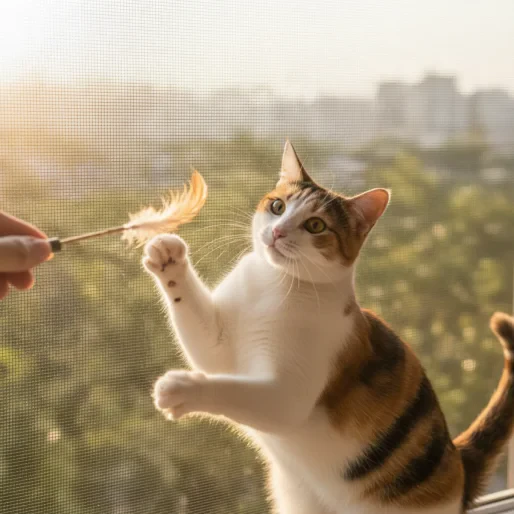
Structured daily play sessions using wand toys, feather lures, or laser pointers (always ending with a tangible "catch" to prevent frustration) provide an outlet for the predatory motor pattern. A cat that has completed a full predatory sequence through play is less likely to be in a heightened state of predatory arousal when a bird appears outside the window. Professional guidelines recommend at least two dedicated interactive play sessions per day, each lasting 10 to 15 minutes.
Window Enrichment Stations
Rather than discouraging window access, enrichment-focused approaches make the window area a safe, engaging station. A sturdy perch at sill height, combined with a secure screen, gives the cat a dedicated watching post. Adding a bird feeder outside a screened window provides visual stimulation without risk. This is an application of environmental modification: shaping the environment so that the desired behaviour (watching from a safe perch) is more reinforcing than the undesired behaviour (pushing against or through a barrier).
Scent and Auditory Enrichment
Spring air carries a rich array of scent information. Allowing safe airflow through screens satisfies the cat's olfactory curiosity. Supplementing with cat-safe herbs (catnip, silver vine, valerian root) placed near window perches can redirect attention inward. The goal is to keep arousal at a moderate, healthy level rather than allowing it to spike into the range where impulsive behaviour overrides caution.
Cats experiencing seasonal restlessness or heightened reactivity may also be dealing with spring allergies affecting their comfort, which can compound irritability and increase erratic behaviour near windows.
Multi-Cat and Kitten Considerations
In multi-cat households, social dynamics add another layer of risk. A cat fleeing from a socially threatening housemate may bolt toward an open window without the usual caution. This is a classic example of redirected flight behaviour, and it is more common in spring when rising temperatures and increased arousal create a generally more reactive household atmosphere.
Kittens are at particular risk due to incomplete motor development, poor spatial judgement, and intense exploratory drive. During kitten season in spring, foster carers and new adopters should treat window security as a day-one essential, not a future upgrade.
Management While Solutions Are Being Installed
If screens, catios, or guards have been ordered but not yet installed, interim management is critical:
- Open windows only in rooms the cat cannot access. Close the door and verify the latch holds.
- Never rely on a cat's "good sense" or past behaviour as evidence of safety. Behavioural triggers are unpredictable.
- Tilt windows should remain fully closed, not tilted, until guards are in place. The injury risk from tilt windows is immediate and severe.
- Supervise any open-window time directly. "Supervised" means actively present and watching, not in the next room.
Pet sitters and shelter volunteers managing foster homes should include window security in their standard safety audit. A spring hazard briefing that covers window and balcony risks can prevent avoidable emergencies.
When to Consult a Certified Animal Behaviourist
Most window-safety situations are resolved with physical barriers and enrichment. However, a referral to a certified applied animal behaviourist (CAAB) or IAABC-certified consultant is warranted when:
- A cat shows compulsive attempts to breach barriers (repeated lunging, persistent clawing at screens), suggesting a level of arousal or compulsive behaviour that management alone will not resolve.
- A cat's window-directed behaviour is driven by fear or anxiety (attempting to escape the home due to noise phobia, inter-cat conflict, or environmental stressors) rather than predatory interest.
- A cat has survived a fall and now shows behavioural changes such as heightened startle responses, avoidance of previously enjoyed areas, or signs consistent with chronic pain. Consultation with both a veterinary behaviourist and a pain management specialist is advisable in these cases.
The FAS (Fear, Anxiety, Stress) scale, widely promoted by Fear Free Pets, provides a useful framework for assessing whether a cat's arousal at windows is healthy engagement or problematic distress. Scores at the moderate-to-severe end of the FAS spectrum indicate a need for professional behavioural assessment.
Summary: Layered Safety for Spring Ventilation
Effective cat-proofing combines physical barriers matched to the window type with behavioural strategies that address the underlying motivation. Mesh screens suit standard windows. Catio kits transform balconies and larger openings into safe outdoor-access zones. Tilt window guards eliminate the specific wedge-trapping hazard. And enrichment, play, and environmental design reduce the intensity of the drive that puts cats at risk in the first place.
No single measure is failsafe. The most reliable approach layers multiple strategies: install the correct physical barrier, enrich the indoor environment, maintain play routines, and monitor for changes in behaviour that signal rising risk. Spring should be a season of fresh air for every member of the household, including the feline ones.
Frequently Asked Questions
Content Disclosure
This article was created using state-of-the-art AI models with human editorial oversight. It is intended for informational and entertainment purposes only and does not constitute veterinary medical advice. Always consult a licensed veterinarian for your pet's specific health needs. Learn more about our process.