A Singapore focused guide to desensitising Singapore Specials for HDB lifts, narrow corridors, cleaner trolleys, and community cats. Built around tropical climate realities, AVS licensing, and LIMA aligned methods.
Key Takeaways
- Singapore Specials adopted through Project ADORE or shelter rehoming often enter HDB flats with patchy early exposure, so calm lift and corridor behaviour must be trained, not assumed.
- Use desensitisation and counter-conditioning (DS/CC) at sub-threshold distances from cleaner trolleys, town council contractors, neighbours, and community cats at the rubbish chute.
- Schedule indoor skill work in air-conditioned rooms during the 11:00 to 16:00 peak, and reserve corridor or void deck practice for the cooler windows before 08:00 or after 19:00.
- Loose lead walking on polished HDB tile needs nail and pad care, a Y front harness, and short reinforcement cycles.
- The six week plan layers foundations, lift mechanics, corridor traffic, novel triggers, generalisation, and weekly maintenance.
- Follow LIMA principles and consult an accredited trainer or veterinary behaviourist if fear escalates. Confirm your dog is licensed with AVS and up to date on core vaccinations before public training.
Why HDB Living Is a Specific Behavioural Challenge
Singapore Specials, the local landrace of mixed breed dogs descended from village and free roaming populations, are typically alert, environmentally sensitive, and quick to form firm opinions about novel stimuli. Many enter adoptive homes through Project ADORE, SOSD, Causes for Animals, or independent fosterers, which means their primary socialisation window (roughly 3 to 14 weeks per current behavioural science consensus) rarely included mirrored lift interiors, the rattle of a cleaner trolley on tile, or close quarter encounters with neighbours wheeling groceries.
The HDB lift itself is a sensory cocktail: enclosed mirrored walls, sudden vertical motion, vibration through the paws, fluorescent lighting, and unpredictable human entries at every floor. Corridors add fast approaching residents, community cats holding a steady stare near the rubbish chute, and town council cleaners pushing metal carts that echo down the tiled walkway. For an under socialised dog, every one of these is a logical reason for caution.
Professional consensus, including guidance referenced by the IAABC and CCPDT, treats fear and reactivity as emotional states rather than disobedience. The aim is not to suppress a flinch or a bark but to change the underlying feeling from worry to neutral, or ideally to positive anticipation.
Singapore Specific Prerequisites
Licensing, Vaccination, and HDB Rules
Before any structured training in shared spaces, verify the basics. The Animal and Veterinary Service (AVS), a cluster of the National Parks Board, requires dog licensing and mandatory microchipping. Core vaccinations typically include distemper, hepatitis, parvovirus, and leptospirosis, with the latter especially relevant given Singapore's drains, monsoon puddles, and community cat activity. HDB allows one approved dog per flat, and Project ADORE provides an approved pathway for adopting larger local mixed breeds into HDB units. Confirm your dog's status before any corridor work so an unexpected encounter does not become a compliance issue.
Equipment
- Y front harness with front and back clip points. Standard medium sizes (around 12 to 20 kg) fit the typical athletic Singapore Special build. Budget around SGD 45 to 90 from local pet retailers.
- 1.5 to 2 metre fixed lead rather than a retractable, so communication stays predictable in a corridor only a metre or two wide.
- High value reinforcers in a hip pouch: boiled chicken breast, freeze dried liver, or small cubes of low sodium cheese. Reserve these strictly for trigger work.
- Lickable food tubes or silicone lick mats for stationary counter conditioning inside the lift.
- Paw wax or non slip booties for slick polished tile, plus a damp microfibre cloth to wipe paws after monsoon walks. Lepto risk is real after heavy rain.
- A lightweight visual barrier, even a folded umbrella, for early lobby sessions if the dog cannot yet cope with full visibility.
Climate and Timing
Singapore's tropical climate is a training variable, not a footnote. Daytime ambient temperatures sit around 31 to 34 degrees Celsius, with humidity routinely above 80 percent. Pavement and metal lift thresholds during midday sun can comfortably exceed 50 degrees Celsius. The five second back of hand test on pavement and on the lift threshold strip is a simple field check: if it is uncomfortable for a human palm, it is unsafe for paws.
- Schedule outdoor sessions before 08:00 or after 19:00, when surfaces have cooled.
- Run skill building sessions indoors in air conditioning at 23 to 25 degrees Celsius.
- Keep sessions short: three to five minutes for fearful dogs, building to ten minutes.
- Carry water and a collapsible bowl. Heat stress can mimic or amplify fear responses, and recovery on humid evenings is slower than owners expect.
- During the Northeast Monsoon (roughly November to January) and Southwest Monsoon surges (June to September), expect afternoon thunderstorms. Thunder phobia frequently complicates corridor training during these months.
For additional warm climate breed considerations, see the Heat-Tolerant Dog Breeds: A Singapore Owner's Guide.
Positive Reinforcement: Step by Step
Step 1: Build a Reinforcement Marker
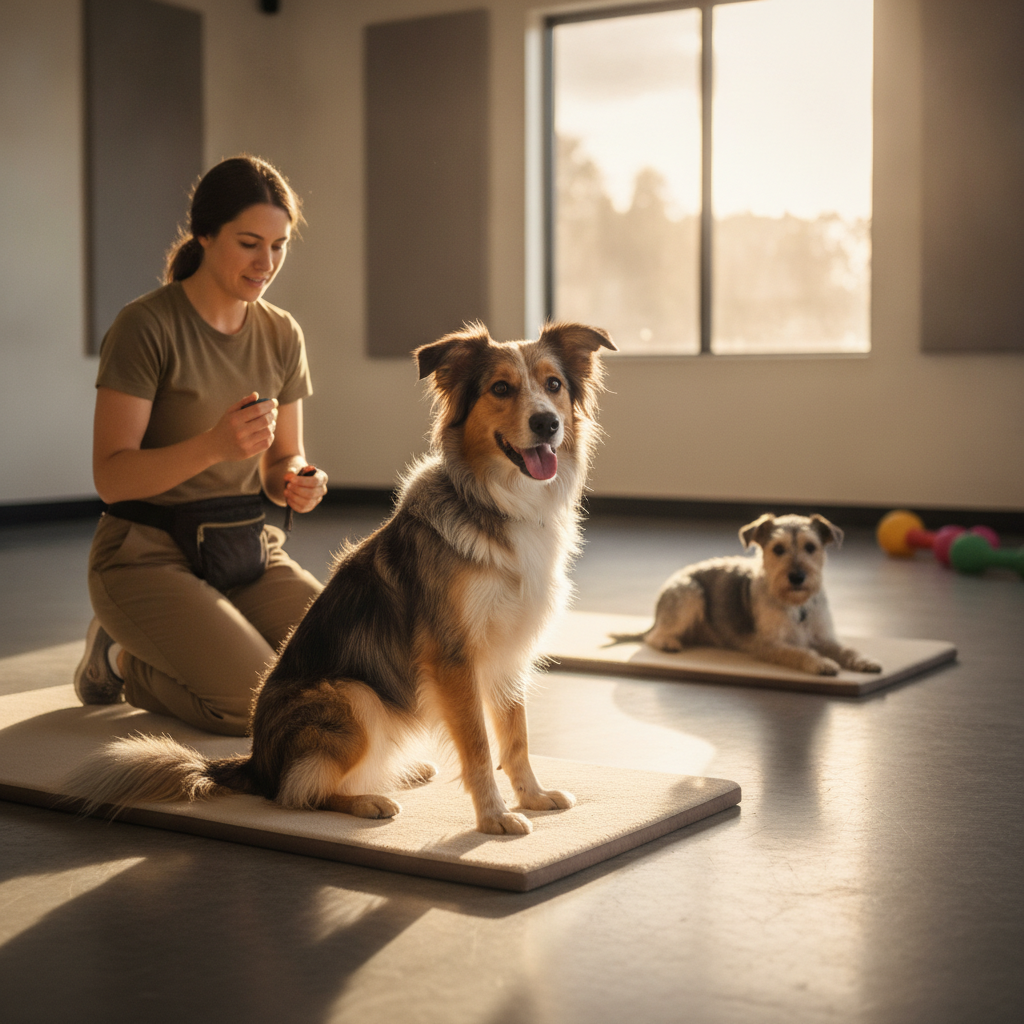
Pair a clicker or a consistent verbal marker such as "yes" with food until the sound itself predicts reinforcement. Aim for 20 to 30 pairings across two short indoor sessions before progressing.
Step 2: Establish a Default Focus Behaviour
Teach a name response and a hand target (nose to flat palm). These become coping tools in lifts and corridors. When a cleaner appears at the rubbish chute, the handler cues a hand target and reinforces heavily, giving the dog a known task instead of leaving them to improvise.
Step 3: Desensitisation to the HDB Lift
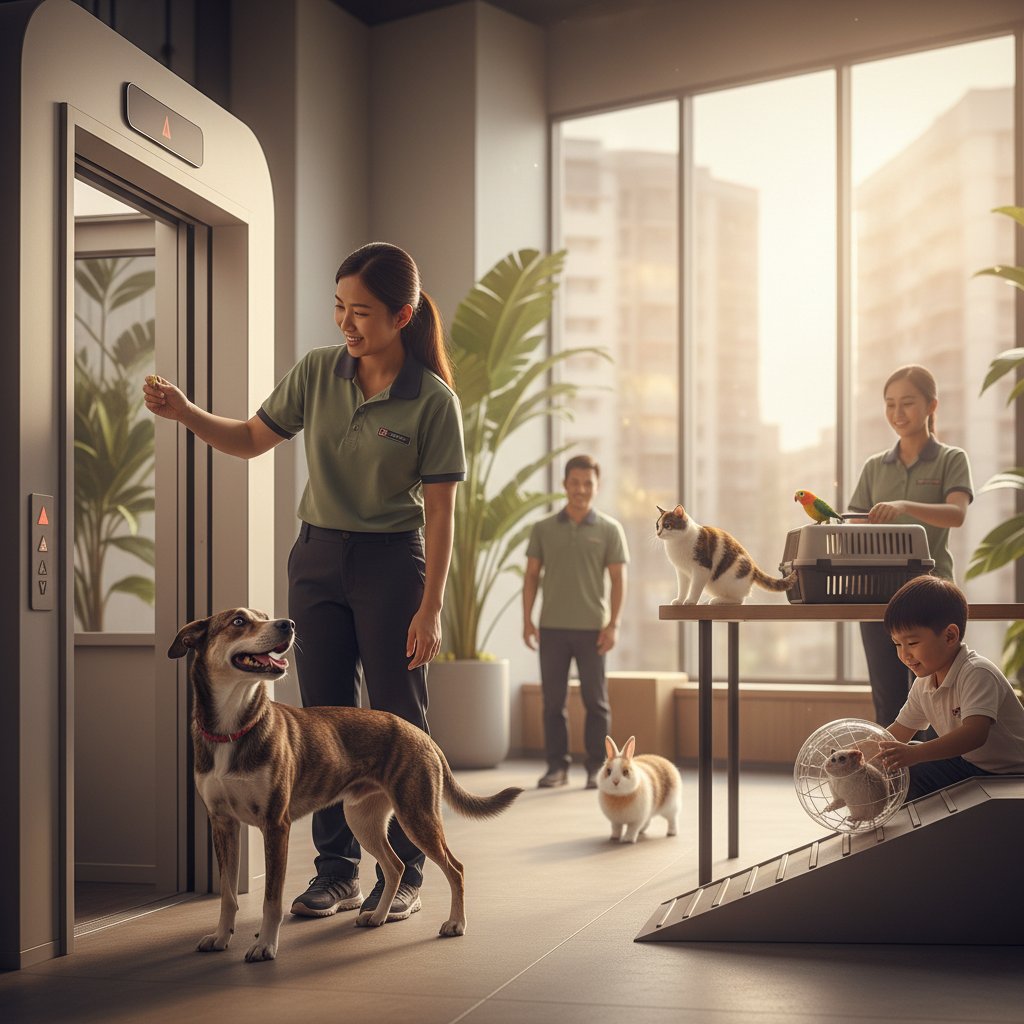
Break the lift into micro steps and choose off peak windows. In most blocks, mid morning between 10:00 and 11:00 and mid afternoon between 14:00 and 16:00 are quieter than the school and work rush.
- Day 1 to 3: Approach the lift lobby, mark and reinforce calm sniffing, then leave without pressing the button.
- Day 4 to 6: Stand near the lift while it arrives empty. Reinforce orientation to the handler when doors open. Walk away without entering.
- Day 7 to 10: Step into the empty lift, immediately step out, reinforce. Repeat until the dog enters voluntarily.
- Day 11 onwards: Take a one floor ride with the lick mat active throughout. Build duration gradually.
Step 4: Counter Conditioning Around Cleaners and Community Cats
Counter conditioning pairs the trigger (cleaner with metal trolley, ginger cat near the chute, neighbour with a delivery trolley) with something the dog already loves. The trigger appears, the food appears. The trigger disappears, the food stops. Order matters in classical conditioning, so the food must follow the trigger, never precede it.
Start at the largest distance at which the dog notices the trigger but can still eat and orient. Signs you are too close include refusing food, hard staring, lip licking, whale eye, or a stiff tail set.
Step 5: Stranger Desensitisation in Narrow Corridors
HDB corridors funnel foot traffic into lanes barely wide enough for two adults. Teach a U turn cue and a tuck behind position so the handler can step between the dog and a passing resident when there is no room to widen the gap. Reinforce the dog for looking at the handler when a person passes, building a strong neighbour equals handler attention pattern.
Step 6: Loose Lead Walking on Slick Tile
Polished corridor tile and the lift floor offer poor traction, which causes some dogs to brace, scrabble, or surge. Address this in three layers:
- Paw care: Keep the fur between pads trimmed and nails short to maximise grip.
- Pace: Walk slowly. A rushed handler creates a rushed dog. Reinforce every two to three steps in early sessions.
- Position: Reinforce on the seam line of your trouser leg so the dog learns where loose lead lives. A taut lead earns a quiet stop, not a correction.
Common Mistakes Owners Make
- Flooding instead of desensitising. Carrying a frightened dog into a packed peak hour lift deepens fear and risks learned helplessness.
- Reinforcing too late. If the trigger has already vanished before the treat appears, the dog learns nothing about the trigger.
- Using low value food for high stakes triggers. Kibble rarely competes with a startling cleaner trolley. Reserve premium reinforcers for premium challenges.
- Skipping the indoor warm up. Cold starting in a hot, busy lobby sets the dog up to fail.
- Punishing growls. A growl is information. Suppressing it removes the warning system without changing the underlying emotion.
- Inconsistent harness fit. A harness that rotates on slick tile creates pressure points and pulling.
Troubleshooting Slow Progress
The Dog Refuses Food in the Lobby
This usually means the dog is over threshold. Increase distance, shorten the session, and rebuild from a calmer baseline. Shifting practice to off peak hours frequently solves it.
Progress on Weekdays, Regression on Weekends
Weekend visitors, town council cleaning rotations, and family gatherings shift the trigger picture. Treat weekends as a different training context and lower criteria accordingly.
The Dog Fixates on the Community Cat
Cats are highly salient for many Singapore Specials with prey drive heritage. Add distance, use a visual block (your body or a folded umbrella), and reinforce a strong find it scatter feed on the floor to redirect the eyes. If fixation persists, work on impulse control games such as It's Your Choice at home first. Note that under the Animals and Birds Act, harming a community cat carries serious penalties, and many estates have active caregivers who appreciate respectful distance.
Heat and Monsoon Setbacks
Panting, slow recovery, and reduced food motivation in humid weather are not training failures. Pivot to indoor sessions and resume outdoor work in cooler conditions. The Backyard Dog Conditioning Circuit for Summer Evenings offers compatible enrichment ideas for tropical climates.
When to Bring in a Professional
Self directed training has clear limits. Consider a credentialled trainer (CPDT KA, KPA CTP, IAABC ADT) or a veterinary behaviourist when any of the following appear:
- Bite history or air snapping at neighbours, cleaners, or other dogs.
- Freezing, urinating, or defecating in the lift after four or more weeks of structured work.
- Generalised fear that worsens despite sub threshold protocols.
- Suspected pain or medical contributors (limping on tile, sudden noise sensitivity, recent infection). A veterinary check should precede behaviour work. For after hours emergencies, contact .
Call the Animal Recovery Centre (ARC) or your nearest 24-hour veterinary clinic.
Several clinics in Singapore offer 24-hour emergency services. The AVS (Animal & Veterinary Service) website lists all licensed clinics.
- Resource guarding triggered around food during training.
For puppies still inside the socialisation window, structured exposure work in low stress public settings is foundational. The Puppy Socialisation at Mediterranean Summer Cafes guide outlines transferable principles that adapt well to void decks and pet friendly coffee shop corners.
The Six Week HDB Plan
Week 1: Indoor Foundations
Marker training, name response, hand target, mat settle, and harness conditioning. All sessions inside with air conditioning on, two to three short sessions daily.
Week 2: Lobby and Lift Door
Approach the lobby, reinforce calm orientation, practise sit at the lift door without entering. Begin loose lead micro walks on the corridor tile outside your unit during off peak hours.
Week 3: Empty Lift Rides
One floor rides in an empty lift with lick mat active. Build to three floor rides. Continue corridor work at sub threshold distances from cleaner activity.
Week 4: Adding Human Traffic
Practise lift entries when one calm neighbour is present (arrange ahead if possible). Reinforce heavily for handler focus. Begin stranger pass drills with U turn and tuck behind cues.
Week 5: Trolleys, Cats, and Novel Triggers
Add structured counter conditioning near the rubbish chute at quiet hours. Pair the sight of a stationary trolley with chicken. Add moving trolley exposure only when stationary trolleys produce relaxed body language.
Week 6: Generalisation and Maintenance
Take the skills to a different block, a different lift bank, or a void deck across the estate. Practise at varied times of day. Build a weekly maintenance schedule of two short reinforcement walks and one lift practice ride so behaviours do not extinguish.
Heat, Hydration, and Recovery
Tropical training success depends on respecting the dog's physiological ceiling. Brachycephalic mixes, senior dogs, and overweight dogs heat stress faster. Offer water every 10 to 15 minutes during outdoor work, watch for excessive panting, brick red gums, or wobbliness, and end the session early if any of these appear. Indoor air conditioned sessions are the primary training environment during the hottest months, with outdoor exposure layered in as a generalisation step.
Welfare and Method
Adherence to LIMA means choosing the least intrusive, minimally aversive effective option. Prong collars, e collars, leash pops, alpha rolls, and intimidation tactics are not part of evidence based protocols for fearful or under socialised dogs and can produce fallout including increased aggression and learned helplessness. Singapore Specials, with their characteristic intelligence and sensitivity, respond particularly well to clear marker training, generous reinforcement schedules, and predictable handler behaviour. With patient, structured work, the HDB lift becomes just another door, the corridor cat becomes background scenery, and the cleaner's trolley becomes a cue for chicken.
Frequently Asked Questions
Is my Singapore Special allowed in an HDB flat? ↓
What time of day is safest for outdoor lift and corridor training in Singapore? ↓
How long does it take to settle a rescued Singapore Special into HDB lift routines? ↓
Can I use a retractable lead in HDB corridors? ↓
What should I do if my dog reacts to a community cat near the rubbish chute? ↓
When should I escalate to a veterinary behaviourist? ↓

Mark Sullivan
Certified Professional Dog Trainer
Certified professional dog trainer — positive-reinforcement methods for every breed and behavioural challenge.
Content Disclosure
This article was created using state-of-the-art AI models with human editorial oversight. It is intended for informational and entertainment purposes only and does not constitute veterinary medical advice. Always consult a licensed veterinarian for your pet's specific health needs. Learn more about our process.