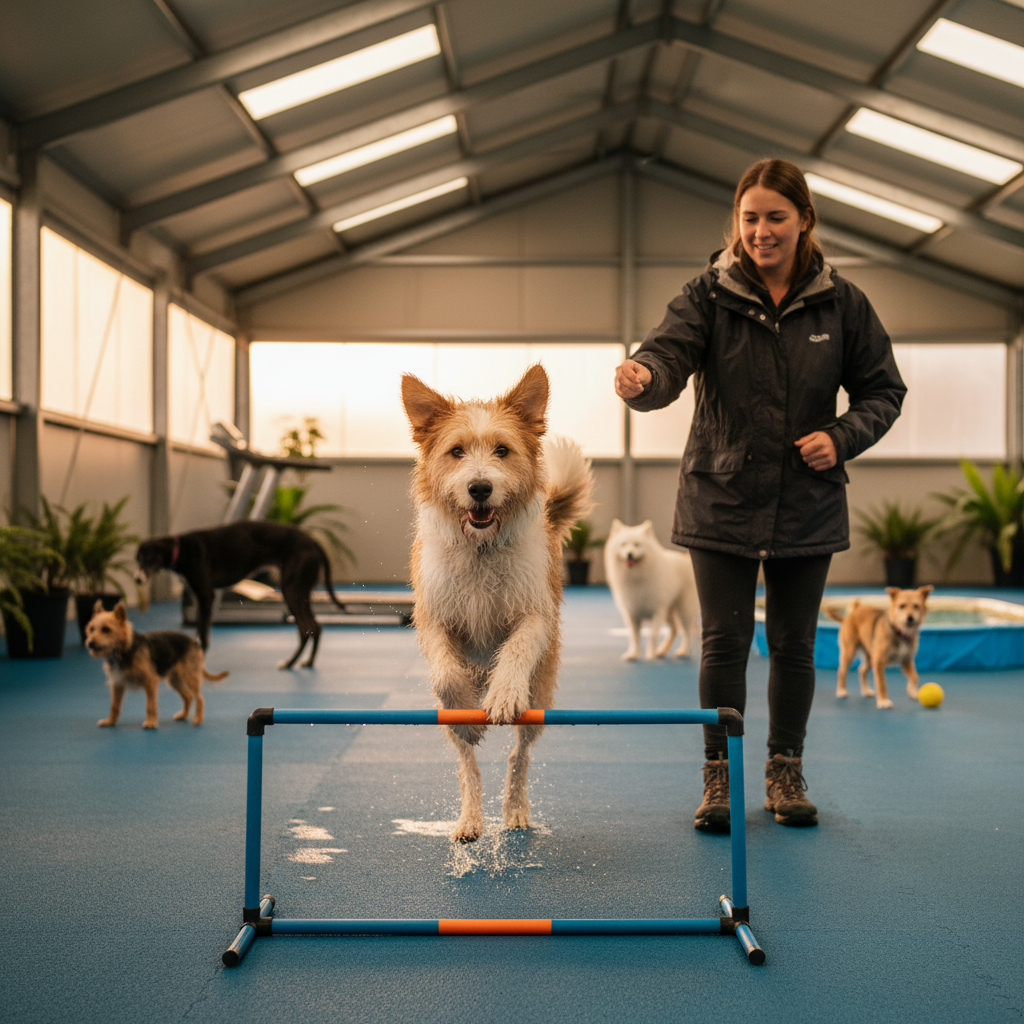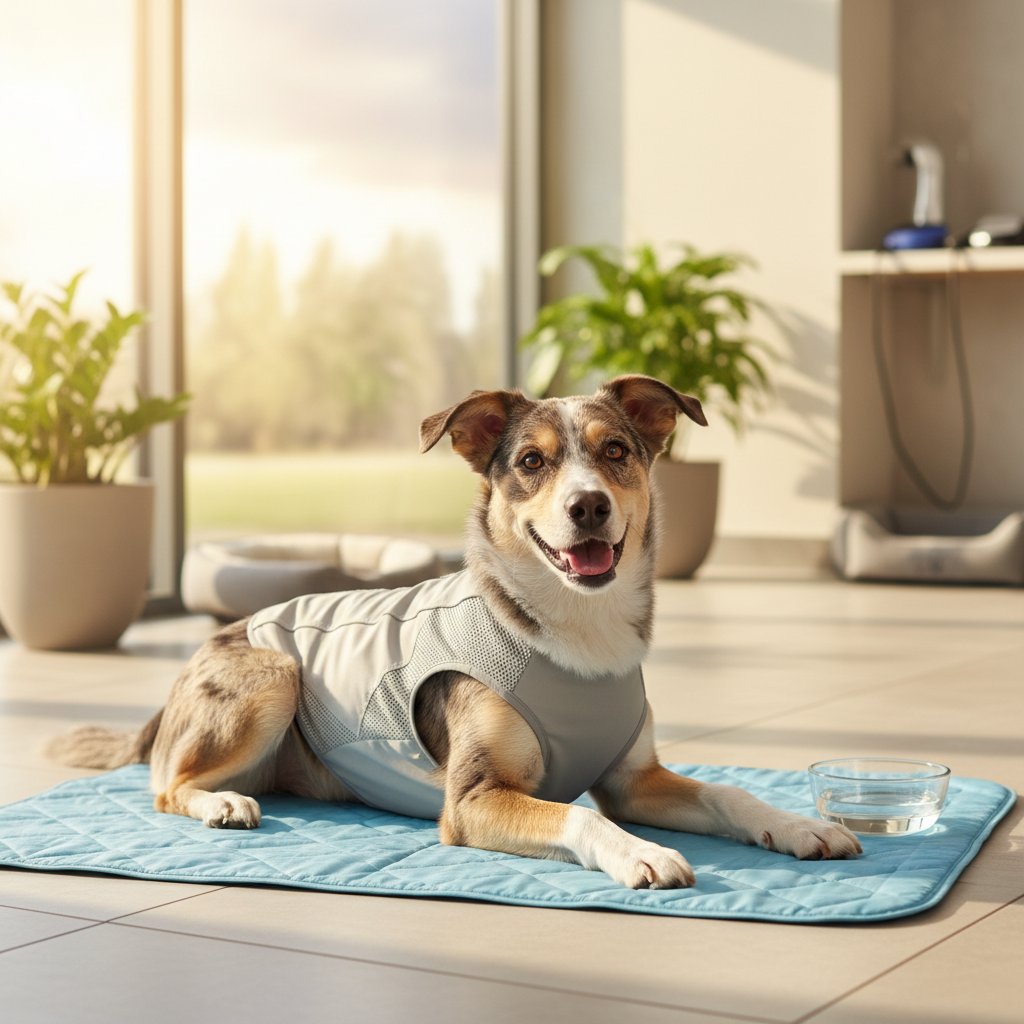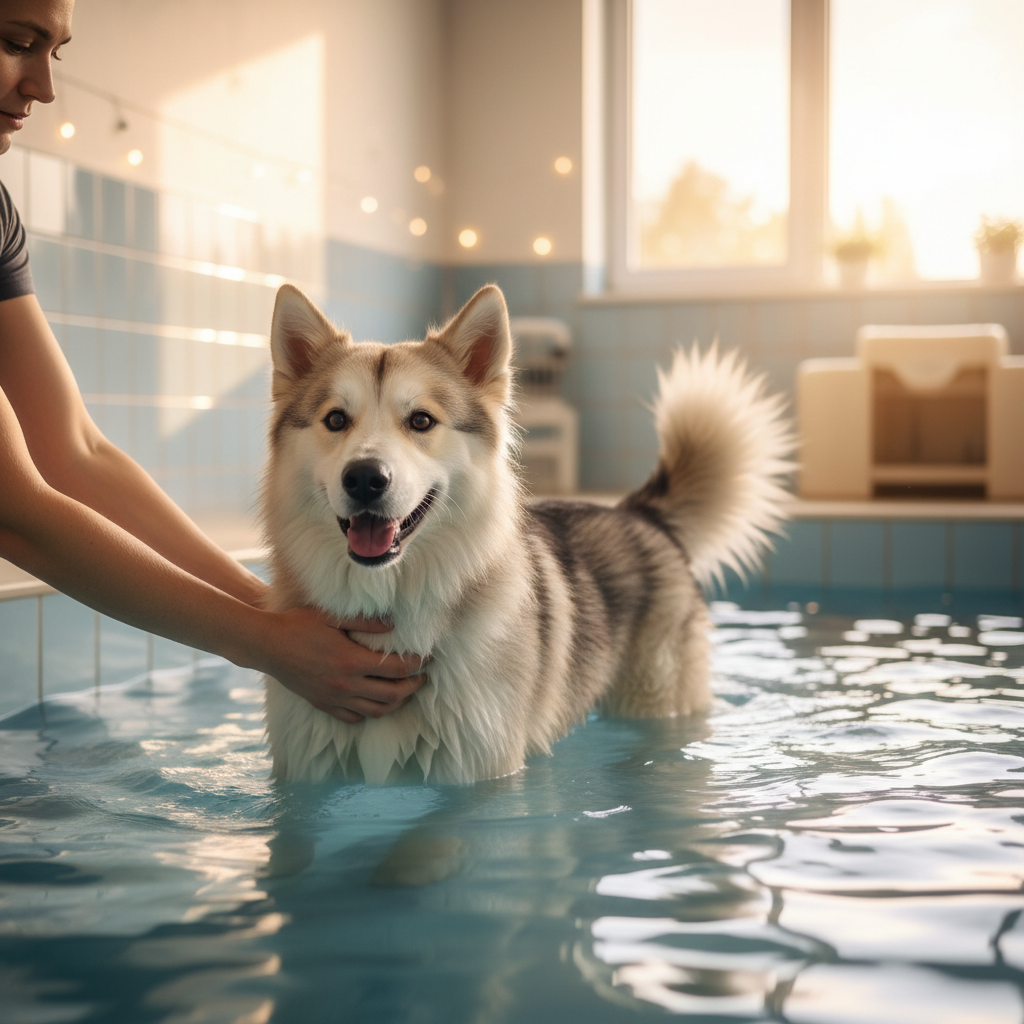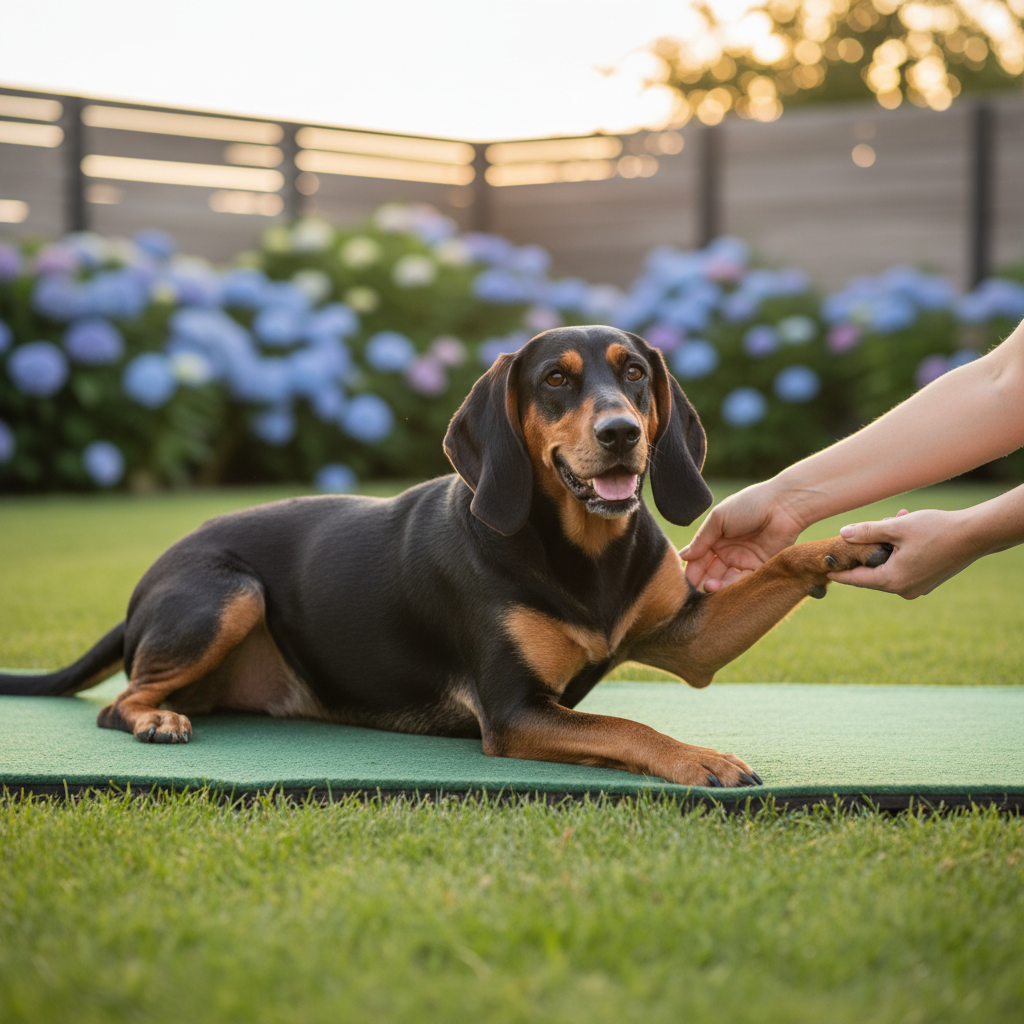
A six week backyard conditioning circuit designed for the wide range of U.S. summer climates, from humid Gulf Coast evenings to smoke prone Western nights. The plan covers cavaletti spacing, wobble cushion progressions, cone weaves, and the regulatory and insurance considerations American dog owners need to know.
Key Takeaways
- Cavaletti pole height and spacing must match your dog's height at the withers and natural stride, not just the breed standard listed by the AKC.
- Wobble cushion progressions should be staged: two paws on a flat surface first, then all four paws on a fully inflated disc.
- Cone weaves develop lateral flexibility and proprioception; spacing should allow a comfortable bend, not a sharp twist.
- Session length for healthy adult dogs is typically 10 to 20 minutes, two or three times a week, with at least 48 hours of rest between strength sessions.
- Warm up and cool down with five minutes of loose leash walking and gentle range of motion work.
- Air Quality Index matters as much as temperature for summer training in wildfire prone Western states.
- Stop immediately and consult your veterinarian if you notice lameness, reluctance to move, or unusual panting.
Why a Backyard Conditioning Circuit Suits the American Summer
U.S. summers are notoriously variable: a humid 95°F evening in Houston or Tampa behaves very differently from a dry 90°F afternoon in Phoenix, smoke filled air in Sacramento, or a balmy 75°F dusk in Minneapolis. Across all of these climates, a backyard conditioning circuit gives dogs a structured outlet for energy without the joint impact of sustained running or the heat stress of midday walks on hot asphalt. The American Veterinary Medical Association (AVMA) consistently emphasises that controlled, repetitive movement supports joint health, balanced musculature, and proprioceptive awareness (the body's sense of where its limbs are in space).
This guide is built for healthy adult dogs cleared for exercise by a licensed U.S. veterinarian. Puppies still in growth plate development, senior dogs with arthritis, and dogs recovering from surgery should follow a plan designed by a Certified Canine Rehabilitation Practitioner (CCRP) or a veterinarian credentialed through the American College of Veterinary Sports Medicine and Rehabilitation (ACVSMR). For overweight or arthritic dogs, low impact water work is often a better starting point; see the article on canine hydrotherapy for arthritic, overweight dogs.
Preparation: What You Need
Equipment Checklist
- 4 to 6 cavaletti poles (lightweight PVC works well; many U.S. agility suppliers sell kits for around $40 to $80).
- 1 wobble cushion or balance disc rated for your dog's body weight in lbs, with a non slip rubber mat underneath.
- 6 to 8 traffic or weave cones, tall enough that the dog must walk around them rather than over them.
- Non slip surface: short dry grass, rubber stall matting, or artificial turf. Avoid wet wooden decks, pool tile, or pea gravel.
- High value treats cut into pea sized pieces, plus fresh water in a shaded spot.
- A well fitted flat collar or Y shaped harness and a 5 to 6 foot leash for guidance.
Environmental Setup
Plan sessions for the cooler part of the evening, ideally when the ambient temperature drops below 75°F and the surface is comfortable to the back of your hand for at least seven seconds. AVMA hot weather guidance notes that pavement can run 40°F to 60°F hotter than the air on a sunny day, so even an 85°F evening can present a 140°F surface. In humid Southern states such as Louisiana, Mississippi, and Georgia, monitor the heat index rather than the raw thermometer reading.
For owners in California, Oregon, Washington, and parts of the Mountain West, wildfire smoke is a serious training variable. Check the EPA AirNow Air Quality Index before each session; an AQI above 100 is generally considered unhealthy for sensitive groups, including dogs with brachycephalic features, heart disease, or respiratory issues. Move sessions indoors to a basement, hallway, or garage on smoky evenings.
Clear the circuit of slippery debris, fire ant mounds (common across the South), sprinkler heads, and lawn chemicals. Keep stations at least 6 feet apart so your dog can transition without rushing.
Cavaletti Spacing for Common U.S. Breeds
Cavaletti work (walking or trotting over a series of low poles) is one of the most evidence supported tools in canine conditioning. It promotes active joint flexion, even weight distribution, and engagement of the deep core. The single biggest mistake American owners make is setting poles too close together, which forces the dog to hop rather than stride. This is especially common with the popular Labrador and Golden Retriever, where owners often underestimate stride length.
General Rules
- Pole height for foundation work: roughly the height of the dog's carpus (wrist) for small to medium dogs, and the height of the hock for larger breeds. Start lower if your dog hesitates.
- Pole spacing: approximately the same distance as the height of the dog at the withers for a walking pace, and slightly longer for a trotting pace.
Suggested Starting Points
- Toy and small breeds (Chihuahua, Yorkshire Terrier, Cavalier King Charles Spaniel, Boston Terrier): poles 2 to 4 inches high, spaced about 8 to 12 inches apart.
- Medium breeds (American Cocker Spaniel, Border Collie, Australian Shepherd, mid size mixed breeds around 35 to 55 lbs): poles 4 to 6 inches high, spaced about 16 to 20 inches apart.
- Large breeds (Labrador Retriever, Golden Retriever, German Shepherd, Standard Poodle): poles 6 to 8 inches high, spaced about 22 to 28 inches apart.
- Giant breeds (Great Dane, Bernese Mountain Dog, Newfoundland): poles 8 to 10 inches high, spaced about 30 to 36 inches apart.
Watch the dog's natural stride and adjust. If the dog clips poles, widen the spacing; if the dog jumps two at a time, shorten it. Lower and slower is almost always the right starting point.
Wobble Cushion Progressions
Balance discs challenge the small stabiliser muscles that hold joints aligned. Veterinary rehabilitation guidelines from the ACVSMR and the American Association of Rehabilitation Veterinarians (AARV) suggest these tools are most effective when introduced in stages, with each stage held until the dog is calm and confident.
Stage 1: Familiarisation (Week 1)
Place the cushion lightly inflated on a non slip mat. Lure the dog to step two front paws on, hold for three to five seconds, then step off. Repeat 5 to 8 times per session.
Stage 2: Rear Paw Awareness (Week 2)
Reverse the position so the back paws are on the cushion. This is harder and often produces a puzzled head tilt. Reward steady weight distribution, not duration.
Stage 3: All Four Paws (Weeks 3 to 4)
Use a slightly larger disc or two cushions side by side. Lure the dog into a square stand with all four paws on. Aim for 10 to 15 seconds of calm balance.
Stage 4: Dynamic Work (Weeks 5 to 6)
Ask for a nose touch to the left, then right, encouraging the dog to engage the core to stay balanced. Never push, pull, or rock the cushion forcefully.
Cone Weave Drills
Cone weaves develop spinal flexibility, hindlimb awareness, and controlled turning. They differ from competition weave poles in that the focus is on slow, deliberate movement rather than speed.
Setting Up
- Arrange 6 cones in a straight line.
- Spacing: roughly 1.5 times the dog's body length apart for foundation work. Closer spacing increases bend; wider spacing reduces it.
The Drill
Lead the dog at a walk in a serpentine pattern around the cones. Most dogs are noticeably stiffer on one side; that side needs more repetitions, not fewer. Begin with three passes in each direction. Add one pass per week up to a maximum of six per direction.
Session Length and Recovery
Conditioning is not the same as cardio. The aim is quality of movement, not exhaustion. Standards used across U.S. canine rehabilitation practice generally recommend:
- Total session length: 10 to 20 minutes for healthy adult dogs, including warm up and cool down.
- Frequency: two to three sessions per week, with at least 48 hours between strength focused sessions.
- Warm up: 5 minutes of loose leash walking plus a few play bows or sit to stand transitions.
- Cool down: 5 minutes of slow walking and, if your dog tolerates it, gentle passive range of motion on each limb.
Recovery is when adaptation happens. Owners commonly underestimate how tiring proprioceptive work is; a dog may seem energetic during the session and then sleep deeply afterwards. That is normal. Stiffness lasting more than 24 hours or any change in gait warrants a rest day and a veterinary check if it persists.
Six Week Plan
Week 1: Foundation
- Session A: Cavaletti walk over 4 poles, 3 passes. Wobble cushion Stage 1.
- Session B: Cone weave at walk, 3 passes each direction.
Week 2: Adding Repetitions
- Session A: Cavaletti 5 poles, 4 passes. Wobble cushion Stage 2.
- Session B: Cone weave 4 passes each direction. Sit to stand x 5.
Week 3: Combining Stations
- Session A: Cavaletti 6 poles, 4 passes. Wobble cushion Stage 3.
- Session B: Cone weave 5 passes each direction. Figure of eight around two widely spaced cones.
Week 4: Building Endurance
- Session A: Cavaletti at slow trot if the dog is balanced, 5 passes. Stage 3 with nose touches.
- Session B: Cone weave 6 passes. Sit to stand x 8 at controlled tempo.
Week 5: Dynamic Balance
- Session A: Cavaletti combined with a wobble cushion stand at the end of the lane.
- Session B: Cone weave plus down to stand x 5.
Week 6: Integration and Assessment
- Session A: Full circuit, two rounds with rest between.
- Session B: Reassess pole spacing, balance duration, and weave smoothness.
Local Regulations and Insurance Considerations
Before starting any outdoor program, make sure the dog's rabies vaccination is current. Every U.S. state mandates rabies vaccination for dogs, although the schedule (one year versus three year boosters) and proof of vaccination requirements vary by state and county. Dogs working outdoors in tick heavy regions, particularly the Northeast, Upper Midwest, and Mid Atlantic, should also be on a year round tick and heartworm prevention protocol prescribed by a veterinarian.
Breed specific legislation (BSL) remains in force in certain U.S. municipalities. Owners of American Pit Bull Terriers, American Bullies, and similar breeds in places such as Miami Dade County, parts of the Kansas City metro, and various Denver area suburbs should review local ordinances before purchasing outdoor agility equipment or hosting backyard training sessions visible from the street, as some jurisdictions require muzzles or specific enclosure standards even on private property.
Veterinary care in the U.S. can be expensive. An emergency orthopaedic consult often runs $200 to $500, and cranial cruciate ligament surgery can range from $3,500 to $7,000 depending on technique and region. Pet insurance covers many conditioning related injuries, but most policies exclude pre existing conditions, so enrolling a young, healthy dog before starting a structured program is worth considering.
What to Watch For
During the Session
- Excessive panting that does not settle within a minute of pausing.
- Refusal or freezing at a station the dog previously enjoyed.
- Repeated pole knocking, suggesting fatigue or poor spacing.
- Slipping on the surface; stop and adjust immediately.
After the Session
- Mild tiredness and a long nap are expected.
- Stiffness on rising the next morning means you progressed too quickly.
- Drinking heavily, then resting comfortably, is normal in warm weather.
Owners of double coated breeds (Siberian Huskies, Alaskan Malamutes, Bernese Mountain Dogs, Australian Shepherds) should remember that conditioning generates body heat. Never shave a double coated dog to cope with summer training; see the article on why you should never shave a double coated dog in summer.
When to Call Your Veterinarian Immediately
- Sudden lameness or non weight bearing on a limb during or after a session.
- Collapse, disorientation, or vomiting, which may indicate heat stress.
- Rapid, distressed breathing that does not normalise with rest, shade, and water.
- Yelping on movement, a hunched back, or reluctance to lie down comfortably.
- Swelling around joints in the 24 to 48 hours after exercise.
For after hours emergencies, contact your nearest 24 hour veterinary hospital or an ACVECC accredited emergency facility:
ASPCA Animal Poison Control Center
Call the ASPCA Poison Control hotline or contact your nearest emergency veterinary clinic immediately.
A consultation fee may apply. For non-poison emergencies, search "emergency vet near me" or call your local animal ER.
Dogs with diagnosed orthopaedic conditions, including hip dysplasia (commonly seen in Labradors and German Shepherds), elbow dysplasia, cranial cruciate disease, or intervertebral disc disease (frequent in Dachshunds and Corgis), should not begin a conditioning program without input from a veterinarian or a CCRP credentialed therapist.
Final Thoughts
A well designed backyard conditioning circuit is one of the most rewarding ways to spend long American summer evenings with a dog. The goal is not to build a canine athlete in six weeks but to develop steady, lifelong physical literacy: balanced movement, calm focus, and resilient joints. Whether you live on the humid Gulf Coast, in the smoke prone West, or in the temperate Northeast, prioritise good form over repetitions, watch local heat and air quality, and treat every session as a chance to learn how your dog moves. With consistency, most owners notice a more confident gait, smoother transitions on stairs, and a happier, more settled dog at home.
Frequently Asked Questions
When is it too hot to run a backyard conditioning session in the U.S.? ↓
Can I train my dog outdoors during wildfire smoke season? ↓
Does U.S. pet insurance cover conditioning related injuries? ↓
Which U.S. breeds need extra caution with this circuit? ↓
How much should I budget for a basic backyard conditioning setup? ↓

Emma Lawson
Practical Pet Care Educator
Practical pet home care specialist — clear, step-by-step guidance grounded in veterinary nursing standards.
Content Disclosure
This article was created using state-of-the-art AI models with human editorial oversight. It is intended for informational and entertainment purposes only and does not constitute veterinary medical advice. Always consult a licensed veterinarian for your pet's specific health needs. Learn more about our process.