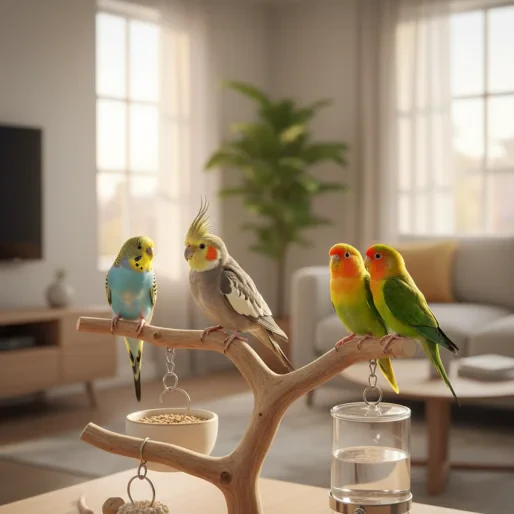

In this article
- Key Takeaways
- Side by Side Comparison Table
- Temperament: What to Expect Day to Day
- Noise Level: Apartment Friendliness
- Lifespan: A Long-Term Commitment
- Space Requirements for Apartment Living
- Monthly Cost Breakdown
- Health Risks to Know
- Lifestyle Match Guide: Which Bird Fits Your Situation?
- Adoption and Sourcing Considerations
- Decision Checklist: Which Is Right for Me?
- Final Thoughts
Key Takeaways
- Budgerigars are the most affordable and compact option, ideal for small apartments and first-time bird owners on a budget.
- Cockatiels offer the most affectionate, laid-back temperament but need more cage space and produce fine feather dust.
- Lovebirds are bold and entertaining but can be nippy, territorial, and louder than many new owners expect.
- All three species can thrive in apartments when provided with adequate flight time, enrichment, and veterinary care.
- Monthly costs for any of these birds typically range from 20 to 60 USD depending on diet quality and location.
Side by Side Comparison Table
| Factor | Budgerigar | Cockatiel | Lovebird |
|---|---|---|---|
| Average Lifespan | 5 to 10 years (up to 15 with excellent care) | 15 to 20 years (some reach 25) | 10 to 15 years |
| Adult Size | 18 cm (7 in), 30 to 40 g | 30 to 33 cm (12 to 13 in), 80 to 100 g | 13 to 17 cm (5 to 7 in), 40 to 60 g |
| Minimum Cage Size | 46 x 46 x 46 cm (18 x 18 x 18 in) per bird | 60 x 46 x 76 cm (24 x 18 x 30 in) | 46 x 46 x 60 cm (18 x 18 x 24 in) per bird |
| Noise Level | Low to moderate; chattering, occasional loud flock calls | Moderate; whistling, contact calls, dawn/dusk peaks | Moderate to high; shrill, short bursts |
| Temperament | Curious, social, trainable, can learn words | Gentle, affectionate, enjoys head scratches | Bold, playful, can be territorial or nippy |
| Handling Ease | Easy to hand-tame with patience | Typically the easiest of the three to handle | Requires consistent, confident handling |
| Dust or Dander | Low | High (powder-down feathers) | Low |
| Estimated Monthly Cost (USD) | 20 to 35 | 30 to 55 | 25 to 45 |
Temperament: What to Expect Day to Day
Budgerigar
Budgerigars (often called budgies or parakeets) are among the most popular companion birds worldwide, and for good reason. They are naturally gregarious, quick to investigate new toys, and capable of learning a surprisingly large vocabulary. Male budgies in particular are noted for their willingness to mimic speech, though results vary widely between individuals.
Because budgies are flock animals, keeping a single bird demands more owner interaction to prevent boredom and stress-related behaviours such as feather picking. Pairs or small groups tend to be more self-entertaining, though they may bond more closely with each other than with their human caretakers.
Cockatiel
Cockatiels are widely described by avian behaviour specialists as one of the most easygoing parrot species. They tend to enjoy physical contact, often soliciting head scratches and sitting on a shoulder for extended periods. Their whistling ability is a highlight: many cockatiels learn tunes and enjoy "singing" along with household sounds.
A common observation among avian rescue organisations is that cockatiels can become over-bonded to a single person, sometimes leading to hormonal behaviours. Providing environmental enrichment and maintaining a consistent light/dark schedule (10 to 12 hours of darkness) helps manage this.
Lovebird
Lovebirds pack a big personality into a small body. They are energetic, acrobatic, and often comically fearless. However, professional avian behaviour consultants frequently note that lovebirds can become nippy or territorial if not handled regularly from a young age.
Contrary to popular belief, lovebirds do not need to be kept in pairs. A single lovebird with plenty of human interaction can be a devoted companion, though an under-stimulated single lovebird may develop behavioural problems faster than a budgie or cockatiel in the same situation.
Noise Level: Apartment Friendliness
Noise is often the deciding factor for apartment dwellers. None of these three species is silent, but there are meaningful differences.
- Budgerigars produce a relatively low-volume chatter throughout the day. They can have occasional louder flock calls, but these are brief and generally tolerable through shared walls.
- Cockatiels are moderate in volume. Their contact calls (a sharp whistle when they want attention) can carry, especially at dawn and dusk. Owners commonly report that once a cockatiel settles into a routine, the calling becomes predictable and manageable.
- Lovebirds produce a high-pitched, shrill call that, while short in duration, can be surprisingly piercing. In thin-walled apartments, lovebird vocalisations are most likely to draw complaints from neighbours.
For noise-sensitive households or apartments with strict noise rules, budgerigars are typically the safest choice. Cockatiels are a close second. Lovebirds require the most tolerance from both owners and neighbours.
Lifespan: A Long-Term Commitment
One of the most common regrets new bird owners report is underestimating the lifespan of their pet. These are not short-lived animals.
- Budgerigars: 5 to 10 years on average, though well-cared-for budgies have been documented living into their mid-teens. Unfortunately, mass-bred budgies from pet shops sometimes have shorter lifespans due to genetic health issues.
- Cockatiels: 15 to 20 years is typical, with some individuals exceeding 25. This is a significant commitment comparable to many dog breeds.
- Lovebirds: 10 to 15 years with proper husbandry.
Prospective owners should consider future life changes (moves, children, career shifts) when choosing a species, particularly with cockatiels.
Space Requirements for Apartment Living
The cage is the bird's primary living space, but supervised out-of-cage time is essential for all three species. A good rule of thumb cited by avian welfare organisations: the cage should be large enough for the bird to fully extend and flap its wings without touching the sides.
Practical Cage Guidance
- Budgerigars: A single budgie needs a minimum of 46 x 46 x 46 cm (18 x 18 x 18 in). For a pair, double the width. Long, horizontal cages are preferred over tall, narrow ones because budgies fly horizontally.
- Cockatiels: Due to their longer tail and larger wingspan, cockatiels need at least 60 x 46 x 76 cm (24 x 18 x 30 in). Flight cages of 80 cm or longer are strongly recommended.
- Lovebirds: Similar minimum dimensions to budgies, 46 x 46 x 60 cm (18 x 18 x 24 in), but wider is always better. Lovebirds are active flyers and benefit from the largest cage an owner can accommodate.
All three species should receive at least one to two hours of supervised out-of-cage time daily in a bird-safe room (windows covered, ceiling fans off, no toxic plants or open water).
For owners who also keep other small pets such as guinea pigs, ensuring separate, safe spaces for each animal is important. For tips on small-pet nutrition and housing, see our Spring Guinea Pig Diet: Safe Grass and Veggie Guide.
Monthly Cost Breakdown
Beyond the initial purchase or adoption fee and cage setup, ongoing costs are an important consideration. The figures below are estimates based on typical pricing in 2026 and will vary by region.
Budgerigar: 20 to 35 USD per Month
- Food: A quality seed mix supplemented with pellets, fresh vegetables, and occasional fruit. Roughly 8 to 15 USD.
- Toys and enrichment: Budgies destroy toys quickly, so a rotating supply is needed. Roughly 5 to 10 USD.
- Veterinary fund: Setting aside 5 to 10 USD monthly toward an annual avian vet checkup (typically 50 to 100 USD) is prudent.
Cockatiel: 30 to 55 USD per Month
- Food: Cockatiels eat more and benefit from a pellet-based diet supplemented with fresh produce and some seed. Roughly 12 to 20 USD.
- Toys and enrichment: Cockatiels enjoy shredding toys, foraging activities, and mirrors. Roughly 8 to 15 USD.
- Veterinary fund: 8 to 15 USD set aside monthly. Cockatiels are prone to certain conditions (discussed below) that may require specialist care.
- Air purifier consideration: Because of cockatiel feather dust, owners with allergies or asthma may need to budget for a HEPA air purifier, which adds to the initial and ongoing electricity cost.
Lovebird: 25 to 45 USD per Month
- Food: A varied diet of pellets, seeds, fresh fruit, and vegetables. Roughly 10 to 18 USD.
- Toys and enrichment: Lovebirds are vigorous chewers and need a steady rotation of safe wood and shreddable toys. Roughly 8 to 12 USD.
- Veterinary fund: 7 to 12 USD monthly.
Health Risks to Know
Responsible ownership means understanding breed-specific (or species-specific) health vulnerabilities before bringing a bird home.
- Budgerigars: Prone to tumours (especially lipomas and kidney tumours in older birds), scaly face mites, and obesity if fed a seed-only diet. Veterinary guidance consistently recommends a pellet-supplemented diet.
- Cockatiels: Susceptible to fatty liver disease, respiratory issues exacerbated by their own feather dust, night frights (panicked thrashing in dark cages, which can cause injury), and chronic egg-laying in females. A night light can reduce night fright incidents.
- Lovebirds: Prone to Psittacine Beak and Feather Disease (PBFD), feather plucking from stress or boredom, and respiratory infections. Purchasing or adopting from a source that tests for PBFD is highly recommended.
For all three species, the Association of Avian Veterinarians (AAV) recommends annual wellness exams with a veterinarian experienced in avian medicine. Finding an avian vet before you bring your bird home is essential, as not all general-practice veterinarians are comfortable treating birds.
Lifestyle Match Guide: Which Bird Fits Your Situation?
Choose a Budgerigar If:
- This is a first bird for a family with older children (typically 8 and above).
- The apartment is small or noise restrictions are strict.
- Budget is a primary concern.
- The owner wants a bird that may learn to mimic words.
- Time at home is moderate (a pair can keep each other company).
Choose a Cockatiel If:
- The owner wants a cuddly, interactive companion and has time for daily handling.
- No household member has respiratory allergies or asthma (due to feather dust).
- The household can commit to a 15 to 20 year relationship.
- There is space for a larger cage and flight area.
- A calmer, quieter demeanour is preferred over high-energy antics.
Choose a Lovebird If:
- The owner enjoys a spirited, entertaining bird with a strong personality.
- The household has experience with handling animals or is willing to invest time in taming.
- Noise tolerance is moderate to high.
- There is time for daily, hands-on interaction to maintain tameness.
- The owner appreciates a bird that is small but acts much bigger.
Adoption and Sourcing Considerations
Just as shelters and rescues are a valuable first stop for dog and cat adoption, avian rescues and parrot sanctuaries frequently have budgies, cockatiels, and lovebirds available. Adopting a rehomed bird offers several advantages:
- Older birds may already be hand-tame and past the nippy juvenile phase.
- Rescue staff can share detailed temperament and health information.
- Adoption fees are typically lower than breeder prices and often include a health check.
If purchasing from a breeder, look for breeders who hand-raise chicks, allow visits to their aviary, and can provide health testing documentation. Avoid purchasing birds from large-scale commercial operations where individual health and socialisation may be neglected.
When travelling with a bird (domestically or internationally), always research airline and destination regulations well in advance. Our Summer Airline Pet Cargo Embargoes: 2026 Guide covers airline restrictions that may affect transport planning. For EU-bound travel, review the New EU Pet Travel Rules April 2026: Full Checklist.
Decision Checklist: Which Is Right for Me?
Before making a final decision, work through these questions honestly:
- How much daily interaction time can the household realistically provide? (Lovebirds and single budgies need the most; cockatiels and budgie pairs are slightly more flexible.)
- Does anyone in the home have respiratory allergies? (If yes, cockatiels are not ideal due to powder-down dust.)
- What is the noise tolerance of the household and neighbours? (Budgies are quietest; lovebirds are loudest.)
- Is the household prepared for a 10 to 20 year commitment? (Cockatiels live the longest.)
- What is the realistic monthly budget for pet care? (Budgies are cheapest; cockatiels cost the most when including air-quality management.)
- Are there young children in the home? (Cockatiels are generally the most tolerant; lovebirds can be nippy with small hands.)
- Is there space for a sufficiently large cage plus out-of-cage flight area? (Cockatiels need the most room.)
If most answers point toward low noise, small space, and lower cost, start with a budgerigar. If answers lean toward maximum companionship and a longer bond, a cockatiel is the strongest match. If the owner wants a bold, high-energy personality and is comfortable with a steeper taming curve, a lovebird will deliver.
Final Thoughts
All three species, budgerigar, cockatiel, and lovebird, can make wonderful apartment companions when their specific needs are met. The key is honest self-assessment. Choosing a bird that matches the household's noise tolerance, time availability, space, and budget leads to a happier bird and a happier owner.
Whatever species is chosen, investing in a relationship with a qualified avian veterinarian from day one is the single most impactful step for long-term health and wellbeing. For broader guidance on responsible pet ownership planning, including insurance considerations for pet care professionals, see our Pet Sitter Insurance and Bonding: 2026 Guide.
Frequently Asked Questions
Content Disclosure
This article was created using state-of-the-art AI models with human editorial oversight. It is intended for informational and entertainment purposes only and does not constitute veterinary medical advice. Always consult a licensed veterinarian for your pet's specific health needs. Learn more about our process.