
In this article
- Key Takeaways
- Why Dogs Fear Nail Trims: Understanding the Behaviour
- Training Prerequisites: Equipment, Environment, and Timing
- The Cooperative Care Protocol: Step by Step
- Common Mistakes Owners Make
- Troubleshooting Slow Progress
- Maintaining Nail Trim Comfort Long-Term
- When to Bring in a Professional Trainer
- Cooperation Over Compliance: The Bigger Picture
Key Takeaways
- Nail trim anxiety is a learned conditioned emotional response, not defiance. It can be systematically changed through desensitisation and counter-conditioning.
- Cooperative care prioritises the dog's emotional state over speed. The goal is voluntary participation, not passive tolerance of restraint.
- Progress is measured by the dog's body language, not by the number of nails trimmed per session.
- Short, frequent sessions of two to five minutes are significantly more effective than infrequent, lengthy ones.
- LIMA (Least Intrusive, Minimally Aversive) principles, as endorsed by the International Association of Animal Behaviour Consultants (IAABC), should guide every step of the protocol.
- If a dog shows persistent fear responses, freezing, or any history of snapping, professional assessment by a CPDT-KA certified trainer or veterinary behaviourist is strongly recommended before proceeding.
Why Dogs Fear Nail Trims: Understanding the Behaviour
Fear around nail trims is one of the most commonly reported grooming challenges among dog owners, and it is entirely understandable from the animal's perspective. Dogs do not instinctively fear nail clippers. Rather, nail trim anxiety is typically a conditioned emotional response (CER), built through one or more negative associations: the unexpected pressure of restraint, the sharp sound of clippers, an accidental cut of the quick (the blood vessel running through each nail), or the gradual accumulation of many mildly uncomfortable experiences over time.
The quick is richly innervated and vascular. Cutting into it is genuinely painful, and even a single aversive experience during a sensitive developmental period can be sufficient to establish a strong negative CER to the entire grooming context. Owners commonly report that a dog who was once manageable progressively becomes more difficult to handle, pulling away, mouthing, or escalating to snapping as the stimulus approaches.
From a classical conditioning standpoint, the dog has learned that specific environmental cues (the sight of clippers, being lifted onto a table, a hand reaching for the paw) reliably predict an aversive outcome. The avoidance behaviour that follows is not stubbornness or disobedience; it is a survival-oriented response entirely consistent with how mammals learn. Understanding this distinction changes the training approach completely.
Nail health also has direct implications for musculoskeletal function. Overgrown nails alter weight distribution and gait mechanics, which can contribute to joint strain over time, particularly in older animals. For more on supporting paw health year-round, see Paw Care During The Big Thaw: Salt, Ice, and Mud Protection. Owners of senior dogs should also review Managing Arthritis in Senior Dogs During Cold Snaps, as physical discomfort during paw handling may have an underlying musculoskeletal component that warrants veterinary assessment before training begins.
Training Prerequisites: Equipment, Environment, and Timing
Choosing the Right Tools
Before beginning any desensitisation work, selecting appropriate equipment reduces unnecessary variables. Professional consensus generally supports two main clipper styles for home use: scissor-action (guillotine-style) and plier-action clippers. Scissor-style models tend to offer greater control for small breeds; plier-action clippers are typically preferred for medium to large breeds due to the additional leverage they provide. A styptic powder or pencil should always be on hand in case the quick is accidentally nicked.
Many cooperative care practitioners also recommend introducing a scratch board as a supplementary tool. A simple piece of board covered in coarse sandpaper can be trained as a voluntary behaviour, where the dog paws at the surface independently, wearing nails down between trim sessions. This approach is well-suited to cooperative care principles because the dog initiates all contact entirely on their own terms.
For owners reviewing their broader grooming toolkit, Eco-Friendly Grooming: A Professional Guide to Natural Brushes and Biodegradable Shampoos provides useful context on sustainable, dog-safe grooming equipment choices.
Setting Up the Environment
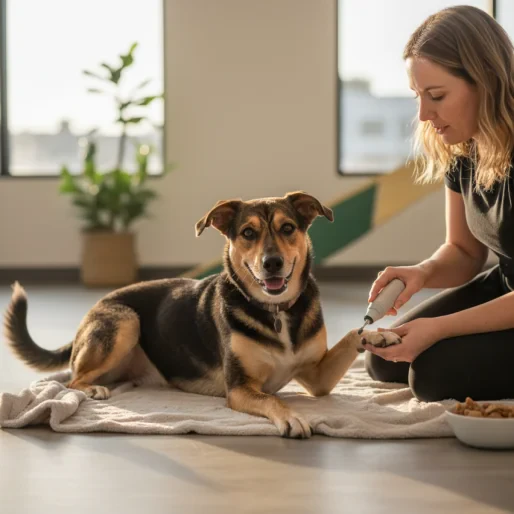
The training environment should be calm, low-distraction, and already associated with positive experiences. A non-slip mat on the floor is recommended so the dog feels physically stable during paw handling. Avoid elevated surfaces during early sessions; working at floor level removes the additional stressor of height and reduces the dog's sense of vulnerability.
Gather high-value food reinforcers before each session begins. The reinforcer must be genuinely motivating for that individual dog: soft treats that can be delivered quickly and consumed in under two seconds are optimal for maintaining training flow. If a dog is not food-motivated in the training environment, this is itself a signal that the dog's stress level is already elevated and the session should not proceed.
Session Length and Frequency
Sessions of two to five minutes, repeated daily or several times per week, consistently outperform infrequent longer sessions in established desensitisation protocols. The dog's emotional state should remain neutral to positive throughout. If stress signals appear (lip licking, yawning, turning away, weight shifting, paw lifting, or sudden stillness), the session should be paused or concluded with a calm, neutral cue, never with frustration or a correction of any kind.
The Cooperative Care Protocol: Step by Step
The protocol below is informed by cooperative care frameworks taught within CPDT-KA accredited curricula and consistent with IAABC positive-reinforcement standards. Each phase should be considered complete only when the dog demonstrates consistently relaxed body language, not simply when the dog tolerates the activity without overt protest.
Phase 1: Foundation Handling Desensitisation
Begin without any grooming tools present. The sole goal of this phase is to build a positive conditioned emotional response to paw handling alone.
- Touch and treat: Gently touch the dog's shoulder, then immediately deliver a high-value treat. Repeat five to ten times per session. Over multiple sessions, gradually move the point of contact toward the lower leg, then the paw, then individual toes, pausing to treat after each touch.
- Duration building: Once the dog relaxes into brief paw contact, begin holding each paw for one to two seconds before treating. Extend duration only when the dog remains visibly relaxed throughout.
- Toe manipulation: Begin gently isolating individual toes and applying light pressure to the nail, mimicking the sensation of clipping. Treat generously after each repetition.
With a fearful rescue dog, the first several sessions may look entirely uneventful to an outside observer: the handler touches the dog's shoulder, the dog eats a treat, and the session ends. This deliberately slow pace is not timidity on the trainer's part; it is precise, evidence-based behaviour modification applied at the correct rate of progression.
Phase 2: Introducing the Clippers as a Neutral Stimulus
This phase applies classical counter-conditioning: the goal is to shift the dog's emotional response to the clippers themselves, transforming them from a predictor of discomfort to a reliable predictor of good things.
- Clipper visibility: Place closed clippers on the floor at a distance from the dog. Mark the dog's calm orientation toward them with a marker word or clicker, and deliver a treat. Repeat across multiple sessions, gradually reducing the distance.
- Clipper handling near the dog: Pick up and hold the clippers near the dog without approaching the paws. Treat continuously while the clippers are visible and active in the handler's hand; put them down and stop treating. The dog begins to form the association: clippers present equals treats present.
- Clipper contact on the body: Over multiple sessions, gently touch the closed clippers to the dog's shoulder, then leg, then paw, treating generously at each stage. Never rush directly to the paw in the opening session of this phase.
Phase 3: Sound Desensitisation
The sound of operating clippers is a significant trigger for many dogs, often independently of physical contact. This phase addresses the auditory component specifically.
- Hold the clippers away from the dog and make a single snip in the air. Immediately deliver a high-value treat. The sequence is always: sound, then treat, consistently and in that order, to establish predictive value.
- Over multiple sessions, bring the clipping sound progressively closer to the dog while maintaining the sound-to-treat pairing throughout.
- When the dog responds to the nearby sound of operating clippers with a visible positive anticipatory response (orienting toward the treat hand, relaxed tail movement, soft posture), the auditory stimulus has been successfully counter-conditioned.
Phase 4: The First Real Trim
This phase should only begin once Phases 1 through 3 are solid and consistent across multiple sessions. Attempting to rush to this stage is one of the most common and most consequential errors in home training protocols.
- Begin with a single nail in the first session. Clip only the very tip, well clear of the quick, deliver a high-value treat immediately, and end the session on a positive note.
- Gradually work toward trimming two, then three, then four nails per session, always monitoring body language and pausing if stress signals emerge.
- Trimming one paw per day across four separate days is entirely acceptable and is strongly preferable to a single stressful full-trim session.
- A reliable chin rest behaviour, where the dog voluntarily rests their chin in the handler's open palm as a stationary position cue, can serve as a cooperative start button. If the dog lifts their chin, the session pauses. This gives the dog genuine behavioural agency and significantly reduces the risk of escalating avoidance across sessions.
Common Mistakes Owners Make
Several recurring errors slow progress or actively set the protocol back. Recognising these patterns early allows owners to course-correct before significant regression occurs.
- Moving too quickly through phases: Skipping ahead because the dog appears to be coping is the most frequent cause of protocol failure. Body language that is neutral or only mildly tense can shift rapidly to overt avoidance when intensity increases too quickly.
- Gripping the paw to prevent withdrawal: Using physical restraint to hold the paw in place introduces exactly the aversive context the protocol is designed to replace. The moment a dog consistently pulls away, the training plan requires revision, not enforcement.
- Using low-value reinforcers: Everyday kibble is rarely sufficient for changing a fear-based conditioned emotional response. Higher-value reinforcers such as small pieces of cooked meat, soft cheese, or premium commercial soft treats are typically necessary during active counter-conditioning work.
- Training when the dog is already stressed: Beginning a session immediately after a stressful event (a veterinary visit, a thunderstorm, or a high-activity household period) is likely to produce poor results. The dog's baseline stress level directly affects their capacity to learn and form new associations.
- Punishing avoidance: Any aversive consequence for pulling away, growling, or refusing (including verbal reprimands, physical correction, or forceful restraint) risks escalating the fear response and significantly eroding the handler-dog relationship. IAABC guidelines and LIMA principles explicitly advise against aversive interventions in fear-based behaviour cases.
Troubleshooting Slow Progress
The Dog Consistently Disengages
If a dog routinely walks away from sessions, the most likely cause is that the training environment, the stimulus intensity, or the rate of progression exceeds their current threshold. The recommended response is to return to the last phase where the dog was fully relaxed, reduce stimulus intensity, and increase the rate of reinforcement delivery. More frequent, shorter sessions typically help consolidate progress during this stage.
The Dog Takes Treats but Remains Tense
Accepting treats does not always indicate a relaxed emotional state. A dog can consume food while remaining in a mild stress response. Professional trainers describe this as working above threshold. Careful observation of the rest of the dog's body language, including ear position, tail carriage, muscle tension around the face and neck, and whether the dog voluntarily moves toward the handler, provides a more complete picture than treat acceptance alone.
Regression After a Setback
An accidental quick cut, a rough handling experience at a grooming salon, or an unplanned forced restraint event can cause rapid regression to earlier stages of the fear response. Following a setback, the protocol should be restarted from a significantly earlier phase, allowing the dog to rebuild positive associations before reintroducing higher-intensity stimuli. Owners commonly report that dogs with a strong prior reinforcement history recover more quickly from setbacks than dogs who were trained primarily through restraint and compliance.
Breed and Individual Variation
Herding breeds, many terrier types, and dogs with known pain sensitivity may require a longer baseline desensitisation period. Senior dogs, particularly those experiencing joint discomfort, may find paw handling uncomfortable for physical rather than purely behavioural reasons. A veterinary assessment to rule out underlying pain should precede cooperative care training in any dog showing unusual sensitivity to leg and paw handling. For context on mobility considerations relevant to older dogs, see Post-Winter Joint Stiffness in Dogs: Low-Impact Warm-Up Routines.
The same desensitisation and counter-conditioning principles apply across species boundaries. For owners working with cats on parallel handling protocols, Early Grooming Habits: A Professional Guide to Desensitising Kittens to Handling provides a species-specific walkthrough of the same foundational methods.
Maintaining Nail Trim Comfort Long-Term
Once a dog reliably accepts nail trims with calm, relaxed body language, maintenance is required to preserve that conditioned emotional response. Periodic sessions in which clippers are presented, the dog receives treats, and no trimming occurs help keep the positive association active over time. Allowing extended gaps between grooming sessions, particularly when the protocol is newly established, risks allowing the positive CER to fade and the fear response to recover.
Regular brief paw handling throughout the week, separate from actual trimming appointments, normalises the experience in daily life. Integrating paw inspections into post-walk routines is a practical way to achieve this, particularly during seasons when paws are exposed to environmental stressors. The broader grooming context matters too: for owners managing coat care alongside nail maintenance, Managing Spring Matting: Shave vs. Detangle Decisions provides complementary guidance on positive handling approaches during multi-step grooming sessions.
When to Bring in a Professional Trainer
Cooperative care training is accessible to most motivated owners, but there are clear indicators that professional support is warranted before continuing independently.
- The dog has snapped, bitten, or made physical contact during any prior grooming attempt. This is a safety concern requiring professional behavioural assessment before training resumes.
- Significant avoidance behaviours (hiding, trembling, sustained vocalisation, or repeated escape attempts) persist even in Phase 1 of the protocol despite consistent, correctly applied sessions over several weeks.
- The dog's fear response generalises beyond nail trims to all forms of physical handling by any person.
- The owner feels uncertain about reading canine body language accurately or delivering reinforcement with correct timing.
A CPDT-KA certified professional trainer or an IAABC member can conduct a formal behavioural assessment and develop an individualised modification plan. In cases involving severe fear or phobia, referral to a veterinary behaviourist is appropriate, as pharmacological support alongside behaviour modification is sometimes clinically indicated and can meaningfully accelerate progress without increasing risk.
Owners who are also assessing their dog's broader handling tolerance and social readiness may find Is Your Dog Ready for Group Play? A Behaviourist's Assessment Guide a useful companion resource for understanding how threshold concepts apply across different handling and social contexts.
Cooperation Over Compliance: The Bigger Picture
The cooperative care model reframes nail trimming not as something done to a dog, but as something done with a dog. When a dog can voluntarily present a paw, remain relaxed throughout the trim, and disengage freely if they choose, grooming becomes a collaborative experience rather than a confrontational one. This shift has measurable benefits for the dog's emotional welfare and for the safety of everyone involved in the dog's care, from owners and groomers to veterinary professionals conducting routine examinations.
The investment of time required to build this foundation pays dividends across the dog's entire lifetime of veterinary and grooming care. Patience, precise timing, and consistent positive reinforcement are the only tools required.
Frequently Asked Questions
Content Disclosure
This article was created using state-of-the-art AI models with human editorial oversight. It is intended for informational and entertainment purposes only and does not constitute veterinary medical advice. Always consult a licensed veterinarian for your pet's specific health needs. Learn more about our process.