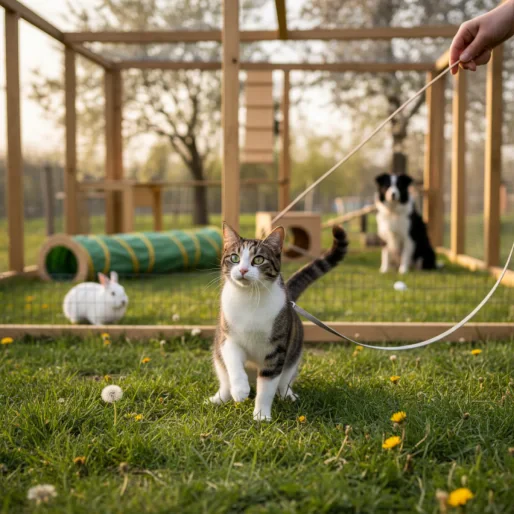
Transitioning a rescue cat from shelter life to outdoor access requires careful, graduated steps. This guide covers territory marking, neighbour cat conflicts, and the safety milestones to reach before unsupervised outdoor time.
Key Takeaways
- Rescue cats need a minimum of three to six weeks of indoor settling before any outdoor introduction begins.
- Graduated exposure, not flooding, is the only humane and effective approach to outdoor access.
- Territory marking (bunting, scratching, middening) is normal and healthy; urine spraying indoors may signal unresolved anxiety.
- Neighbour cat conflicts require proactive management: scent swapping, time sharing, and visual barriers.
- A clear set of behavioural milestones must be met before any unsupervised outdoor time is permitted.
- Consult a certified applied animal behaviourist (CAAB) or veterinary behaviourist if fear, aggression, or self-harm behaviours emerge.
Understanding the Behavioural Baseline: Why Shelter Cats Need a Structured Transition
Rescue cats arriving from indoor shelter environments carry a behavioural history shaped by confinement, unpredictable social contact, and chronic low-level stress. The Fear, Anxiety, and Stress (FAS) scale, widely used by Fear Free certified professionals, helps categorise a cat's emotional state from mild unease (FAS 1: ears slightly rotated, slow blinking reduced) through moderate anxiety (FAS 3: dilated pupils, body tension, hiding) to severe distress (FAS 5: aggression, learned helplessness, or self-directed behaviours such as over-grooming).
A cat that scores consistently at FAS 2 or above indoors has not yet reached the emotional baseline required for outdoor introduction. The transition process described below assumes the cat has already completed the initial indoor settling period: typically three to six weeks during which the cat acclimates to the home's sights, sounds, scents, and human routines.
Professional consensus from bodies such as the International Association of Animal Behavior Consultants (IAABC) and the American College of Veterinary Behaviorists (ACVB) supports the principle that outdoor access must be earned through observable behavioural readiness, not granted on a fixed timeline.
Root Cause Analysis: Why Outdoor Transitions Cause Stress
The outdoor world presents a sensory environment that is categorically different from the controlled shelter setting. Key stressors include:
- Novel olfactory input: Outdoor scents (vegetation, soil, other animals, traffic residues) can overwhelm a cat whose scent world has been limited to bleach-cleaned kennels and recycled indoor air.
- Auditory unpredictability: Birdsong, traffic, wind, children playing, and neighbourhood dogs all represent trigger stacking opportunities where individually tolerable stimuli combine to push the cat past its coping threshold.
- Territorial uncertainty: The cat has no established territory outdoors. From an ethological perspective, a cat without territory is a cat without safety.
- Social pressure from conspecifics: Resident neighbourhood cats may view the newcomer as an intruder, leading to inter-cat aggression, resource guarding of garden spaces, and redirected aggression indoors.
Spring introduces additional variables. Increased daylight triggers hormonal shifts (even in neutered cats, adrenal androgens fluctuate seasonally), neighbourhood cats are more active, prey species are abundant, and gardens are being treated with fertilisers and pesticides that pose ingestion risks. For advice on managing outdoor grooming needs during this period, see Spring Grooming Schedule for Outdoor Cats.
Is Outdoor Access Normal and Appropriate for Every Rescue Cat?
Outdoor access is not universally appropriate. Cats with the following profiles may benefit from permanent indoor living or secure catio access instead:
- Cats with FIV, FeLV, or chronic illness that increases vulnerability.
- Cats with a documented bite history or severe fear-based aggression towards other animals.
- Cats that have been exclusively indoor for several years and show no exploratory motivation.
- Cats in high-traffic urban environments where risk of road traffic injury is substantial.
For cats that are candidates for outdoor access, a catio can serve as a valuable intermediate step. More detail is available in Training Your Cat to Use a Catio This Spring.
Phase 1: Scent Introduction (Days 1 to 7)
The Outdoor Scent Library
Before the cat physically enters the outdoor space, bring the outdoors in. This classical conditioning approach pairs novel scents with existing positive associations (food, play, safe resting spots).
- Place a small patch of garden soil, a handful of grass, and a leaf or two inside a perforated container. Set it near (not inside) the cat's preferred resting area.
- Rotate scent items daily: bark, a stone from the garden path, a cloth rubbed along the fence line.
- Observe the cat's response. Approach, sniffing, and rubbing (bunting) against the container indicate positive valence. Retreat, flattened ears, or hissing indicate the scent is aversive at this proximity; increase the distance.
- Pair scent exploration with a small, high-value food reward to build a positive conditioned emotional response (CER).
Neighbour Cat Scent Preparation
If neighbourhood cats frequent the garden, collect scent samples (a cloth rubbed along fences or gate posts where other cats have cheek-rubbed). Present these indoors using the same graduated protocol. The goal is habituation: reducing the cat's emotional response to conspecific scent before the first outdoor encounter.
Phase 2: Visual and Auditory Exposure (Days 7 to 14)
Open windows (secured with mesh or a window restrictor) to allow the cat to experience outdoor sounds and sights from the safety of the home interior. Key principles:
- Sub-threshold exposure: The cat should be able to observe without showing signs above FAS 1. If the cat freezes, pupils dilate, or the tail tucks, the exposure is too intense. Close the window partially or increase the cat's distance.
- Counter-conditioning: Offer food, gentle play, or slow-blink interactions during window time. The goal is to associate outdoor sensory input with positive emotional states.
- Session length: Start with five to ten minutes. Extend only as the cat's body language remains relaxed (soft eyes, neutral ear position, willingness to eat).
Phase 3: Supervised Door Threshold Visits (Days 14 to 21)
Open the door to the garden (or the catio entrance) and allow the cat to approach at its own pace. Critical rules:
- Never carry, push, or lure the cat across the threshold. Autonomy is fundamental to a fear-free approach.
- Sit quietly near the open door. Read a book. Let the cat investigate on its own timeline.
- Many rescue cats will spend the first three to five sessions simply sitting at the threshold, sniffing, and retreating. This is not failure; it is healthy information gathering.
- When the cat places one or more paws outside, offer quiet verbal praise and a treat tossed to a spot just inside the door (reinforcing the return, not the departure).
Phase 4: Supervised Garden Exploration (Days 21 to 35 and Beyond)
Session Structure
Once the cat voluntarily crosses the threshold, supervised outdoor sessions can begin. Recommended structure:
- Time of day: early morning or late afternoon in spring, when neighbourhood cat activity tends to dip and ambient noise is lower.
- Duration: ten to fifteen minutes initially, extending by five-minute increments per session as the cat remains relaxed.
- Owner position: remain in the garden, seated, at a consistent location. Become a predictable safety anchor.
- Exit strategy: leave the door open at all times so the cat can self-select retreat. Never close the door behind the cat.
Territory Marking Behaviour: What to Expect
As the cat gains confidence, marking behaviours will emerge. These are normal, adaptive, and essential to territorial establishment:
- Bunting (facial rubbing): The cat deposits pheromones from perioral glands onto fence posts, plant pots, and garden furniture. This creates a "scent map" of safe zones. Encourage this by placing stable vertical objects at the garden perimeter.
- Scratching: Visual and scent marking via interdigital glands. Provide an outdoor scratching post (untreated wood or sisal) to channel this behaviour away from fences shared with neighbours.
- Middening: Leaving uncovered faeces in strategic locations as a territorial signal. While normal, this can create neighbour disputes. Providing a dedicated outdoor litter area with soft, diggable substrate (sand or fine soil) can redirect middening to a managed zone.
- Urine spraying outdoors: Typically normal territorial communication. If spraying begins indoors, it often signals social stress, inadequate territory confidence, or inter-cat conflict and warrants professional behavioural assessment.
Managing Neighbour Cat Conflicts
Inter-cat tension is the single most common complication in outdoor transitions. Cats are not obligate social animals in the way dogs are; they form flexible social structures, but territory defence is deeply hardwired.
Prevention Strategies
- Time sharing: Observe when neighbouring cats use the garden. Schedule supervised sessions during their absence. Over time, natural time-sharing arrangements often develop without direct confrontation.
- Visual barriers: Dense planting, reed screening, or strategically placed garden furniture can break sightlines, reducing the intensity of visual triggers.
- Scent co-mingling: Rub a cloth on the newcomer cat and place it along boundary points. Do the same with scent from the outdoor environment. This creates a blended scent profile that reduces the "intruder alarm" response in resident cats.
- Avoid resource competition: Never leave food outdoors. Ensure multiple water sources are available in separated locations.
When Conflict Occurs
If the rescue cat encounters a neighbour cat and a confrontation develops:
- Do not intervene physically between two cats displaying aggression. Clap hands loudly or toss a soft object nearby (not at the cats) to interrupt.
- Allow the rescue cat to retreat indoors. Do not force re-exposure on the same day.
- Assess FAS levels over the following 24 to 48 hours. A cat that remains at FAS 3 or higher (hiding, refusing food, over-grooming) after a conflict may need the outdoor timeline paused and restarted from an earlier phase.
- Repeated aggressive encounters, especially those resulting in physical injury, warrant consultation with a CAAB or IAABC-certified consultant. Redirected aggression towards household members is a serious safety concern and must be addressed by a professional.
Safety Milestones Before Unsupervised Outdoor Access
Unsupervised time is the final stage and should only be granted when the following milestones are consistently demonstrated across multiple sessions (a minimum of five consecutive sessions is a reasonable benchmark):
- Reliable recall or return cue: The cat returns to the door when called, when a specific sound cue is used (e.g., a particular whistle or the sound of a treat container), or at a routine time. Classical conditioning of a recall cue should begin indoors weeks before outdoor access starts.
- Calm threshold crossing: The cat exits and enters without bolting, flattening, or freezing. Body language shows neutral ear carriage, upright tail (social greeting signal), and willingness to pause at the door.
- Consistent territory patrol pattern: The cat follows a recognisable route through the garden, checks marking sites, and returns. Predictable patrol behaviour indicates established territory confidence.
- Appropriate response to startle: When startled by a noise or sudden movement, the cat orients, assesses, and either resumes activity or calmly returns indoors. A cat that panics, scales fences, or bolts into unknown territory is not ready for unsupervised time.
- Neutral or avoidant (not aggressive) response to neighbour cats: The cat either ignores or calmly moves away from conspecifics. Stiff postures, vocalisation, or pursuit indicate unresolved inter-cat tension.
- No indoor behaviour regression: Indoor litter box use, eating patterns, sleep quality, and social behaviour with household members remain stable. Regression in any area suggests the outdoor exposure is exceeding the cat's coping capacity.
Management Strategies While Training
During the transition period, several practical management tools support the behavioural programme:
- Microchip and collar with ID: Ensure the cat's microchip registration is current and a breakaway collar with contact details is fitted before any outdoor exposure.
- Parasite prevention: Spring brings increased flea, tick, and worm exposure. Veterinary-recommended parasite prevention should be current before outdoor access begins.
- Secure garden audit: Check for toxic plants (lilies, azaleas, daffodils are common spring hazards), open drains, gaps in fencing, and chemical storage. A garden that is safe for a dog agility course (see DIY Garden Agility Course for Dogs This Spring) still needs a cat-specific safety review.
- GPS tracker consideration: A lightweight GPS collar attachment can provide peace of mind during early unsupervised sessions, allowing owners to monitor roaming range and identify potential risk areas.
- Veterinary health check: A pre-outdoor veterinary examination ensures vaccinations are current and identifies any health issues that could complicate outdoor access. For guidance on managing veterinary costs, see Vet Visit Costs: Budget Alternatives Pet Owners Need.
When to Consult a Certified Animal Behaviourist
The following situations exceed the scope of owner-managed behaviour modification and require professional assessment:
- The cat shows persistent FAS 3 or higher responses to outdoor stimuli after four or more weeks of graduated exposure.
- Aggression (towards other cats, dogs, wildlife, or humans) escalates in frequency or intensity.
- Self-directed behaviours such as psychogenic alopecia (over-grooming to the point of hair loss or skin damage) emerge or worsen.
- The cat displays non-recognition aggression towards household cats after returning from outdoor sessions (a phenomenon where outdoor scents trigger aggressive responses from indoor companions).
- Urine spraying or inappropriate elimination begins or increases indoors.
- The cat bolts or panics repeatedly despite consistent sub-threshold training.
Qualified professionals include those certified by the Animal Behavior Society (CAAB or ACAAB), diplomates of the American College of Veterinary Behaviorists (DACVB), and certified consultants through the IAABC. Fear Free certification, while not a behaviour specialisation, indicates a practitioner committed to low-stress handling principles.
If relocation stress is part of the cat's history, additional resources on managing animal transport anxiety are available in Air Pet Relocation in Heat: Embargoes and Alternatives. Additionally, owners who plan to maintain comprehensive cover during the transition period may find relevant information in Pet Insurance Waiting Periods: Your Questions Answered.
Putting It All Together: A Spring Timeline
The following is a general framework, not a rigid schedule. Each cat progresses at its own pace, and regression is a normal part of the process:
- Weeks 1 to 6 post-adoption: Indoor settling only. No outdoor exposure. Focus on building trust, establishing routines, and achieving a stable FAS 0 to 1 baseline.
- Week 7: Scent introduction (Phase 1).
- Week 8: Visual and auditory exposure (Phase 2).
- Weeks 9 to 10: Door threshold visits (Phase 3).
- Weeks 10 to 14: Supervised garden exploration (Phase 4).
- Week 14 onward: Milestone assessment. If all six milestones are met across five consecutive sessions, begin short unsupervised periods (fifteen to thirty minutes), gradually increasing duration.
Some cats will complete this process faster; many will take longer. A cat that spent years in a shelter environment may need six months or more before unsupervised access is appropriate. Patience is not a luxury in behaviour modification; it is the methodology.
Frequently Asked Questions
How long should a rescue cat stay indoors before outdoor access? ↓
What are the signs a rescue cat is ready for unsupervised outdoor time? ↓
How should owners handle conflicts between a rescue cat and neighbourhood cats? ↓
Is outdoor access appropriate for every rescue cat? ↓

David Okafor
Certified Animal Behaviourist
Certified animal behaviourist — science-based strategies for fear, anxiety, reactivity, and behavioural challenges.
Content Disclosure
This article was created using state-of-the-art AI models with human editorial oversight. It is intended for informational and entertainment purposes only and does not constitute veterinary medical advice. Always consult a licensed veterinarian for your pet's specific health needs. Learn more about our process.