
In this article
- Key Takeaways
- Why Hydrotherapy Is a Standard Recommendation in the U.S.
- How Underwater Treadmill Sessions Work
- U.S. Cost Breakdown by Region and Facility Type
- Pet Insurance Coverage in the U.S.
- Financial Assistance and Financing Options
- Seasonal and Climate Considerations Across the U.S.
- Session Frequency Guidelines
- What the Evidence Shows
- Questions to Ask a U.S. Rehabilitation Facility
- When Hydrotherapy May Not Be Appropriate
- Budgeting Summary for U.S. Dog Owners
Key Takeaways
- A single underwater treadmill session in the U.S. typically costs $50 to $120, with significant variation between metro and rural markets.
- Most rehabilitation protocols call for one to three sessions per week over six to twelve weeks, bringing total program costs to roughly $700 to $3,000 before insurance reimbursement.
- The American College of Veterinary Sports Medicine and Rehabilitation (ACVSMR) recognizes hydrotherapy as a standard component of multimodal hip dysplasia management.
- U.S. pet insurance providers such as Nationwide, Trupanion, and Healthy Paws increasingly cover rehabilitation therapies, though waiting periods and pre-existing condition exclusions apply.
- Third-party financing through CareCredit, Scratchpay, or clinic payment plans can help spread costs over several months.
Why Hydrotherapy Is a Standard Recommendation in the U.S.
Hip dysplasia remains one of the most frequently diagnosed orthopedic conditions in American veterinary practices, particularly among popular breeds like Labrador Retrievers, German Shepherds, Golden Retrievers, Rottweilers, and Bulldogs. The Orthopedic Foundation for Animals (OFA), based in Columbia, Missouri, maintains a public registry of hip evaluation results and reports that some breeds show dysplasia prevalence rates above 20%.
Veterinary rehabilitation has grown substantially in the U.S. over the past two decades. The American Association of Rehabilitation Veterinarians (AARV) and the ACVSMR have helped standardize training and practice guidelines, making underwater treadmill therapy widely accessible in most metropolitan areas and many mid-size cities. For dogs that are not surgical candidates, or as a complement to procedures like total hip replacement (THR) or femoral head ostectomy (FHO), structured hydrotherapy offers a proven approach to improving joint function and comfort.
How Underwater Treadmill Sessions Work
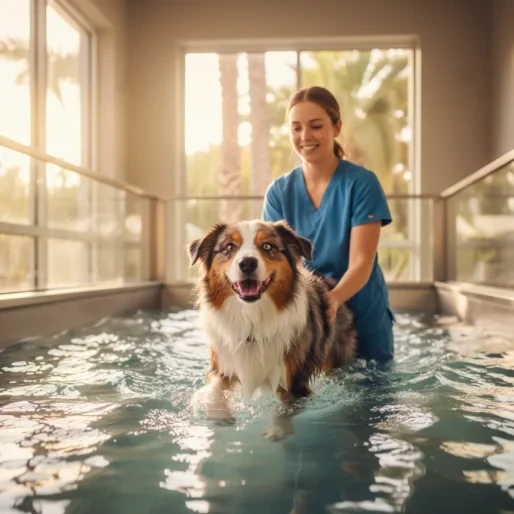
An underwater treadmill unit consists of an enclosed chamber with a motorized belt at the base. The chamber fills with temperature-controlled water, typically warmed to approximately 80 to 86°F, to a level selected by the therapist. Key variables adjusted during treatment include:
- Water depth: Higher water levels provide greater buoyancy and reduce joint loading by roughly 40% to 60% of the dog's body weight. Lower levels increase weight-bearing demand as the dog progresses.
- Treadmill speed: Usually set between 0.3 and 2.0 miles per hour, calibrated to the dog's comfort and gait quality.
- Session duration: Initial sessions may involve only 5 to 10 minutes of active walking. Over several weeks, active time typically builds to 20 to 30 minutes.
- Resistance jets: Some units include adjustable water jets that add resistance to further engage core and limb muscles.
Sessions are supervised by a credentialed professional, most commonly a Certified Canine Rehabilitation Practitioner (CCRP, credentialed through the University of Tennessee) or a Certified Canine Rehabilitation Therapist (CCRT, credentialed through the Canine Rehabilitation Institute). Board-certified veterinary sports medicine and rehabilitation diplomates (DACVSMR) offer the highest level of oversight and charge accordingly.
Underwater Treadmill vs. Swimming Pool Therapy
Some U.S. facilities offer pool-based therapy as an alternative. Underwater treadmills generally provide better gait retraining because they encourage a normal walking or trotting pattern, which is particularly valuable for hip extension. Swimming involves a paddling motion that targets different muscle groups and may not address dysplasia-specific movement deficits as effectively. Treadmill sessions tend to cost more due to higher equipment costs (units typically run $30,000 to $80,000 or more), but the clinical consensus in the U.S. rehabilitation community favors treadmill therapy for hip dysplasia cases.
U.S. Cost Breakdown by Region and Facility Type
Geographic Pricing Variation
Veterinary costs in the United States vary considerably by region. Sessions in major metros like New York City, San Francisco, Los Angeles, Boston, and Seattle tend to fall at the higher end of the range ($80 to $120 per session), while clinics in the Midwest, Southeast, and rural areas often charge $50 to $75. States with higher costs of living, such as California, Massachusetts, and New York, generally reflect those economics in veterinary pricing.
Facility Type and Credentials
Pricing also depends on the level of professional oversight:
- DACVSMR diplomates (board-certified specialists): $100 to $150 per session, typically at specialty referral hospitals or university veterinary teaching hospitals.
- CCRP or CCRT therapists within a veterinary practice: $60 to $100 per session, the most common setting in the U.S.
- Independent hydrotherapy or canine fitness centers: $40 to $75 per session, often staffed by trained technicians without full veterinary credentials. Veterinary oversight may be indirect.
Size and Breed Considerations
Dogs over 80 lbs may incur surcharges of $10 to $25 per session at some facilities due to increased water volume, longer setup time, and additional staffing needs. Since breeds most predisposed to hip dysplasia (Labs, Goldens, German Shepherds, Rottweilers, Great Danes, Saint Bernards) typically weigh 60 to 150 lbs or more, most owners should plan for mid-range to upper-range pricing.
Average Cost Table
| Item | Typical U.S. Cost Range |
|---|---|
| Initial rehabilitation assessment | $125 to $300 |
| Single underwater treadmill session (20 to 30 min) | $50 to $120 |
| Package of 6 to 10 sessions | $350 to $950 |
| Maintenance phase (1 to 2 sessions per month) | $50 to $240 per month |
| Total initial program (6 to 12 weeks, 1 to 3x per week) | $700 to $3,000+ |
Many U.S. clinics offer package discounts of 10% to 20% when sessions are purchased in blocks. Always ask about bundled pricing during the initial consultation.
Pet Insurance Coverage in the U.S.
The U.S. pet insurance market has expanded significantly, and rehabilitation therapy is increasingly included as a covered benefit. However, coverage details vary widely:
- Comprehensive accident and illness plans from providers such as Nationwide, Trupanion, Healthy Paws, Embrace, and Petplan often include rehabilitation therapy, sometimes with annual sub-limits of $1,000 to $2,500 for complementary or rehabilitative care.
- Pre-existing condition exclusions: If hip dysplasia was diagnosed before the policy effective date or during the waiting period, hydrotherapy costs will almost certainly be excluded. This is standard across virtually all U.S. pet insurance providers.
- Orthopedic waiting periods: Some insurers impose waiting periods of 6 to 12 months specifically for orthopedic or hereditary conditions. Owners of predisposed breeds should enroll puppies early, ideally before any clinical signs appear.
- Veterinary referral requirements: Most insurers require that hydrotherapy be prescribed by a licensed veterinarian (DVM) and performed at a recognized facility to qualify for reimbursement.
- Deductibles and co-pays: Annual deductibles of $100 to $500 and reimbursement rates of 70% to 90% are standard. Owners should review their specific plan documents carefully.
For a deeper look at policy timing and restrictions, see Pet Insurance Waiting Periods in the U.S. Explained.
Financial Assistance and Financing Options
For owners without insurance or facing coverage exclusions, several U.S.-specific options can help manage costs:
- CareCredit and Scratchpay: These third-party healthcare financing providers are accepted at many U.S. veterinary practices and offer promotional interest-free periods (often 6 to 12 months) for qualifying applicants.
- In-house payment plans: Some rehabilitation clinics offer their own installment plans, allowing owners to spread costs over several months.
- Veterinary teaching hospitals: University-affiliated veterinary hospitals (such as those at UC Davis, Colorado State, Cornell, Ohio State, and the University of Pennsylvania) often provide rehabilitation services at reduced rates while training veterinary residents and students.
- Charitable organizations: The Pet Fund, RedRover Relief, and breed-specific rescue foundations (such as those associated with the Golden Retriever Club of America or the German Shepherd Dog Club of America) sometimes help cover rehabilitation costs for qualifying owners.
ASPCA Animal Poison Control Center
Call the ASPCA Poison Control hotline or contact your nearest emergency veterinary clinic immediately.
A consultation fee may apply. For non-poison emergencies, search "emergency vet near me" or call your local animal ER.
Seasonal and Climate Considerations Across the U.S.
The U.S. climate varies dramatically by region, and this affects how hydrotherapy fits into a broader management plan:
- Northern states and harsh winters: Cold weather can worsen hip dysplasia symptoms. Dogs in states like Minnesota, Wisconsin, Michigan, and the Northeast may benefit from increased hydrotherapy frequency during winter months when outdoor exercise is limited by ice, snow, and freezing temperatures.
- Southern and humid climates: In states like Texas, Florida, Georgia, and Louisiana, summer heat (often exceeding 95°F) limits safe outdoor exercise. Hydrotherapy in a climate-controlled facility provides a valuable exercise alternative during peak heat months.
- Western states and wildfire seasons: In California, Oregon, Colorado, and other fire-prone areas, poor air quality during wildfire season can restrict outdoor activity. Indoor hydrotherapy sessions maintain conditioning when outdoor walks are unsafe.
For dogs whose outdoor exercise is seasonally restricted, maintaining a consistent hydrotherapy schedule helps prevent the deconditioning that accelerates joint deterioration. Complementary home exercises, prescribed by a rehabilitation therapist, can bridge gaps between sessions. For broader fitness ideas, see the Spring Fitness Restart Plan for Overweight Dogs.
Session Frequency Guidelines
While no single protocol applies to every case, U.S. rehabilitation professionals generally follow a phased approach aligned with AARV guidelines:
Acute or Post-Surgical Phase (Weeks 1 to 4)
Two to three sessions per week with short active intervals of 5 to 15 minutes. The focus is on pain reduction, gentle reintroduction of weight bearing, and early muscle activation.
Strengthening Phase (Weeks 5 to 12)
One to two sessions per week with 15 to 25 minutes of active treadmill walking. Speed may increase and water depth may decrease to progressively challenge the muscles. Reassessments of gait scores and range of motion typically occur every two to four weeks.
Maintenance Phase (Ongoing)
One to two sessions per month for dogs with chronic hip dysplasia. Many owners find that consistent maintenance hydrotherapy, combined with weight management and joint supplements, reduces or delays the need for escalating pain medication. Nutritional strategies can further support joint health; see Raw vs Cooked vs Freeze-Dried Dog Food: US Guide for dietary considerations.
What the Evidence Shows
Veterinary rehabilitation is a growing specialty, and the evidence base consists primarily of clinical studies and case series published in journals such as the American Journal of Veterinary Research and Veterinary Surgery. Available research consistently supports the following outcomes:
- Statistically significant improvements in hip joint range of motion, measured by goniometry.
- Reduced lameness scores on both subjective gait assessments and objective pressure-sensitive walkway analysis.
- Measurable increases in thigh circumference (often 1 to 3 cm), indicating improved muscular support of the dysplastic joint.
- Improvements on validated owner questionnaires, including the Canine Brief Pain Inventory (CBPI), in areas like mobility, willingness to play, and overall comfort.
- Some reports suggest dogs completing full hydrotherapy courses may require lower doses of NSAIDs, though medication changes should always be managed by a veterinarian.
Questions to Ask a U.S. Rehabilitation Facility
Before committing to a program, American pet owners should clarify:
- What credentials does the therapist hold (CCRP, CCRT, DACVSMR)?
- Is a licensed veterinarian (DVM) on site or available by consultation?
- What does the initial assessment include, and is it billed separately from the first session?
- Are package discounts available, and what is the cancellation or no-show policy?
- Will the facility provide itemized invoices and medical records in a format accepted by pet insurance companies?
- How will progress be measured, and how often will formal reassessments take place?
When Hydrotherapy May Not Be Appropriate
Hydrotherapy is not suitable for every dog. Contraindications may include open wounds or active skin infections, uncontrolled heart or respiratory disease, severe water-related anxiety, certain infectious conditions, and orthopedic instability requiring surgical correction before rehabilitation can safely begin. A thorough veterinary assessment should always precede the first session. For understanding how technology can help track symptoms between visits, see How AI Pet Health Apps Analyse Your Pet's Symptoms.
Budgeting Summary for U.S. Dog Owners
The cost that often surprises owners is not a single session (which is comparable to a standard veterinary office visit) but the cumulative total over weeks and months. Budgeting $1,000 to $2,000 for an initial six to twelve week course is a realistic starting estimate for most U.S. markets, with ongoing maintenance adding $50 to $240 per month. Owners are encouraged to explore insurance options early, ask about package pricing, consider teaching hospital alternatives, and maintain open communication with their rehabilitation team about goals, timelines, and financial constraints.
Frequently Asked Questions
Content Disclosure
This article was created using state-of-the-art AI models with human editorial oversight. It is intended for informational and entertainment purposes only and does not constitute veterinary medical advice. Always consult a licensed veterinarian for your pet's specific health needs. Learn more about our process.