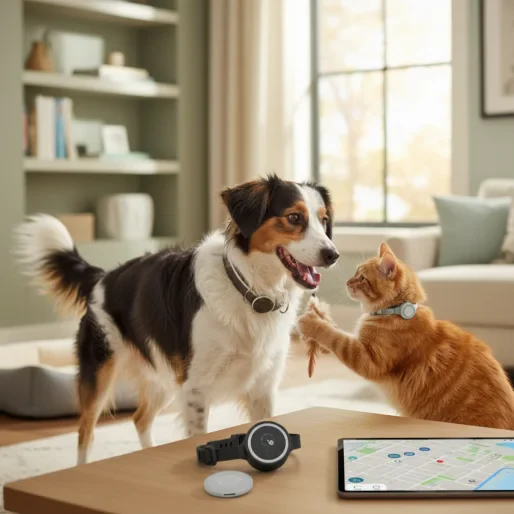
With over 10 million pets lost annually in the United States, choosing between a cellular GPS collar and a Bluetooth tag is a critical safety decision. We break down the coverage maps, subscription models, and terrain challenges from the Rockies to the suburbs to help American pet owners choose right.
Key Takeaways for US Owners
- Infrastructure Matters: GPS collars rely on US cellular networks (typically AT&T or Verizon); if your phone has no service in the Adirondacks or Rockies, neither will the collar.
- The Apple Advantage: Due to the massive market share of iPhones in the US, AirTags are significantly more effective here than in Android-dominant regions.
- Disaster Prep: For families in hurricane or wildfire zones, a battery-efficient tracker is a mandatory part of your pet's 'Go Bag'.
- Microchips are Federal Standard: While trackers are useful, a registered microchip remains the only permanent proof of ownership recognized by US shelters and animal control.
According to the American Society for the Prevention of Cruelty to Animals (ASPCA), approximately 10 million dogs and cats are lost or stolen in the United States every single year. It is a staggering statistic that keeps veterinarians and shelter workers up at night. In the sprawling suburbs of Atlanta or the dense urban canyons of New York City, a loose dog faces immediate dangers: high-speed traffic, wildlife like coyotes, and unfortunately, theft.
A decade ago, the American standard for lost pet recovery was a stapled flyer on a telephone pole and a frantic call to the local pound. Today, we have the "digital leash." The US market is flooded with technology, from the ubiquitous $29 Apple AirTag to sophisticated smart collars like Fi, Whistle, and Tractive that utilize LTE cellular networks. But American geography is vast and varied, and a device that works perfectly in downtown San Francisco might be a paperweight in rural Montana.
As a veterinary professional looking at the US landscape, the question isn't just "which is better?", it's "which works where you live?" Let’s dismantle the marketing hype and look at the infrastructure behind the tracking.
The Tech Divide: Cellular vs. Bluetooth in America
To make an informed decision, you must understand the backbone of these technologies. In the US, this is largely a story of cellular coverage versus smartphone density.
1. GPS & Cellular Trackers (The "Always-On" Solution)
Dedicated GPS collars are essentially smartphones for your dog. They combine a GPS receiver (to talk to satellites) with a cellular radio (to talk to you). In the US, the major players, Fi, Whistle, and Tractive, typically piggyback on the AT&T or LTE-M networks.
- The Coverage Reality: These devices work anywhere your cell phone works. If you live in a "dead zone" in Appalachia or the rural Midwest, these collars cannot transmit the dog's location to your phone, even if the GPS satellite lock is perfect.
- The Subscription Model: Unlike European markets where pay-as-you-go is common, US trackers almost universally require a monthly or annual subscription plan, ranging from $8 to $20 per month.
- Real-Time Pursuit: In 'Lost Dog Mode', these devices update every few seconds, allowing you to actively track a running dog across neighborhoods or state lines.
2. Bluetooth Tags (The "Mesh Network" Solution)
Bluetooth trackers like Apple AirTags, Tile, and Samsung SmartTags are passive. They do not have GPS chips. They broadcast a secure Bluetooth signal roughly 30 to 100 feet.
Why this matters in the US: The United States has one of the highest concentrations of iPhone users in the world (over 50% market share). This creates a massive, dense "Find My" network. If your dog runs through a suburb in Chicago, they will likely pass within 30 feet of an iPhone in a house, a car, or a pocket every few minutes. The tag borrows that stranger's data connection to anonymously ping you.
- Urban Dominance: In US cities, AirTags are incredibly precise due to population density.
- Rural Failure: In a cornfield in Iowa or a trail in Wyoming, where no other smartphones are present, an AirTag is effectively silent.
Detailed Comparison: The US Market
| Feature | GPS Smart Collar (Fi/Whistle) | Bluetooth Tag (AirTag) |
|---|---|---|
| Network Dependency | AT&T / Verizon / LTE-M | The "Find My" Network (requires nearby Apple devices) |
| Range | Nationwide (where cell service exists) | ~30-100 ft from a phone |
| Battery Life | 1 week to 3 months (rechargeable) | 1 year (replaceable CR2032) |
| US Cost Structure | $100-$150 hardware + $99/year sub | $29 flat fee |
| Durability | Rated for swimming/rough play | Water-resistant (needs rugged case) |
| Activity Monitoring | Advanced (Step counting, sleep tracking) | None |
The Case for GPS Collars in the US
For many American dog owners, especially those with yards or access to open space, GPS is the professional standard. The peace of mind comes from autonomy, the device doesn't need help from strangers to work.
Geofencing for the Suburban Yard
The average American suburban yard is fenced, but gate latches fail and service workers leave doors ajar. GPS collars allow you to draw a digital perimeter around your property (Geofence). If your Husky digs under the fence in Phoenix, you get an alert on your phone before they reach the end of the block. This early warning system is critical for preventing road accidents.
The "Escape Artist" Protocol
US shelters are full of "runners", breeds like Coonhounds, Huskies, and Beagles that follow their noses. For these dogs, a 10-minute head start can mean they are three miles away. A GPS collar allows you to see their trajectory. Are they heading toward the Interstate? Are they entering a neighbor's pasture? This directional data allows you to intercept them rather than aimlessly searching.
Regional Specifics: The Hiking & Hunting Factor
If you hike in National Parks or on Bureau of Land Management (BLM) land, standard cellular GPS collars have a limitation: Dead Zones. However, they are still superior to Bluetooth. Most modern US smart collars utilize "store and forward" technology, uploading the path once a sliver of signal is found.
Note for Hunters: If you are running dogs in deep backcountry (like the remote Appalachians or Rockies) where absolutely no cell service exists, consumer GPS collars (Fi/Whistle) will not work. You require radio-telemetry collars (like Garmin Astro/Alpha), which use handheld radio frequencies rather than cell towers. This is a specialized, albeit expensive, tier of equipment.
The Case for Bluetooth Tags (AirTags)
While less powerful, the AirTag is a masterpiece of efficiency for the modern American pet owner living in high-density areas.
The "Urban Armor"
In cities like Boston, Austin, or Seattle, the density of iPhone users is astronomical. An AirTag on a lost dog in these environments effectively updates in near real-time because the signal is constantly bouncing off passing pedestrians, drivers, and residents. It is crowd-sourced surveillance at its finest.
The Battery Benefit
Americans are busy. We forget to charge our own phones, let alone our dog's collar. The #1 reason GPS collars fail is a dead battery. An AirTag battery lasts a full year. It is "set and forget." For a low-risk dog, like a senior Golden Retriever who rarely leaves the porch, this reliability often outweighs the features of a dead GPS collar.
Theft Recovery
Dog theft is a rising crime in the US, particularly for high-value breeds like French Bulldogs. A GPS collar is obvious and bulky; a thief will remove it immediately. An AirTag can be hidden inside a collar lining or a specialized holder, potentially offering a way to track a stolen pet to a location before the thief realizes it is there.
Critical US Safety Considerations
1. The Ingestion Hazard
US emergency vets see this too often: a dog chews a dangling AirTag and swallows it. The lithium coin battery inside can cause fatal esophageal burns within hours. Never let an AirTag dangle. Use a slide-on mount that sits flush against the collar webbing. If you suspect ingestion, this is an immediate medical emergency. [LOCAL_VET_EMERGENCY_en-us]
2. Wildlife Risks
In the Southwest and West, a lost dog faces environmental threats: rattle snakes, scorpions, and extreme heat. Speed is of the essence. A GPS collar that leads you directly to a dog stuck in a ravine is a lifesaver. Waiting for a Bluetooth ping in the desert is a gamble you cannot afford to take.
3. Subscription Fatigue
Be honest with your budget. The "subscription economy" is real. If you buy a $150 collar but cancel the $99/year plan to save money, the hardware is useless. If you are budget-conscious, a $29 AirTag is infinitely better than a deactivated GPS collar.
Decision Guide: The American Lifestyle Test
Scenario A: The National Park Adventurer
You spend weekends hiking in Zion or the Smokies.
Verdict: GPS (with caveats). You need GPS for the trailhead and areas with signal. For deep backcountry, keep a long-line leash on. Bluetooth is useless here.
Scenario B: The Apartment Urbanite
You live in a condo in Miami or downtown Denver.
Verdict: Bluetooth (AirTag). Your risk is slipping a collar on a walk. The dense network of phones will find your dog instantly. The bulky GPS collar is overkill.
Scenario C: The Suburban Family
You have a fenced yard in a subdivision.
Verdict: GPS + Geofence. The ability to get an alert the moment your dog leaves the yard (perhaps through a gate left open by a landscaper) is invaluable prevention.
Final Thoughts: The "Belt and Suspenders" Approach
As a professional in the US pet care industry, my recommendation for most owners is redundancy. I use both. My dogs wear a waterproof GPS collar for our hikes, but they also have an AirTag secured in a hidden holder on the collar strap.
Why? Because technology fails. Cell towers go down during storms. GPS batteries die. But if my dog is found by a teenager two towns over, that kid definitely has an iPhone that will ping the AirTag. Conversely, if my dog is lost in the woods behind my house, the GPS will guide me to him when no one else is around.
Remember, technology is a backup, not a replacement for responsible ownership. Secure fences, solid recall training, and a registered microchip are your primary defenses. But when the unthinkable happens, having the right tracker can be the difference between a "lost dog" poster and a reunion.
Frequently Asked Questions
Do AirTags work for dogs in rural America? ↓
Which GPS collar has the best coverage in the US? ↓
Are GPS trackers worth the monthly subscription? ↓
Can I use a hunting radio collar instead of a subscription GPS? ↓
Do I still need a microchip if I have a GPS tracker? ↓

Priya Nair
Dog Breed Advisor & Adoption Counsellor
Dog breed advisor and adoption counsellor — honest breed comparisons and lifestyle matching for prospective owners.
Content Disclosure
This article was created using state-of-the-art AI models with human editorial oversight. It is intended for informational and entertainment purposes only and does not constitute veterinary medical advice. Always consult a licensed veterinarian for your pet's specific health needs. Learn more about our process.