
In this article
- Key Takeaways
- Why Spring Water Safety Is a U.S. Priority
- Regional Spring Risks Across the U.S.
- Harmful Algal Blooms: A Growing U.S. Threat
- Water Temperature Thresholds for U.S. Dogs
- Assessing Currents, Lakes, and Coastal Conditions
- Canine Life Jacket Fitting
- Post-Swim Ear Drying Protocol
- Vaccinations and Waterborne Disease
- Leash Laws, Access Rules, and Local Regulations
- Essential Gear Checklist for U.S. Spring Swims
- When to Seek Emergency Veterinary Care
Key Takeaways
- Assess every site, every visit: Check current speed, water clarity, and shoreline stability before allowing your dog near any U.S. waterway, even familiar ones.
- Harmful algal blooms (HABs) can kill dogs within hours: The EPA and state health departments issue real-time advisories; checking them should be part of your pre-swim routine.
- Water temperature thresholds depend on breed and size: Dogs under roughly 22 lbs face hypothermia risk below about 59 °F, while large double-coated breeds tolerate slightly cooler water.
- A properly fitted canine life jacket is essential in any open water with currents, drop-offs, or low visibility.
- Post-swim ear drying is a simple habit that significantly reduces ear infections, especially in floppy-eared breeds popular in the U.S.
Why Spring Water Safety Is a U.S. Priority
The United States offers an extraordinary range of open water environments, from Great Lakes shorelines and Pacific Northwest rivers to Appalachian mountain streams and Southern reservoirs. Spring (roughly March through June, depending on region) is the season when snowmelt, heavy rainfall, and warming temperatures converge to create deceptively dangerous conditions. In northern states, spring runoff can triple river volume in a matter of days. In the South and Southwest, warming shallows fuel early algal blooms that may go undetected until a dog becomes critically ill.
The cost of an emergency veterinary visit for water-related incidents in the U.S. typically ranges from $1,500 to $5,000 or more, depending on the severity and region. Cyanotoxin poisoning or near-drowning events requiring overnight ICU care can exceed $10,000. Prevention, by contrast, costs almost nothing and takes only a few minutes per outing.
Regional Spring Risks Across the U.S.
Northern and Mountain States
States such as Colorado, Montana, Oregon, Minnesota, and Michigan see significant snowmelt from March through May. Rivers that appear calm in summer can run fast, cold, and silty during spring. Water temperatures in mountain streams often remain below 50 °F well into June, creating serious hypothermia risk for any dog, and especially for smaller or lean-bodied breeds. The Great Lakes also maintain cold surface temperatures through late spring, with dangerous thermoclines lurking just below the surface.
Southern and Gulf States
In states like Texas, Florida, Louisiana, and Georgia, spring water temperatures warm quickly, making conditions more comfortable for swimming but accelerating the growth of harmful algal blooms. Nutrient runoff from agriculture is a major contributor to eutrophic conditions in reservoirs, bayous, and slow-moving rivers throughout this region. Alligators are also an open water hazard in the Southeast, and dogs should never swim in waters where alligators may be present.
Pacific Coast and Desert Southwest
Pacific Northwest rivers fed by snowpack run dangerously fast through spring. In California and Arizona, desert reservoirs and stock ponds can develop HABs year-round due to high nutrient loads and intense sunlight. Owners should be especially cautious at smaller, unmonitored bodies of water in these regions.
Harmful Algal Blooms: A Growing U.S. Threat
Understanding the Risk
Blue-green algae (cyanobacteria) produce toxins that are among the most rapidly lethal natural poisons a dog can encounter. The EPA tracks harmful algal blooms across the country, and the frequency of blooms has increased significantly in recent decades due to agricultural runoff, warming temperatures, and nutrient loading. Every U.S. state with freshwater bodies has documented cases of canine illness or death linked to cyanotoxin exposure.
How to Identify a Potential Bloom
- Surface appearance: Blooms often resemble spilled green paint, pea soup, or a thick greenish scum floating on the surface. Some species produce reddish-brown or blue-tinged mats.
- Texture: Scooping water into a clear container may reveal clumpy, granular, or stringy particles rather than the smooth filaments of harmless aquatic plants.
- Odor: A musty, swampy, or foul smell near the water's edge is a warning sign.
- Shoreline residue: Dried, crusty, or paint-like deposits along the waterline indicate recent bloom activity, even if the water currently appears clear.
Checking Advisories
Many state environmental and health agencies maintain online HAB reporting systems. The EPA also provides national-level monitoring data. Before heading out, check your state's environmental quality department website or look for posted signage at popular recreation areas. States such as Ohio, Florida, California, and New York have particularly active HAB monitoring programs. County-level health departments may also post advisories for specific lakes and reservoirs.
What to Do If Exposure Occurs
Cyanotoxins include hepatotoxins (such as microcystins, which damage the liver) and neurotoxins (such as anatoxin-a, which can cause respiratory paralysis). Dogs are at heightened risk because they drink water while swimming and lick contaminated fur afterward. Symptoms can appear within 15 to 60 minutes and may include vomiting, diarrhea (sometimes bloody), excessive drooling, seizures, muscle tremors, difficulty breathing, or collapse.
If any of these signs appear after water contact, this is a veterinary emergency. Do not wait. Rinse the dog thoroughly with clean water to remove residue from the coat and transport to the nearest emergency veterinary hospital immediately.
ASPCA Animal Poison Control Center
Call the ASPCA Poison Control hotline or contact your nearest emergency veterinary clinic immediately.
A consultation fee may apply. For non-poison emergencies, search "emergency vet near me" or call your local animal ER.
The ASPCA Animal Poison Control Center (888-426-4435) can also provide guidance, though a fee typically applies for the consultation.
Water Temperature Thresholds for U.S. Dogs
Hypothermia risk varies based on body weight, coat type, body fat, and overall health. Veterinary sports medicine resources offer useful general guidelines:
- Small breeds and lean dogs (under about 22 lbs): Water below approximately 59 °F poses meaningful hypothermia risk. Sessions should be very brief or avoided entirely.
- Medium breeds (22 to 55 lbs) with moderate coat: Water between 54 °F and 59 °F may be tolerated for supervised swims of roughly 5 to 10 minutes.
- Large and giant breeds with dense double coats (e.g., Labrador Retrievers, Newfoundlands, Chesapeake Bay Retrievers): These dogs generally tolerate water down to about 50 °F for short sessions, though individual variation is significant.
- Senior dogs and those with arthritis or chronic conditions: Regardless of size, these dogs are more vulnerable to cold stress. Choose warmer water and shorter sessions.
Recognizing Cold Stress
Watch for shivering, reluctance to re-enter the water, a tucked tail, stiff movement, or whining. If any of these appear, end the swim, dry the dog with an absorbent towel, and move to a warm, sheltered area. A dog that becomes lethargic, uncoordinated, or unresponsive after cold water exposure needs prompt veterinary evaluation.
ASPCA Animal Poison Control Center
Call the ASPCA Poison Control hotline or contact your nearest emergency veterinary clinic immediately.
A consultation fee may apply. For non-poison emergencies, search "emergency vet near me" or call your local animal ER.
Assessing Currents, Lakes, and Coastal Conditions
River Safety
- Volume and speed: Snowmelt and spring rain can double or triple a river's normal flow within days. A simple test: toss a stick into the water and watch its speed. If it moves faster than a brisk walk, the current is likely too strong for most dogs.
- Underwater obstacles: Submerged logs, rocks, and debris accumulate over winter. Murky spring water hides them completely.
- Low-head dams and weirs: These structures are common on U.S. rivers and create recirculating "keeper" hydraulics that can trap and drown strong swimmers, both canine and human. The U.S. Army Corps of Engineers warns against swimming near any dam structure.
- Bank stability: Saturated spring soil erodes fast. A bank that looks solid may collapse under a dog's weight.
Lake and Reservoir Safety
- Thermoclines: Surface water may feel tolerable while water just a few feet deeper remains near freezing, especially in the Great Lakes and mountain reservoirs. A dog that swims out to depth can experience sudden cold shock.
- Wind and chop: Spring wind patterns are unpredictable across much of the U.S. Even small waves can exhaust a swimming dog, particularly if the dog must swim against the wind to return to shore.
Canine Life Jacket Fitting
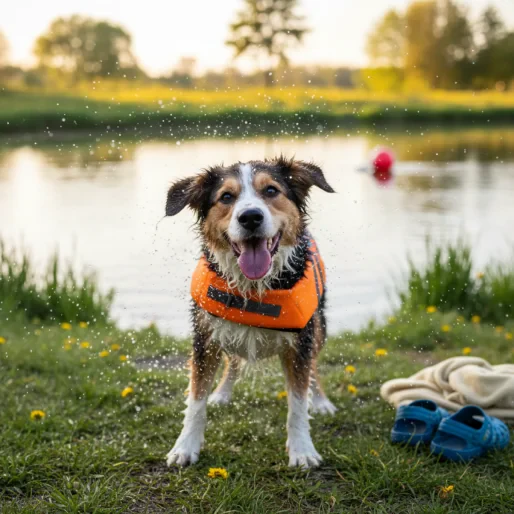
The AVMA and multiple veterinary water safety resources recommend flotation devices for all dogs in open water. Even strong swimmers can tire, panic in currents, or be caught by unexpected waves.
Fitting Steps
- Measure accurately: Use the manufacturer's sizing chart. Measure girth at the widest part of the ribcage and length from the base of the neck to the base of the tail. If between sizes, the snugger fit usually provides better security, as long as it does not restrict breathing or shoulder movement.
- Secure all straps: Adjust straps at the neck, chest, and belly so the jacket cannot slide forward over the head or rotate sideways. You should be able to fit two fingers between strap and body.
- Test the dorsal handle: Lift the dog gently by the top handle on dry land. The jacket should hold evenly without riding up or compressing the throat.
- Check leg freedom: The dog should walk, trot, and paddle normally. Watch for chafing behind the front legs.
- Shallow water test first: Let the dog wear the jacket in a calm, controlled setting before heading to open water.
Post-Swim Ear Drying Protocol
Breeds with floppy ears (such as Golden Retrievers, Cocker Spaniels, and Basset Hounds) or narrow ear canals are especially prone to otitis externa triggered by trapped moisture. Swimming is consistently identified as a leading risk factor for recurrent ear infections in veterinary dermatology literature.
- Immediately after swimming, gently lift each ear flap and blot visible moisture from the inner ear flap and the entrance to the ear canal with a soft, absorbent cloth or cotton ball. Do not insert anything deep into the canal.
- If your veterinarian has recommended it, apply a veterinary-approved ear drying solution according to the product's instructions.
- Allow air circulation: After blotting, let the ear flaps remain open for a few minutes. For floppy-eared breeds, gently folding the ear flap back temporarily helps with evaporation.
- Monitor for 24 to 48 hours: Head shaking, ear scratching, redness, odor, or discharge all warrant a veterinary exam.
Vaccinations and Waterborne Disease
Leptospirosis is a bacterial disease transmitted through contaminated water and is present throughout much of the United States, particularly in areas with standing water, wildlife activity, and warm temperatures. The AVMA considers the leptospirosis vaccine a core or recommended vaccination for dogs at risk, and any dog that swims in natural water should be considered at risk. Discuss vaccination status with your veterinarian before the start of spring swim season.
Giardia is another waterborne pathogen found in lakes, ponds, and streams across the country. Dogs that drink from natural water sources while swimming are at increased risk. Bringing fresh drinking water from home reduces the likelihood of ingestion.
Leash Laws, Access Rules, and Local Regulations
Open water access for dogs varies widely across U.S. jurisdictions. Many state parks, national recreation areas, and municipal beaches have specific rules about dog access, leash requirements, and seasonal restrictions. Some key considerations:
- National Park Service lands generally require dogs to be on a leash no longer than 6 feet and may prohibit dogs from certain trails and water areas entirely.
- State parks and Army Corps of Engineers recreation areas set their own pet policies, which can vary from one site to another within the same state.
- Some cities and counties enforce breed-specific legislation that may affect access to public spaces.
- Rabies vaccination is required by law in all 50 states, though specific requirements (frequency, licensing) vary by state and county.
Always verify current rules for any specific location before visiting with your dog.
Essential Gear Checklist for U.S. Spring Swims
- A properly fitted canine life jacket
- A long line (15 to 30 feet) for initial open water introductions
- Fresh drinking water from home
- Absorbent towels and a windbreak for drying (a vehicle with the tailgate open works well)
- A basic first aid kit: antiseptic wipes, styptic powder, and a thermal or emergency blanket
- Ear drying supplies: cotton balls and veterinary-approved ear drying solution if recommended
- A phone with your nearest emergency vet clinic number saved
When to Seek Emergency Veterinary Care
Contact an emergency veterinary hospital immediately if your dog shows any of the following after open water exposure:
- Vomiting, diarrhea, or appetite loss within hours of swimming (possible cyanotoxin exposure or waterborne infection)
- Persistent shivering, lethargy, or weakness after thorough drying and warming (possible hypothermia or "limber tail" syndrome)
- Head shaking, ear scratching, redness, or foul odor within 24 to 72 hours (possible otitis externa)
- Coughing, labored breathing, or nasal discharge (possible water aspiration)
- Skin irritation, hot spots, or rashes, especially in skin folds (possible contact dermatitis)
- Lameness or reluctance to move (possible musculoskeletal injury from underwater obstacles)
Never take a "wait and see" approach with suspected algae toxin exposure. This is always an emergency.
ASPCA Animal Poison Control Center
Call the ASPCA Poison Control hotline or contact your nearest emergency veterinary clinic immediately.
A consultation fee may apply. For non-poison emergencies, search "emergency vet near me" or call your local animal ER.
Frequently Asked Questions
Content Disclosure
This article was created using state-of-the-art AI models with human editorial oversight. It is intended for informational and entertainment purposes only and does not constitute veterinary medical advice. Always consult a licensed veterinarian for your pet's specific health needs. Learn more about our process.