A clinical breakdown of how gel, phase change, and evaporative cooling gear actually lowers a dog's core temperature. Includes sizing for flat faced breeds, replacement cycles, and whether they beat a wet towel.
Key Takeaways
- Three technologies dominate the 2026 market: pressure activated gel, phase change materials (PCM), and evaporative microfibre fabrics. Each cools through a different physical mechanism.
- None of them lower a dog's core temperature directly. They reduce skin and surface temperature, which slows heat gain and supports the dog's own thermoregulation.
- Brachycephalic breeds need different sizing because their cooling demand is concentrated around the chest, throat, and inguinal region, not the back.
- Replacement cycles matter: gel mats typically degrade within 1 to 3 years, PCM packs lose phase efficiency after repeated cycles, and evaporative fabrics break down with UV and chlorinated water.
- A wet towel can match basic gel mats in still air, but cooling vests outperform towels once airflow is added.
- None of these products replace veterinary care for suspected heatstroke. They are preventive tools, not treatments.
What Is Actually Happening Inside Your Dog
Dogs do not sweat across their body the way humans do. Thermoregulation in canines relies on panting (evaporative loss across the tongue and upper airway), vasodilation in the ear flaps and paw pads, and behavioural cooling such as seeking shade or cool surfaces. When ambient temperature climbs above roughly 26 to 29 degrees Celsius, or when humidity prevents efficient evaporation, these systems begin to fail. The American Veterinary Medical Association (AVMA) and the Royal Veterinary College have both highlighted that heat related illness in dogs is driven less by air temperature alone and more by the combination of heat, humidity, and exercise intensity.
Cooling mats and vests are engineered to support, not replace, these natural mechanisms. They work by altering the thermal gradient at the skin surface, which is the layer where heat exchange between the dog and the environment actually happens.
Pressure Activated Gel: The Phase Transition That Is Not Really a Phase Transition
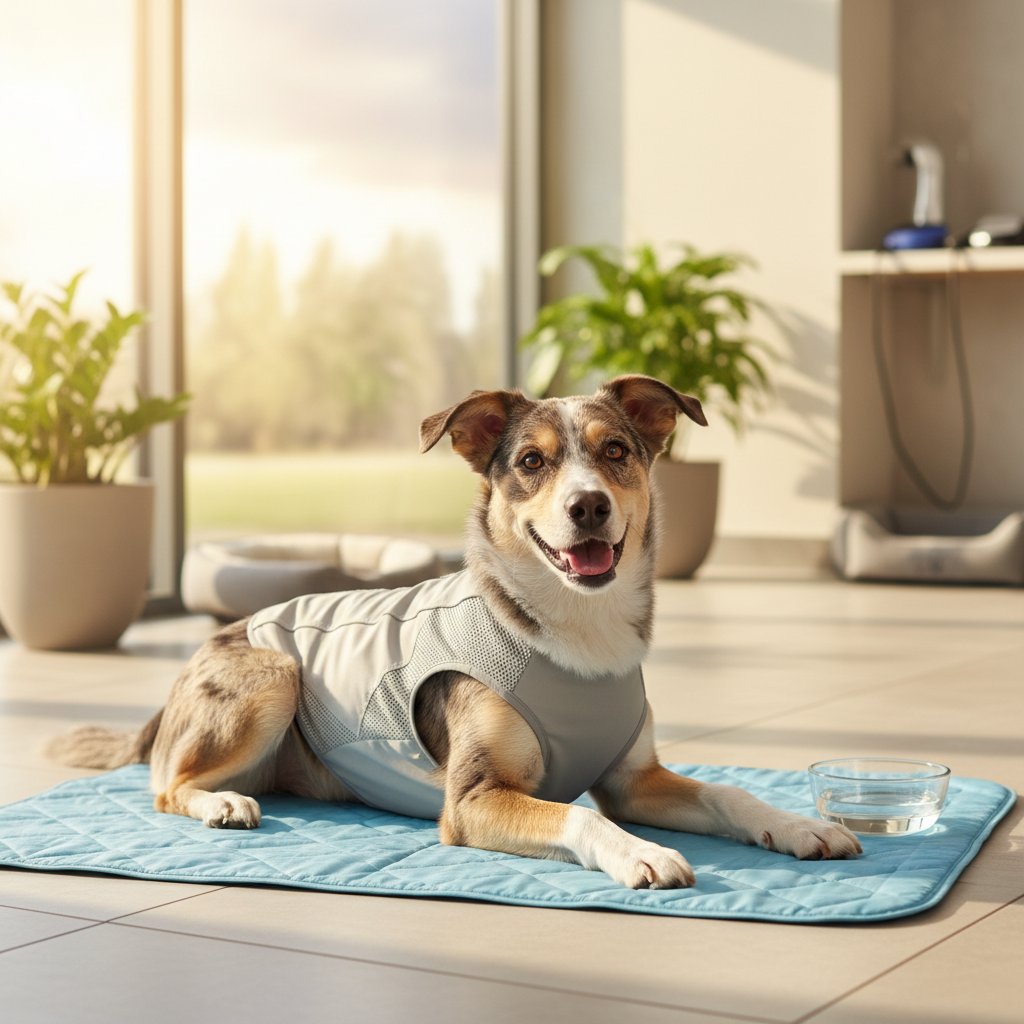
Most pressure activated gel mats contain a polymer matrix suspended in a glycol or water based gel. When a dog lies down, the pressure changes the local thermal conductivity of the gel and allows body heat to disperse across a larger surface area. The mat does not need refrigeration because it is not storing cold. It is acting as a heat sink, drawing warmth away from the dog and dissipating it into the floor below.
The practical limit of this technology is well documented in materials science literature. Once the gel matches the dog's surface temperature, cooling effectively stops until the mat is vacated and allowed to re equilibrate, typically over 15 to 20 minutes. This is why owners often observe a dog moving off the mat after a short rest and returning later.
Phase Change Materials: Storing Cold as Latent Heat
Phase change materials (PCM) are substances engineered to melt and solidify at a specific target temperature, often somewhere between 18 and 28 degrees Celsius for canine applications. As the PCM melts, it absorbs a large quantity of energy without changing temperature, a property known as latent heat of fusion. This is the same principle used in aerospace thermal management and surgical cooling garments.
For a cooling vest, this means the dog experiences a stable, sustained temperature against the chest and back for the duration of the phase change, typically 1 to 4 hours depending on ambient conditions and the PCM mass. Once the material is fully liquid, performance drops sharply. PCM vests are generally considered the most effective option for working dogs, search and rescue dogs, and athletes during structured exercise.
Evaporative Fabrics: Engineering the Wet Towel
Evaporative cooling vests use hydrophilic microfibre or PVA (polyvinyl alcohol) layers that hold water and release it slowly. As water evaporates from the fabric, it draws latent heat from the underlying skin and coat. This is the same physical process as human sweating, simply externalised onto the garment.
The efficiency of evaporative cooling depends heavily on humidity and airflow. In dry, breezy conditions, these vests can be remarkably effective. In humid coastal climates, evaporation slows dramatically and the vest may actually trap heat against the body. This is a critical point that owners in the Gulf, Southeast Asia, and the southeastern United States often overlook.
How to Recognise the Signs That Cooling Gear Is Not Enough
Cooling products are preventive. They are not a substitute for clinical thermoregulation when a dog is already overheating. Owners should know the early warning signs that intervention is needed regardless of what gear the dog is wearing.
Early Stage Heat Stress
- Rapid, shallow panting that does not slow with rest
- Bright pink or red gums and tongue
- Increased thirst and restlessness
- Reluctance to move or seeking cool surfaces obsessively
- Mild incoordination
Progression to Heatstroke
- Excessive drooling with thick, ropey saliva
- Vomiting or diarrhoea, sometimes with blood
- Glazed eyes and disorientation
- Collapse, seizures, or loss of consciousness
- Core body temperature above 40 degrees Celsius (104 Fahrenheit)
Veterinary emergency guidelines from the AVMA and BSAVA emphasise that any dog showing signs beyond the early stage requires immediate active cooling (tepid water, not ice) and emergency veterinary transport. A cooling mat or vest is not appropriate first aid for a collapsed dog.
What the Research Says About Prevention
Independent Laboratory Test Patterns
Independent textile and thermal testing facilities typically evaluate cooling gear using three benchmarks: surface temperature reduction (measured against a heated mannequin or thermal plate), duration of effective cooling, and recovery time between cycles. Across the published literature on industrial and athletic cooling garments, PCM systems consistently outperform gel and evaporative systems in sustained cooling tests, while evaporative systems perform best in low humidity, high airflow conditions.
For canine specific products, peer reviewed veterinary studies remain limited. Most performance data comes from manufacturer testing, which should be interpreted with caution. Owners should look for products that disclose their testing protocol, target phase change temperature (for PCM), and the ambient conditions under which results were obtained.
Sizing for Brachycephalic Breeds
Flat faced breeds such as French Bulldogs, English Bulldogs, Pugs, Boston Terriers, and Cavalier King Charles Spaniels face a fundamentally different thermoregulatory challenge. Their compressed upper airways limit panting efficiency, meaning evaporative loss across the tongue is reduced by an estimated 30 to 50 percent compared to mesocephalic breeds, according to research summarised by the Royal Veterinary College.
For these breeds, professional consensus suggests:
- Prioritise chest and throat coverage rather than back coverage. The major blood vessels of the neck and the large surface area of the chest are more thermally accessible than the spine.
- Avoid vests that constrict the trachea or restrict chest expansion. Brachycephalic dogs already work harder to breathe, and a tight vest can worsen brachycephalic obstructive airway syndrome (BOAS).
- Inguinal and axillary cooling is highly effective. Some PCM vests now include pockets at the armpit and groin, areas where vasodilation occurs readily.
- Size up, not down. A mat that allows the dog to lie in lateral recumbency with the full ventral surface in contact is more useful than a tight fitting vest.
Replacement Cycles That Owners Underestimate
Cooling products degrade. The rate depends on technology and use, but veterinary product reviewers and material engineers generally observe the following patterns:
- Pressure activated gel mats: Effective lifespan of 1 to 3 years with regular use. The polymer matrix breaks down, the gel can leak, and cooling capacity diminishes. Punctures from claws are a common failure point.
- PCM vests and packs: Phase change materials can theoretically cycle thousands of times, but the encapsulation degrades. Most manufacturers suggest replacement of PCM inserts every 2 to 4 years for consistent performance.
- Evaporative microfibre and PVA vests: Typically 1 to 2 seasons of heavy use. UV exposure, chlorinated pool water, and salt water all accelerate fibre breakdown. Owners often report that a vest still feels wet but no longer cools, which indicates the fabric structure has degraded.
A practical recommendation: log the purchase date of cooling gear and assess performance at the start of each warm season. If the mat no longer feels cooler than the surrounding floor after 10 minutes of rest, or the vest does not produce noticeable surface cooling within 5 minutes of application, it is time to replace it.
Cooling Gear Versus a Wet Towel: The Honest Comparison
This is the question owners ask most often, and the honest answer depends on context. A wet towel works through the same evaporative principle as a microfibre vest. In still air with moderate humidity, a damp towel laid across the dog's back can match or exceed a basic gel mat for short periods.
However, several factors shift the balance toward purpose built gear:
- Duration: A wet towel cools rapidly then loses effect as it warms and dries. A PCM vest sustains cooling for hours.
- Mobility: A towel falls off a moving dog. A fitted vest stays in place during walks, agility work, or transport.
- Targeted cooling: Vests with strategic placement at the chest, axilla, and inguinal regions deliver cooling to the most vascular areas. A towel cools wherever it lies, which is often the less vascular dorsum.
- Humidity tolerance: PCM and gel systems do not depend on evaporation, so they continue to work in humid conditions where a wet towel underperforms.
For owners on a budget, a damp towel in a shaded, ventilated area remains a legitimate cooling strategy for a resting dog. For working dogs, brachycephalic breeds, and active outdoor scenarios, engineered cooling gear offers measurable advantages.
When to See Your Vet, and What to Ask
Cooling gear is a wellness purchase, but the underlying reason for needing it (heat sensitivity, exercise intolerance, breathing difficulty) sometimes deserves clinical evaluation. Veterinary guidelines recommend a consultation if:
- A dog pants heavily at rest in moderate ambient temperatures
- Exercise tolerance has decreased noticeably
- A brachycephalic breed shows snoring, gagging, or cyanosis (bluish gums) during mild exertion
- The dog has a previous history of heat related collapse
- The dog is geriatric, obese, or has known cardiac or respiratory disease
Useful Questions for the Veterinary Appointment
- Does my dog have any anatomical or medical risk factors that increase heatstroke risk?
- What is a realistic safe ambient temperature ceiling for outdoor activity for this breed?
- Would my dog benefit from BOAS assessment or other respiratory evaluation?
- Are there exercise modifications you recommend during the warm season?
- What signs should trigger emergency presentation rather than home cooling?
For breeds and contexts with elevated baseline risk, a structured conditioning programme may be more valuable than any cooling product. Readers exploring low impact warm weather fitness may find the backyard dog conditioning circuit for summer evenings useful as a starting framework. Owners of working breeds operating in extreme environments should also review the AI smart collars for outback working dogs guide, which covers continuous temperature and exertion monitoring.
Heat sensitivity is not exclusive to dogs. Owners of multispecies households may find the heatstroke guide for rabbits and guinea pigs a useful complement, as small mammals are even more vulnerable than dogs to rising temperatures.
Practical Summary for the 2026 Season
Cooling mats and vests are not magic. They are physics. Pressure activated gel mats provide passive heat sinks for resting dogs, phase change materials offer sustained cooling for active and at risk dogs, and evaporative fabrics work best in dry, ventilated environments. None of them lower core temperature directly, and none of them substitute for shade, fresh water, exercise restriction during heat waves, and prompt veterinary care when warning signs appear.
For brachycephalic breeds, sizing should prioritise chest and throat coverage without constricting the airway. For all breeds, replacement cycles of 1 to 4 years are realistic and should be planned into the household pet care budget. And yes, a wet towel still has a place, particularly for stationary cooling in still air, but it cannot match a well fitted PCM vest for sustained, mobile, or humid environment cooling.
The most important principle remains unchanged from a decade ago: cooling gear extends the safe operating window, but it does not eliminate the risk. Owners who treat these products as supportive tools, rather than as a license to push activity in extreme heat, will get the most value from them and the best outcomes for their dogs.
Frequently Asked Questions
Do cooling mats and vests actually lower a dog's core body temperature? ↓
Which technology is best for brachycephalic breeds like French Bulldogs and Pugs? ↓
How often should I replace my dog's cooling mat or vest? ↓
Is a wet towel really as good as a cooling vest? ↓
Can I use a cooling vest as first aid if my dog shows signs of heatstroke? ↓

Dr. James Harrington
Veterinarian & Pet Health Writer
Veterinarian and health writer — translating complex medical topics into clear, actionable guidance for pet owners.
Content Disclosure
This article was created using state-of-the-art AI models with human editorial oversight. It is intended for informational and entertainment purposes only and does not constitute veterinary medical advice. Always consult a licensed veterinarian for your pet's specific health needs. Learn more about our process.