
In this article
- Overview: Why a Heat-Resilient Catio Matters in Portugal
- Recognising Heat Stress in Catio Cats
- Positioning: The Single Most Important Decision
- Shade Materials and Recycled Timber
- Passive Cooling and Airflow Design
- Drought-Friendly, Cat-Safe Plants
- Low-Water Maintenance Through June and July
- When to Seek Emergency Help
- Conclusion
Overview: Why a Heat-Resilient Catio Matters in Portugal
A catio (an enclosed outdoor cat patio) gives indoor cats safe access to fresh air, sunlight, and enrichment without the risks of roaming. In Portugal's Mediterranean climate, however, the summer is the make-or-break season. Inland regions such as the Alentejo regularly push past 35C in June and July, and even coastal areas combine strong afternoon sun with long, rainless dry spells. A catio that is comfortable in May can become a dangerous heat trap by midsummer if it is not designed with shade, airflow, and cooling in mind.
Building for heat resilience and sustainability at the same time is entirely achievable. Recycled timber, passive cooling, and drought-tolerant cat-safe planting reduce both the welfare risk to your cat and the environmental footprint of the structure. This guide walks through material choices, layout, planting, and the low-water maintenance routine that keeps everything functioning through the driest months.
Key Takeaways
- Position first: Orient the catio to avoid direct afternoon and west-facing sun, the hottest exposure of the Portuguese day.
- Layer shade: Combine a solid roof section, shade cloth, and living plants so cats always have a cool retreat.
- Design for airflow: Cross-ventilation and the stack effect move hot air out without any electricity.
- Choose recycled timber: Reclaimed, properly treated wood lowers cost and environmental impact, but avoid toxic preservatives.
- Plant cat-safe and drought-friendly: Use non-toxic Mediterranean species that thrive on minimal water.
- Always provide shade, water, and an exit: Cats must be able to retreat indoors to true cool at any time.
Recognising Heat Stress in Catio Cats
Even a well-built catio requires daily observation, because cats hide discomfort well. Owners should know the early warning signs of overheating so they can act before a mild problem becomes an emergency.
Early signs
- Seeking the coolest, shadiest spot and pressing the body flat against tile or stone.
- Reduced activity, reluctance to play, and increased sleeping.
- Grooming more than usual (cats use saliva evaporation to cool down).
- Mild panting or open-mouth breathing after exertion.
Warning signs that need urgent action
- Persistent panting, drooling, or rapid breathing at rest.
- Lethargy, stumbling, or disorientation.
- Vomiting or diarrhoea.
- Bright red or very pale gums.
- A body temperature that feels hot to the touch with a racing heart.
Heatstroke in cats is a medical emergency. Veterinary guidance is consistent that a feline body temperature above roughly 40C (104F) is dangerous and that signs can escalate quickly. If you suspect heatstroke, move the cat indoors to a cool room, offer water, apply cool (not ice-cold) water to the paws and belly, and contact a veterinarian immediately. Building cooling features into the catio is prevention, not a substitute for veterinary care.
Positioning: The Single Most Important Decision
Before choosing a single board or plant, study how the sun crosses your space across the day. In Portugal the southern and especially the western faces receive the most intense, prolonged heat, with the worst exposure between roughly 14:00 and 19:00 in midsummer. Afternoon sun is both hotter and lower in the sky, so it drives heat deep under simple roofs.
Practical positioning principles
- Favour north and east aspects. An east-facing catio catches gentle morning sun and falls into shade by early afternoon, the ideal pattern for a hot climate.
- Use existing shade. Position against a wall that blocks the western sun, or beneath the canopy of an established, non-toxic tree.
- Avoid heat-radiating surfaces. Light-coloured walls reflect heat away; large expanses of dark render or paving re-radiate heat into the evening.
- Plan a cool indoor connection. The catio should open into the coolest part of the home so the cat can always retreat to genuine shade and air.
If your only available wall faces west, you can still succeed, but you must compensate aggressively with layered shade and ventilation as described below.
Shade Materials and Recycled Timber
Shade is delivered in layers. No single material does the whole job in a Portuguese summer, so the most resilient catios combine a solid element, a permeable element, and living plants.
The roof and shade layer
- Solid roof section: A pitched panel of timber, recycled corrugated sheet, or insulated board over the main resting platforms blocks direct overhead sun and provides rain cover for the brief but heavy autumn showers.
- Shade cloth: A high-density (around 80 to 90 percent) UV-stabilised shade cloth over the remaining area cuts radiant heat while still letting warm air escape upward. Light colours reflect more heat than dark ones.
- Bamboo or reed screening: A renewable, attractive option for vertical west-facing panels that blocks low afternoon sun while allowing airflow.
Choosing recycled and eco-friendly timber
Reclaimed timber, salvaged pallet wood, and offcuts dramatically reduce the carbon and cost of a catio, but safety comes first.
- Avoid treated mystery wood. Older timber may contain creosote or chromated copper arsenate (CCA), which are toxic. Use only wood you can confirm is untreated or treated with pet-safe products.
- Check pallets carefully. Look for the IPPC stamp: HT (heat treated) is safe, while MB (methyl bromide) should be avoided entirely.
- Sand and seal. Remove splinters and finish with a water-based, low-VOC, pet-safe outdoor sealant or oil to extend the timber's life in the dry-then-damp Portuguese climate.
- Prefer durable species. Reclaimed chestnut, pine, and cork-region hardwoods are common in Portugal and weather well when sealed.
Use stainless or galvanised fixings to resist coastal humidity, and choose welded galvanised or PVC-coated mesh with gaps small enough that a cat cannot push through or get a head stuck (a common guideline is around 2.5cm or smaller).
Passive Cooling and Airflow Design
Passive design uses physics rather than electricity to keep the structure cool, which suits both sustainability goals and rural areas prone to summer power interruptions. The principles mirror those covered in our guide to cat hydration during Gulf summer power blackouts, where keeping cats cool without grid reliance is essential.
Cross-ventilation
Position mesh openings on opposite sides of the catio so prevailing breezes pass straight through. In much of coastal Portugal a reliable afternoon sea breeze (the nortada) can be channelled to do most of the cooling work if openings are aligned with it.
The stack effect
Hot air rises. Low intake vents combined with a high outlet (a ridge gap, gable vent, or raised section of mesh near the roof) create a continuous upward draught that pulls heat out. This is one of the most effective no-cost cooling tools available.
Thermal mass and ground cooling
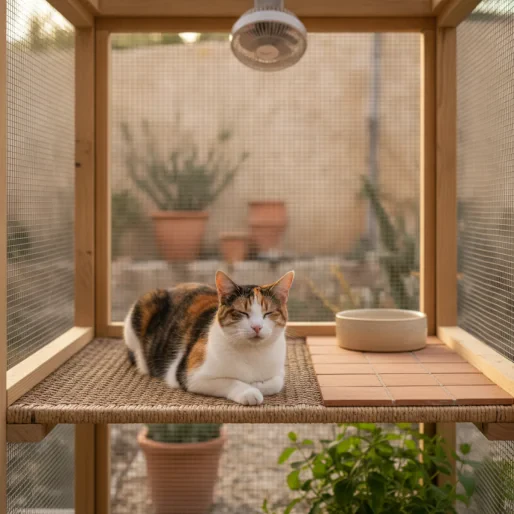
- Cool tile or stone: A section of unglazed terracotta or natural stone flooring in shade stays noticeably cooler than the air and gives cats a surface to stretch out on. Many owners report cats gravitating to tile during the hottest hours.
- Raised platforms: Elevated resting shelves sit in moving air, away from re-radiated ground heat.
- Evaporative effect of plants: A densely planted corner releases moisture and shades the ground, lowering the local temperature.
Water features
A shallow, shaded, regularly refreshed water source provides both drinking water and a small evaporative cooling benefit. Position water away from direct sun to slow algae growth and keep it palatable. For deeper coverage of canine and feline cooling aids, see the 2026 science guide to cooling mats and vests, many principles of which apply to cats resting in a catio.
Drought-Friendly, Cat-Safe Plants
Planting softens the structure, improves air quality, provides shade and enrichment, and, crucially in the dry season, can be chosen to survive on very little water. The non-negotiable rule is that every plant a cat can reach must be non-toxic. The ASPCA maintains a widely referenced list of plants that are toxic and non-toxic to cats, and checking it before planting is strongly advised.
Cat-safe Mediterranean and drought-tolerant options
- Rosemary: Aromatic, hardy, drought-loving, and non-toxic to cats.
- Cat grass (oat, wheat, or barley grass): Safe to nibble and easy to grow in pots.
- Cat thyme (Teucrium marum) and culinary thyme: Tough, low-water, and enriching.
- Catnip and silver vine: Drought-tolerant herbs that double as enrichment.
- Olive (in a pot): Non-toxic, iconic, and extremely drought-hardy.
- Lavender: Generally considered low-risk in the garden and very drought-tolerant; provide in moderation and monitor.
Plants to avoid completely
Keep all lilies far away (highly toxic, even tiny amounts can cause kidney failure), along with oleander, sago palm, aloe, ivy, and many common ornamentals. When in doubt, leave it out and verify against the ASPCA database first.
Water-wise planting technique
- Group plants in containers with quality potting mix and a generous mulch layer to slow evaporation.
- Use light-coloured pots; dark pots cook roots in full sun.
- Place thirstier herbs in shade and the toughest species in the brighter spots.
Low-Water Maintenance Through June and July
Portugal's driest, hottest stretch demands a maintenance routine built around water efficiency. The goal is healthy plants and a clean, safe space without wasteful irrigation.
Watering strategy
- Water early or late. Irrigate at dawn or after sunset to minimise evaporation losses.
- Deep and infrequent. Encourage deep roots by watering thoroughly but less often, rather than little and often.
- Harvest greywater and rain. A small rain barrel filled from spring showers can carry container plants through dry weeks. Use only plain household greywater free of harmful detergents.
- Drip and ollas. Simple drip lines or buried unglazed clay pots (ollas) deliver water straight to roots with almost no waste.
- Mulch generously. Bark, gravel, or cork mulch can cut soil evaporation substantially.
Daily and weekly checks
- Refill and rinse water bowls at least daily; in extreme heat, twice daily.
- Check that shade cloth and screens remain secure after windy afternoons.
- Sweep shaded tile so it stays cool and clean.
- Inspect timber and mesh seasonally for splinters, rot, or gaps a cat could exploit.
- Remove any dropped or unknown plant material promptly.
Building cooling into a structure follows the same logic seen across hot-climate pet care, from managing aquarium oxygen and heat in Thailand's hot season to cooling diets for parrots in Mexico: anticipate the heat, layer your defences, and never rely on a single safeguard.
When to Seek Emergency Help
No catio, however well designed, removes the need for vigilance. Contact a veterinarian immediately if your cat shows any of the following during or after time in the catio:
- Collapse, weakness, or inability to stand.
- Continuous panting, drooling, or laboured breathing.
- Vomiting, diarrhoea, or signs of severe dehydration (sunken eyes, very dry gums, skin that stays tented when gently lifted).
- Seizures, tremors, or disorientation.
- Any suspicion that a toxic plant has been eaten, in which case treat it as an emergency even before symptoms appear.
While transporting the cat, keep it cool with damp towels and air movement, but avoid ice-cold water, which can cause harmful shivering and blood-vessel constriction. Early intervention dramatically improves outcomes in feline heat illness.
Conclusion
A heat-resilient, eco-friendly catio is the product of good decisions made in the right order: position to escape the afternoon sun, layer shade with a solid roof and living plants, design airflow that works without electricity, build from safe recycled timber, and plant cat-safe species that thrive on little water. Maintained with a water-wise routine through June and July, such a space gives a Portuguese cat the best of the outdoors safely, comfortably, and sustainably. For any sign of heat stress or plant poisoning, professional veterinary advice should always be the next step.
Frequently Asked Questions
Content Disclosure
This article was created using state-of-the-art AI models with human editorial oversight. It is intended for informational and entertainment purposes only and does not constitute veterinary medical advice. Always consult a licensed veterinarian for your pet's specific health needs. Learn more about our process.